Introduction
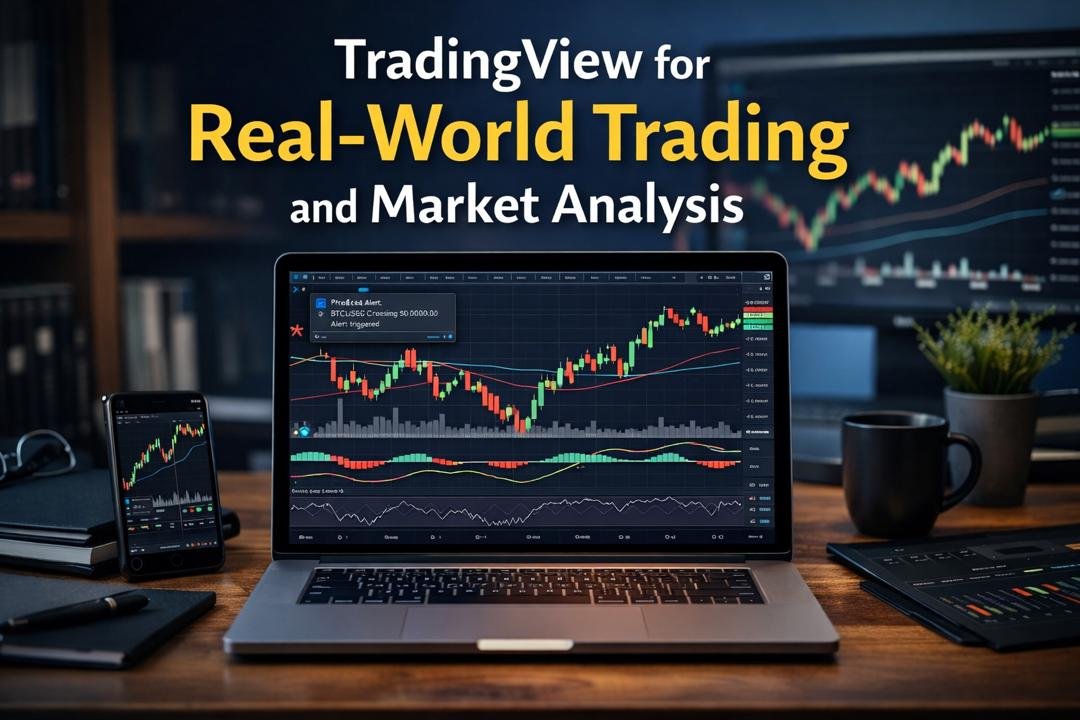
The financial market in the world has changed a lot over the past 20 years as it is no longer a manual trading floor but rather a highly digital and data-driven trading floor. Due to the emergence of online trading, investors and traders have become overly dependent on analytical platforms to understand market dynamics, find opportunities and risks. Out of many other charting and analysis tools that exist in the market today, TradingView for real-world trading has become one of the most popular tools in the global market.
Nevertheless, popularity does not necessarily mean effectiveness. Most platforms look good on the surface but lack consistency in provision of value in actual trading conditions. This brings up a key question: How useful is TradingView in real world trading and market analysis? Is it a hypothetical learning instrument, or does it actually aid the traders in the real market environment?
This paper assesses the real world applicability of TradingView as compared to its theory by analyzing how traders can use its charting packages, indicators, alerts, and layout capabilities in practice. Based on actual trading workflow and insights based on the original Chinese analysis, this discussion examines the way TradingView works in day to day trading decisions, strengths of the tool, limitations of the tool as well as the overall applicability of the tool in the contemporary market analysis. In the article, the main sentences like TradingView to trading, TradingView to market analysis tools, and TradingView to live trading decisions is naturally added in order to demonstrate the practical implementation as opposed to only theory.
TradingView Overview as a Market Analysis Somewhere
TradingView is a charting and analysis software based on the cloud that has made the financial data available in various markets such as stocks, forex, crypto currencies, indices, commodities, and futures, to name a few. It is also accessible to traders across the geographical boundaries and across the various devices both web and mobile.
The simplicity and depth of TradingView are one of its main features. Novices are able to use the interface with ease and are able to use simple indicators whereas the more sophisticated traders have access to complex charting tools, custom scripts and multi-chart compositions. Social functionality is also incorporated in the platform, which enables traders to exchange ideas, publish analysis, and learn amongst themselves.
Applied trading View in Live Trading Environment
Charting and Visual Market Analysis
The usefulness of TradingView for real-world trading is based on the charting system. In actual trading, one needs to have the skill to read the price movement. Tradingview has extensive chart types, which include:
- Candlestick charts
- Heikin Ashi
- Renko
- Range charts
- Point and Figure
Of these, the candlestick charts are the most commonly applied in actual trading since they portray the psychology of the market clearly based on open, high, low and close prices. TradingView enables traders to zoom in and out with ease, toggle between periods in real time and evaluate price pattern across several market periods. This is necessary because traders working with top-down analysis- looking at bigger timeframes to determine direction of the trend and smaller timeframes to determine entry points.
This skill saves time and minimizes error in the practical trading field. On a daily chart, a trader is able to highlight zones of support and resistance and then switch to a 15-minute chart, but do not leave the platform to fine-tune entries.
Live Markets, Indicators and Technical Analysis
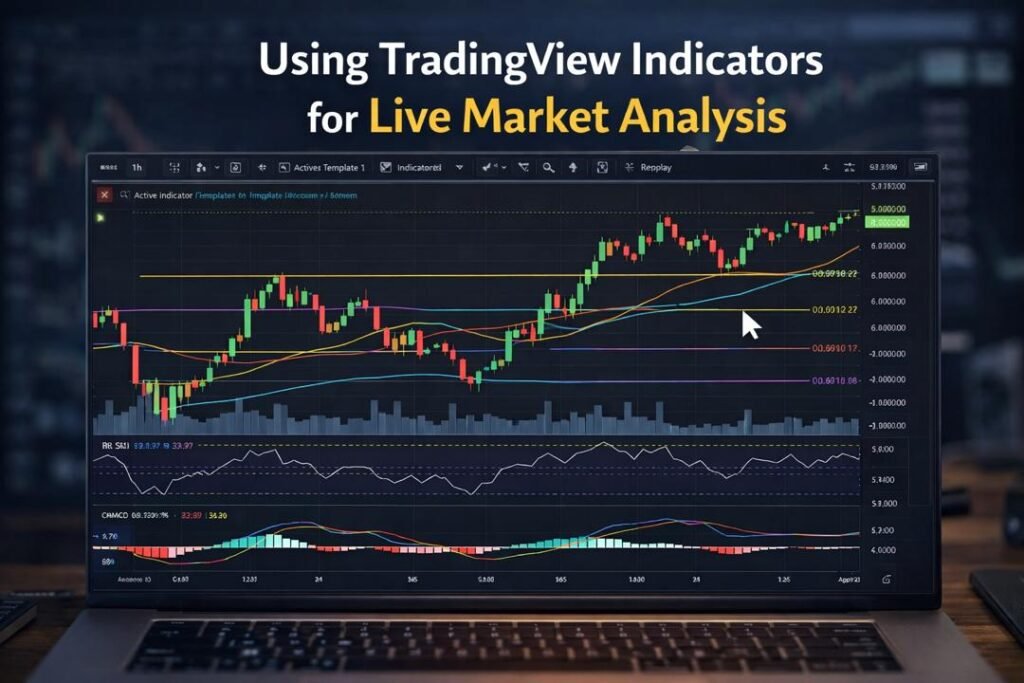
The large range of indicators available is one of the greatest strengths of TradingView market analysis tools. The traders can see inbuilt and user generated indicators such as:
- Moving Averages (SMA, EMA, VWMA)
- RSI (Relative Strength Index)
- MACD
- Bollinger Bands
- Volume Profile
- Fibonacci retracement indicators.
- Ichimoku Cloud
Indicators are not used singly in real-life trading. Rather, traders will use combination of indicators in order to verify signals and minimize false entries. As an illustration, a trader can wait until the RSI indicates that it is oversold as the price nears a support level that was determined using Fibonacci retracement.
The TradingView provides the ability to customize all indicators, including their periods, colors, and calculation techniques according to the strategies of a trader. More experienced traders have the option to code their own indicators with Pine Script, the in-built programming language of the TradingView.
Such flexibility allows the TradingView to be extremely useful in practical real-trading, particularly when such traders do not depend on automated trading but on technical strategies.
Live Trading: Alerts and Notifications
The alert system is one of the most convenient TradingView features. Constant screen observation is impractical and in most cases results in fatigue and emotional decision-making in lives trading. To solve this issue, TradingView for real-world trading allows users to create automated alert on the basis of:
- Price levels
- Trend line breaks
- Indicator crossovers
- Percentage changes
- Pine Script Condition Custom Pine script conditions.
Alerts may be sent either by mobile, email or in-app. This helps traders to be out of the charts and still be aware of important market moves.
To use the example, a trader who is waiting until the price breaks above the resistance does not have to track the chart. Rather, they have an option of setting an alert and responding only after the condition is attained. This enhances discipline and minimizes impulsive trade- two significant problems that traders in live markets have.
This is the only feature that renders live trading decisions with the TradingView very practical and particularly to swing traders and part-time traders.
Multi-Chart Workflows and Layouts
TradingView enables users to add as many chart layouts as possible in a single screen. It is particularly helpful with traders who keep an eye on numerous assets or time periods in a row.
Examples of common setups of real world layouts are:
- A single asset at various time intervals.
- Several currency pairs adjacent to each other.
- Correlation (e.g. gold and USD) markets.
- Index and stock comparisons
As an illustration, a trader can use one screen to analyze Bitcoin on the daily chart, the 1-hour chart, and the 5-minute chart and identify the trend direction, structure and entry respectively. Such collaborative workflow can improve decision making and minimize cross platform switching.
Layouts are stored and reused which enables traders to be consistent in their analysis. Such an order is crucial in the fast-paced markets where speed and clarity are important.
TradingView under Various Trading Styles
Day Trading
Day traders are very dependent on precision and timing. This is supported by TradingView which enables real-time update of prices, quick charting and comprehensive settings of indicators. Volume analysis and VWAP as well as intraday support and resistance levels are especially handy with short term trades. TradingView is the analytical engine of the majority of day traders, although the trading is usually effected on outside platforms.
Swing Trading
The multi-timeframe and alert system on TradingView is very useful to swing traders. The trades are held in days or weeks so alerts assist traders in managing the positions without always monitoring the charts.
Such indicators as moving averages, RSI, and Fibonacci retracements are widely applied in this trading, and TradingView works with all of them effectively.
Cryptocurrency Trading
Crypto traders particularly like TradingView since it allows:
- 24/7 markets
- Multiple exchanges
- High-volatility assets
- Crypto-specific indicators
There is a significant group of traders of cryptocurrencies who use TradingView as the primary tool of technical analysis and trade on Binance or Bybit.
TradingView Strengths of the Real-World Application
The practical benefits of TradingView are:
- User friendly interface that is friendly to the beginner.
- Sophisticated products to the advanced traders.
- Adjustable pointers and designs.
- Reliable alert system
- Cross-device compatibility
- Good ecosystem of a community and sharing ideas.
- Multiple asset class support.
Those are the strengths that enable TradingView to be one of the most flexible market analysis platforms of the present time.
Limitations of TradingView
TradingView for real-world trading has specific limitations that should be used by the traders despite its benefits:
- Free version – Basic – Basic features are limited, it needs a paid plan.
- None of that is a complete trading terminal -Execution relies on brokers.
- Excessive dependence on indicators – Misleading to amateur enlightenment.
- Internet addiction – Stability is crucial in service.
These are the limitations that do not render TradingView useless, they only indicate the significance of using it together with adequate trading education and risk management.
General Assessment: Can TradingView be used in Real Trading?
The response is a resounding yes, with realism.
TradingView cannot be a golden parachute to profitability nor can it substitute experience and discipline. It is however good in market analysis and decision-supporting tool. It is more practical in the real world trading due to its combination of charting power, flexibility in indicators, and alert systems and its user-friendly design. It is a good teaching platform to new users. To intermediate traders it improves the execution of the strategy. It is more customized and efficient to high-end traders. With proper application, TradingView can greatly enhance the level of market analysis, trade planning and risk management of a trader.
Conclusion
It has been established that TradingView is much more than just a theoretical charting system. It is an efficient, efficient, and effective tool that aids in trading in the real world, trading in various assets. It is among the most powerful market analysis platforms that can be used nowadays, due to its charting features, flexibility of indicators, alert system, and layout customization.
Despite its weaknesses, it has many strengths which greatly outweigh its weaknesses when it is used appropriately. To traders, who would like to strike a balance between the simplistic and the sophisticated, the TradingView has continued to be one of the most useful tools of understanding the markets and making a sound trading decision.
To sum up, TradingView is not only a great tool to learn but very practical in actual trading provided that it is used with discipline, strategy and adequate risk management.
Get well researched information about Trading and Market analysis here