
It is also easy to get confused by programming, particularly when given a massive, complicated problem. When a project is too large or complex, it is easy to get stalled when trying to do everything simultaneously. Nevertheless, a technique referred to as modular thinking can enable programmers to simplify complex tasks into manageable tasks. This is not only a way of simplifying the process of coding but also improves the quality of the product. In this paper, we shall examine the ways in which modular thinking can assist in solving problems related with complex programming by breaking them down into simple problems. The advantages of this approach we will discuss are code can be reused, it is easier to debug, and better collaboration when working on a team project.
The Strength of Modular Thinking
Modular thinking entails decomposing a program into smaller and independent parts or modules, which perform a certain function. This is a key process in the process of handling complex tasks as the programmer will be able to work on a bit of the puzzle at a given time. Through this, programmers will be able to build every module separately and test it and then change it without compromising the whole system.
The main principle of modular thinking is to make functionality isolated. You write many small blocks of codes that can be independent of each other as opposed to writing a single large block of code that can solve a whole problem. Such a methodology results in cleaner, more maintainable, and scalable code.
Advantages of the Modular Thinking in Programming
Reusable Code
Modular thinking has been shown to have one of the greatest advantages in that it encourages reusable code. It is possible to reuse programs of other programs or projects by decomposing a program into smaller modules, each of which can perform a particular task. This saves unnecessary writing of redundant code and it also makes the development process faster.
As an example, suppose you are doing a program where you have to deal with input of users in various locations, you can have a module that takes care of handling user input. Then you just need to call this module whenever you need to process the input, and you do not need to repeat the same logic every time. The result of this practice is efficient as well as easy to maintain code.
Less Trouble with Debugging and Testing
With a huge codebase, it is so simple to miss bugs, particularly when the code is not organized properly. The process of debugging is simplified with modular thinking as modules represent a smaller unit of functionality. In case any bug appears, you are able to isolate the module that is causing the problem and test it independently.
It also aids in unit testing using this modular approach. Because each of the modules is self-contained, you are able to write a module-specific test. This will make sure that every component of your program operates properly prior to being plugged in with those of the rest of the modules, preventing the possibility of adding errors into the system.
More Effective Group Work
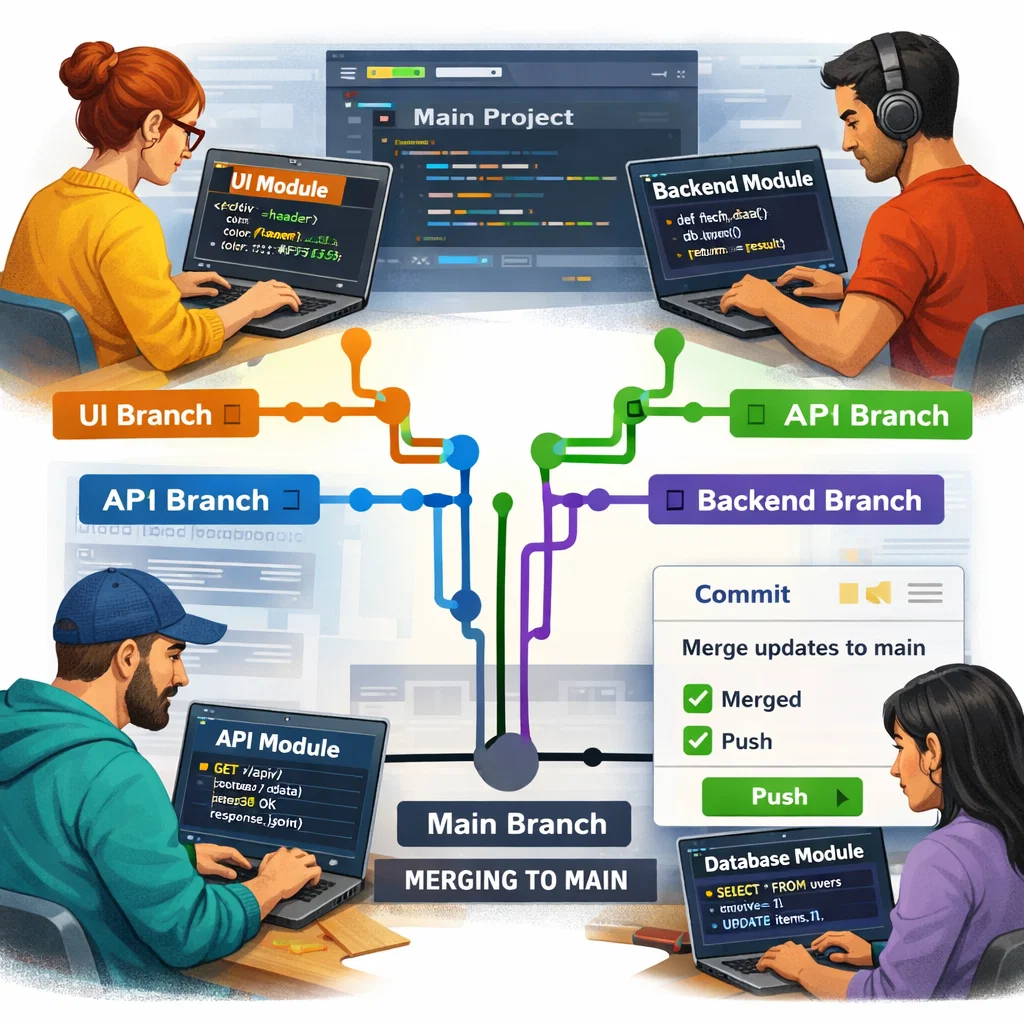
Modular thinking is of vital importance when one works in a team. It enables members of a team to work on various modules simultaneously without treading on each other. The members of a team can be tasked with a particular module, and the project can be developed in parallel. This does not only accelerate development but also reduces codebase conflicts.
Furthermore, the modules are independent, and therefore, team members can easily combine their efforts after they are done. The modular design will make sure that there will not be a conflict between the code of various contributors assuming the interfaces between the modules are properly defined.
Enhanced Code Maintainability
The code is harder to maintain as the projects become bigger. With a modular approach, it is easier to update, refactor, or extend the code. In the event you require altering the logic of a particular section of the program, you can do so by altering the specific module, and not the rest of the code. It is also easy to incorporate new features with time.
To illustrate, in one of the web applications, you may have a user authentication module. In case you want to change the system with the help of username/password to a more complex system based on authentication, you just need to upgrade the authentication module. Other parts of the application are not changed, which will save you time and minimize chances of bringing in bugs.
Training: How to Break Down a Complex Problem
Understand the Problem
It is important to get the problem under consideration before getting into the coding process. Spend some time to examine the requirements and decompose them into small parts. Ask yourself: what are the certain tasks to be done, and how are they connected to each other?
To illustrate, when creating an e-commerce site, such fundamental capabilities as user registration, product catalog, shopping cart, payment processing, and order tracking may be listed. All these features can be regarded as individual modules.
Break Down the Problem into Smaller Modules
When you have the key parts, then divide them into smaller parts that you can easily manage. The modules are supposed to be independent of each other and have one responsibility. In one example, the addition of an item into the shopping cart, the shopping cart view, and the checkout may be split into modules.
This step will be to determine the major functionalities of each of the modules and to make sure that every elementary piece of the puzzle can be located and solved on its own. Even a simple flowchart or diagram will help visualize the relations among various modules and the way to divide the work in the best way.
Test and Implement Each Module
Begin adapting each of the modules separately. Whilst doing the modules, make sure that every module is properly tested before proceeding to the other. This may involve writing unit tests to ensure that the module does what it is supposed to do. It is important to remember that each of these independent modules is to be connected with others to create a fully functioning program, and therefore, it is necessary to test every one of them.
As an example, in the case of the implementation of the product catalog on an e-commerce site, you may wish to check whether the items are displayed properly, whether they can be sorted by categories, and whether the appropriate information is displayed.
Integrate the Modules
After the implementation and testing of all the modules are done, start integrating. This includes making sure that the modules interact with each other the way they should, exchanging data with each other where needed. Integration can lead to the discovery of certain problems, but they are usually simpler to resolve due to the modular structure.
The hardest part is usually that of integration, which is easier with the modular thinking. In case one of the modules exhibits a problem in the integration phase, you will be able to isolate the problem area of interest and resolve the issue without affecting the other sections of the code.
Refactor and Optimize
Once the system has been integrated, refactoring and optimization of the code is time. This can include the elimination of any redundancies or making certain modules more efficient. The reason why modular thinking is useful in this case is the ability to optimize individual sections of the program instead of needing to make changes across the entire codebase.
Real-Life Case: Modular Thinking in Practice
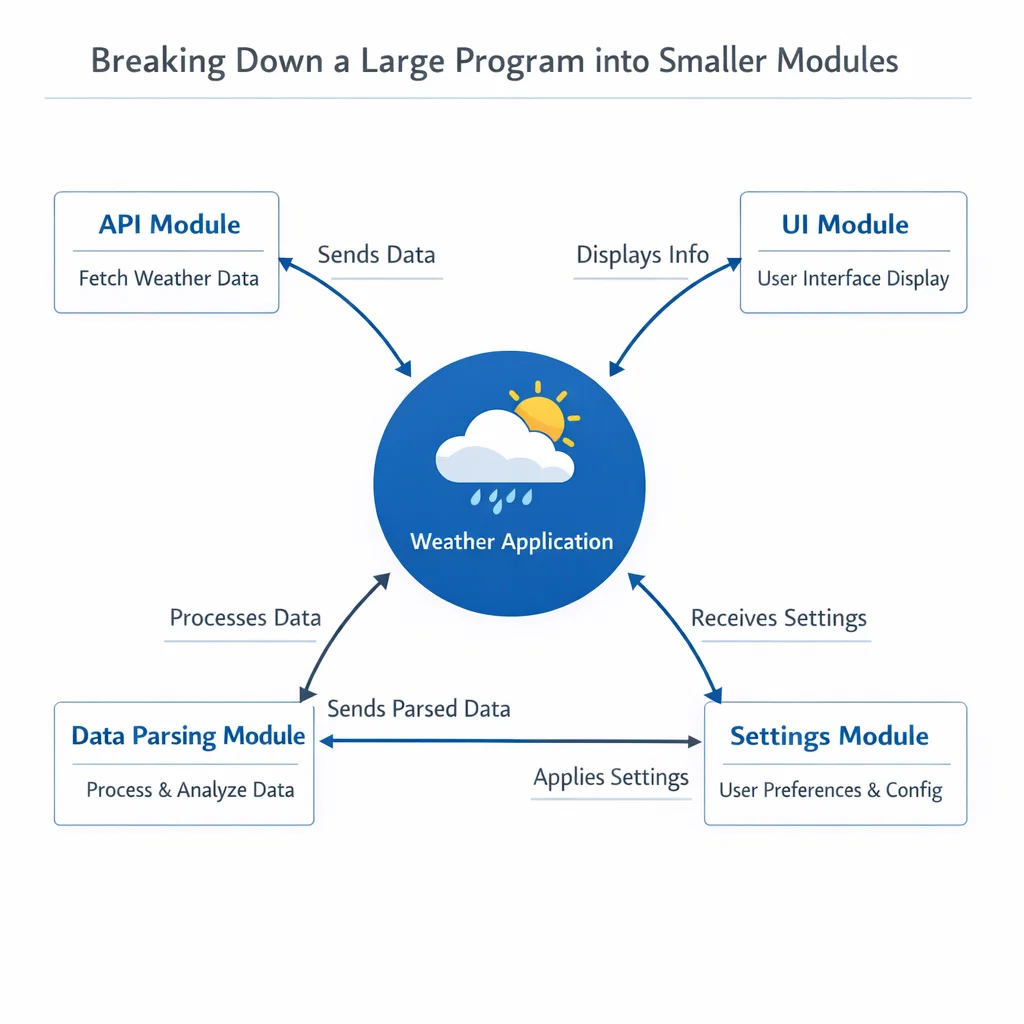
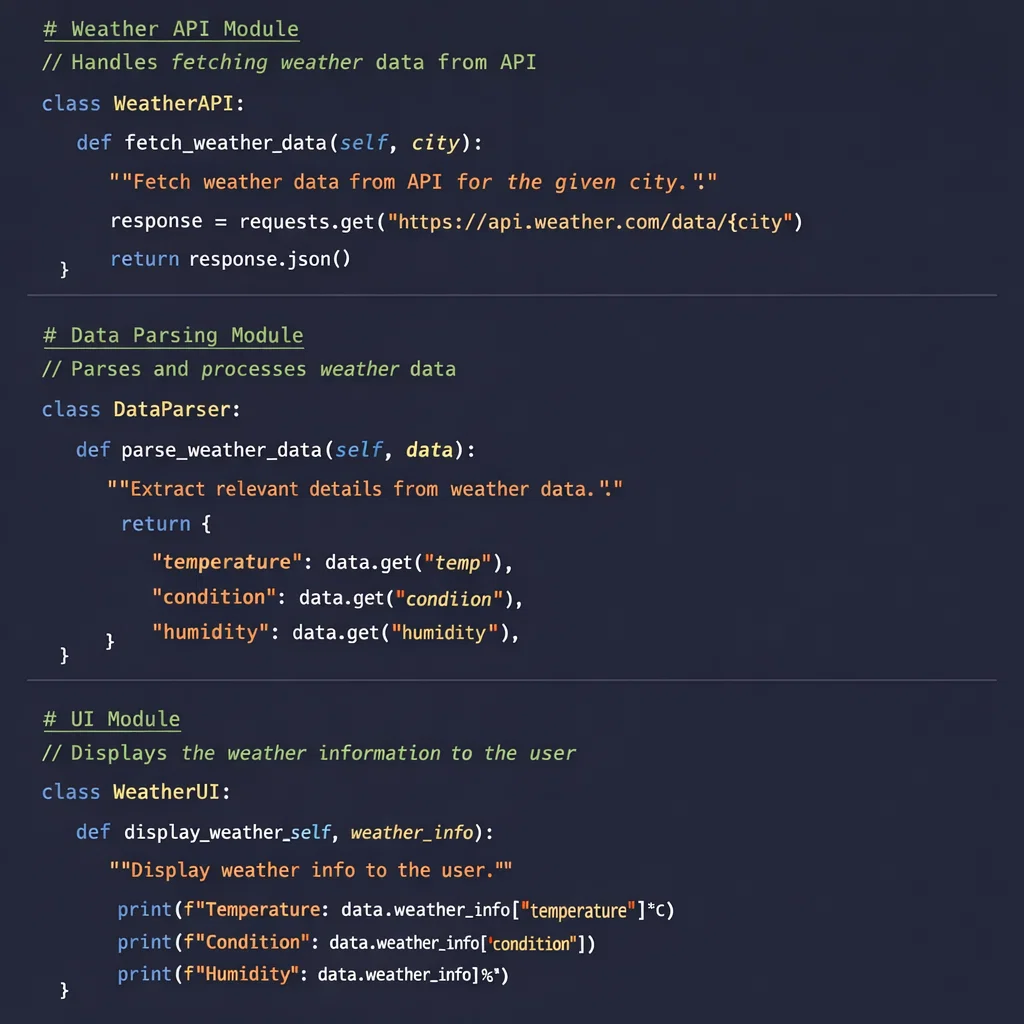
To learn more about how modular thinking applies in the real world, we can take a real-life example, which is the construction of a weather application. Some of the features that might be included in this application are obtaining weather through an API, showing the weather forecast, and user settings.
Through modular thinking, we manage to divide the problem into the following modules:
- API Module: This module has the responsibility of retrieving weather information via an external API.
- Data Parsing Module: The role of the module is to decode the response of the API and retrieve the information therein.
- UI Module: This module is in charge of showing the data about the weather on the screen.
- Settings Module: It is in charge of user preference (e.g., temperature unit, location).
All these modules are independent to develop and test. When all of them are ready, they can be merged into a complete weather application. In case of any problems, they can be separated to the module that is causing the problem, making it easier to debug.
Conclusion
The concept of decomposing large and complex problems into small and easy-to-solve problems is an effective way of programming. Modular thought processes not only enable the coding process to be made more manageable, but also result in reusable code, facilitate the debugging process, and enhance team project work. By concentrating around individual modules, developers are able to address complex issues in stages and, in the end, produce more maintainable and scalable systems. Regardless of whether you work individually or collaboratively, modular thinking is a skill that needs to be researched, and it will enable you to create superior software that will withstand the test of time.