Digital image processing has been a component of contemporary technology and it is used in areas of medical imaging and satellite imagery as well as photography and industrial inspection. To students and early-career professionals entering the imaging-related fields, the fundamentals of digital image processing need to be learned. This paper presents the fundamental ideas, methods, and uses, which constitute the basis of digital image processing.
Digital Image Processing What is Digital Image Processing?
The processing of digital images is the manipulations of the images with the computer algorithms to enhance the visual quality or to find some significant information. Digital processing, in contrast to the analog image processing, directly processes images in a discrete form–pixels organized in a matrix. Intensity or color values are represented in each pixel and various purposes can be advanced, filtered, segmented and compressed using computer techniques.
Digital image processing has the advantages of noise reduction, enhanced detail, correct feature extraction as well as efficient storage. Consequently, it is extensively applied in such fields as medical diagnostics, remote sensing, machine vision and multimedia applications.
Digital Image Processing Major Goals
Digital image processing is expected to reach the following goals:
- Image Enhancement: This is the act of enhancing the visual quality of an image to enable human interpretation.
- Image Restoration: Undergoing distortion or degradation by the imaging process is removed.
- Image Segmentation: Breaking down an image into significant parts of analysis.
- Image Compression: An image compression is the reduction of image size to make it occupy less storage space or to transmit the image to a different location.
- Feature Extraction: This is the process of detecting significant patterns, objects or textures in an image.
All these are achieved by mathematical and algorithmic and computational approaches.
Image Enhancement
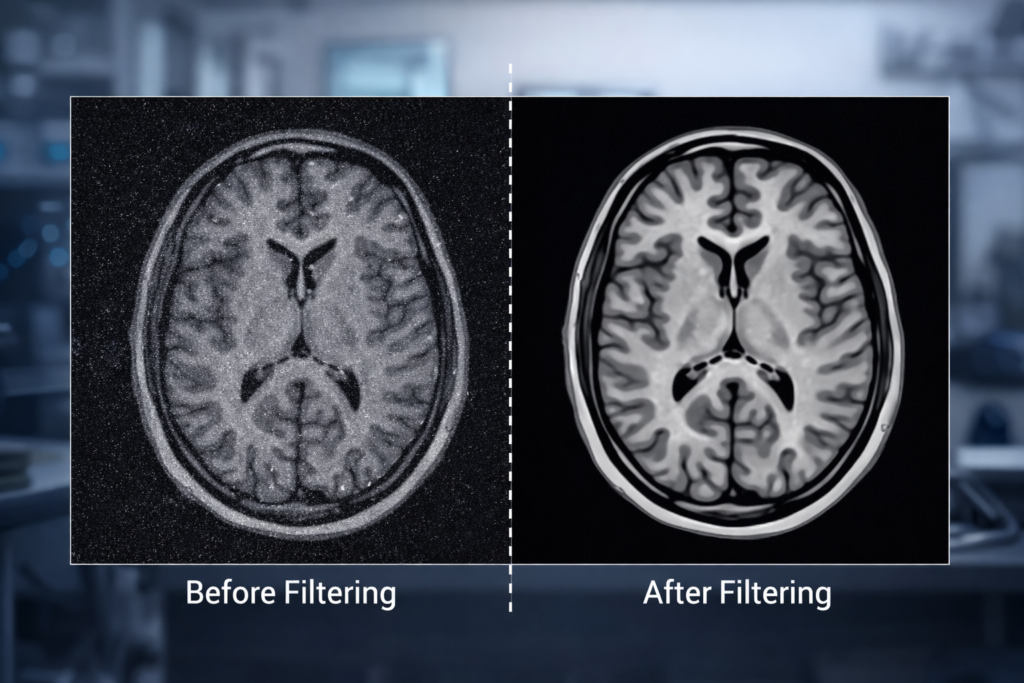
Image enhancement aims at enhancing the visual or interpretative appeal of the images. It may include changing brightness, contrast, sharpness or colour. Common techniques include:
Point Processing
Point processing methods change the values of the individual pixels without taking into consideration those that are adjacent. Examples include:
- Contrast Stretching: Enhances the privileges of pixel intensity to enlarge the details to be seen.
- Histogram Equalization: Redistributes the pixel intensities to enhance contrast.
- Thresholding: Images of grayscale are transformed between binary images using an intensity threshold.
Spatial Filtering
Spatial filtering takes into consideration the values of the adjacent pixels in order to improve an image. Filters can be:
- Smoothing Filters: This helps to smooth the image and remove noise. Case: Mean and Gaussian filters.
- Sharpening Filters: Details on edges and fineness. Laplacian and high-pass filters are an example.
Using these methods, processing of digital images enables us to utilize a lot of information which is important and downplay those that are not essential, making the information more analyzable.
Image Filtering
Filtering is an essential element of image processing, which tries to amplify or reduce certain elements. There are usually two types of filters that can be classified as a linear or non-linear.
Linear Filters
Linear filters are mathematical operators such as convolution to alter the values of pixels. Examples of common linear filters are:
- Low-pass Filters: Soften pictures and eliminate noise of high frequency.
- High-pass Filters: Accentuate edges and fine details.
Non-linear Filters
Non-linear filters process different pixels depending on the surrounding of that pixel and in many cases, they tend to preserve edges whilst eliminating noise. Examples:
- Median Filter: Median filters are useful in eliminating salt-and-pepper noise and do not blur edges.
- Morphological Filters: Morphological filters are used when making shape-based adjustments on binary images, e.g. erosion and dilation.
Filtering plays an important role in image pre-processing, which is followed by other operations, including segmentation or feature extraction.
Image Segmentation
Image segmentation refers to the task of subdivision of an image into meaningful components or objects. It is also necessary when it is needed to analyze certain elements of an image individually.
Threshold-Based Segmentation

Thresholding is one of the simplest techniques that are used to divide the objects and the background by allocating pixels to regions as a result of intensity.
Edge-Based Segmentation
Boundaries in an image are detected by Edge detection, which can be on the form of the Sobel, Prewitt, or Canny operator.
Region-Based Segmentation
The region-growing methods are used to group adjacent pixels that share similar characteristics forming coherent segments of objects or areas of interest.
Segmentation has extensive use in medical imaging (e.g. localizing tumors), satellite imagery (e.g. land cover classification) and industrial vision systems.
Image Compression
Image compression involves the use of fewer bits to represent the image to save space and ensure that the image is transmitted faster. The compression techniques may include:
Lossless Compression
Maintains originality of information and data are not lost. Examples: PNG and GIF formats, Huffman coding and Run-Length Encoding (RLE).
Lossy Compression
Compression by loss of certain information that is not so noticeable to a human eye. Examples: JPEG format, Discrete Cosine Transform (DCT) and compression by wavelet.
Compression is specifically relevant in areas where there is a bandwidth or storage constraint like streaming media or telemedicine.
Mathematics and Algorithms Role
Digital image processing is based on mathematics and algorithms. Images are often manipulated with the help of linear algebra, calculus, probability and Fourier analysis. For instance:
- Convolution: This is a mathematical operation, which is utilized in filtering to mix pixel values in an activity.
- Fourier Transform: Transforms images to frequency domain in order to analyze and filter images.
- Morphological Operations: Set theory based processing of binary images based on their shape.
These mathematical operations are implemented in software by algorithms which allow large images to be processed fast and accurately. The tools such as open-source libraries such as OpenCV and MATLAB are common products that can be used to easily experiment.
Digital Image Processing Applications
Applications of digital image processing are in many industries, such as:
- Medical Imaging: Medical imaging is used to improve the quality of MRI, CT, and X-rays to make a diagnosis.
- Remote Sensing: This is the study of the environment using satellites and aerial images.
- Industrial Inspection: This is used to identify flaws or quality problems in the manufacturing process.
- Multimedia: The improvement of photos, videos and visual effects.
- Security: Fingerprint, facial recognition, and surveillance.
The knowledge of these applications allows beginners to view the application of image processing techniques in the real world.
Introduction to Digital Image Processing
Beginners should always begin with small scale projects. Steps include:
- Study the Theory: Learn about such fundamental concepts as pixel representation, intensity and color models.
- Experiment with Libraries: Python libraries including OpenCV and scikit-image and Pillow can be used to manipulate pictures.
- Test Basic Improvements: Histogram equalization, filtering and edge detection of sample images.
- Results Analysis: Processed images will be compared with original ones to comprehend the effects of each technique.
Conclusion
Digital image processing is a dynamic and critical area, which integrates mathematics, algorithms and computer science to improve, analyze and compress images. Among the students and the early career professionals, understanding the basics such as enhancement, filtering, segmentation and compression can provide a vast range of applicability. Through their practice and by experimenting with real-life situations, novices are able to create a solid base and prepare themselves to the skills that are more and more valuable in the modern information-driven society.