Introduction
The picture sensors are the hidden motors of practically all the devices that can capture visual data today – smartphones and digital cameras, medical scanners, satellites, and industrial inspection systems. They transform the light into electrical signals which can be stored, processed and depicted to form images. It is very unlikely that without image sensors, photography, video recording, and most of the work of science and engineering would be the way they are today.
Image sensors are at the heart of a contemporary imaging system as they define the ability to capture light with accuracy, retain detail, process images in a short period and efficiency in power consumption. The space is dominated by two major sensor technologies, namely Charge-Coupled Devices (CCD) and Complementary Metal-Oxide-Semiconductor (CMOS) sensors. The technologies possess different operating principles, capabilities and limitations that affect its usage and location.
This paper is an in-depth analysis of CCD and CMOS image sensors discussing their functions, their performance and cost and power usage and applications. At the conclusion, readers should reach a good basis of knowledge in sensor choice in imaging devices design and why CMOS has taken over supplanted importance in specialized applications to CCD.
Image Sensors in the Contemporary Imaging System
An image sensor is a semiconductor device, which picks up the photons arriving and converts them into electrical charges. The charges are then manipulated to create a digital image. In modern imaging systems, the sensor is closely combined with the optics and signal processing and software programs to generate quality images in various lighting conditions.
On the simplest level, there is a set of pixels that are the basic components of image sensors. The size of each pixel is the size of a small light-sensitive spot. The quantity of light collected at a point determines the electrical signal that will be produced and this is what will eventually determine the brightness of the pixels in the final image.
The most important difference between the CCD and CMOS technologies is the manner in which these electrical charges are transferred, read out and converted into digital information.
Image Sensors Charge-Coupled Device (CCD) Image Sensors
Principles of the basic operation of CCD Sensors
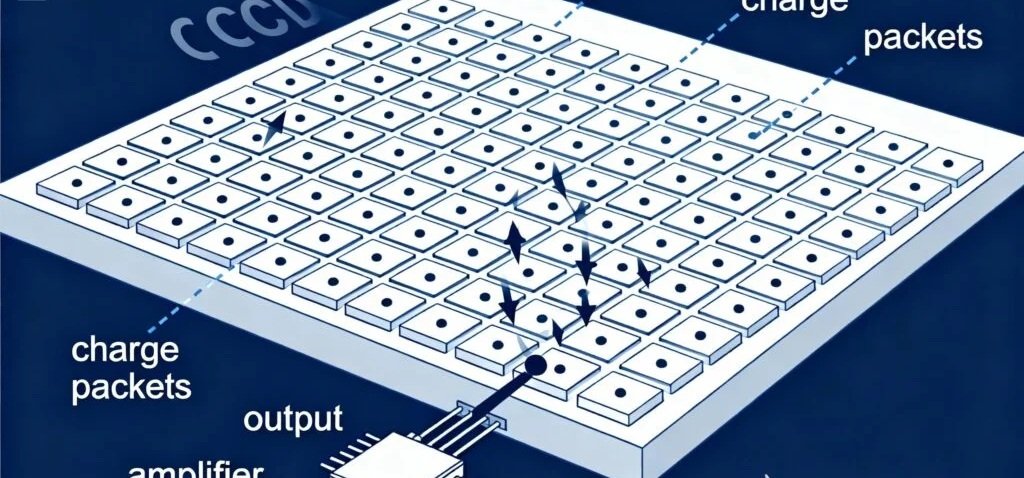
CCD sensors were also one of the first successful solid-state based imaging technologies and they have been important in development of digital imaging. A CCD sensor is a sensor that works by accumulating electric charge in each pixel according to the number of light photons striking it within an exposure time.
When all the exposure has occurred, the charges in each pixel are then moved across the chip in a synchronized process, as though buckets of water being moved along a line. This is where the charge is transferred row by row to a common output node, and then converted to a voltage signal, multiplied by amplification, and digitalized.
A common characteristic of CCD technology is the shared readout mechanism.
Globally important features of CCD Sensors
CCD sensors are characterized by consistency and picture quality. Differences between pixels are small because the pixels are fed to one common output amplifier. This results in:
- Very low fixed-pattern noise
- High image uniformity
- Excellent dynamic range
- Precise reproduction of color.
It is these attributes that put CCD sensors in the gold standard of scientific imaging and professional photo making over many years.
The Benefits of CCD Technology
- Poor Image Quality: CCD cameras have desirable consistency in the quality of images and low noise particularly in a low-light environment.
- High Quality Sensitivity: Photon collection is efficient owing to the pixel structure.
- Even Response across Pixels: This is good when measurements of great accuracy are needed.
Limitations of CCD Sensors
CCD sensors have a number of demerits on top of their strengths:
- Large Power Consumption: The consumption of power needed to carry out the charge transfer process is high.
- Reduced Readout Speed: Frame rates are restricted by sequential charge transfer.
- Increased Cost of manufacture: Cost is increased by special fabrication processes.
- Scarcity of On-Chip Processing: Signal processing is frequently externalized.
These restrictions cleared the way to alternative technologies as the requirements of imaging changed.
Complementary Metal-Oxide-Semiconductor (CMOS) Image Sensors
How CMOS Sensors Work
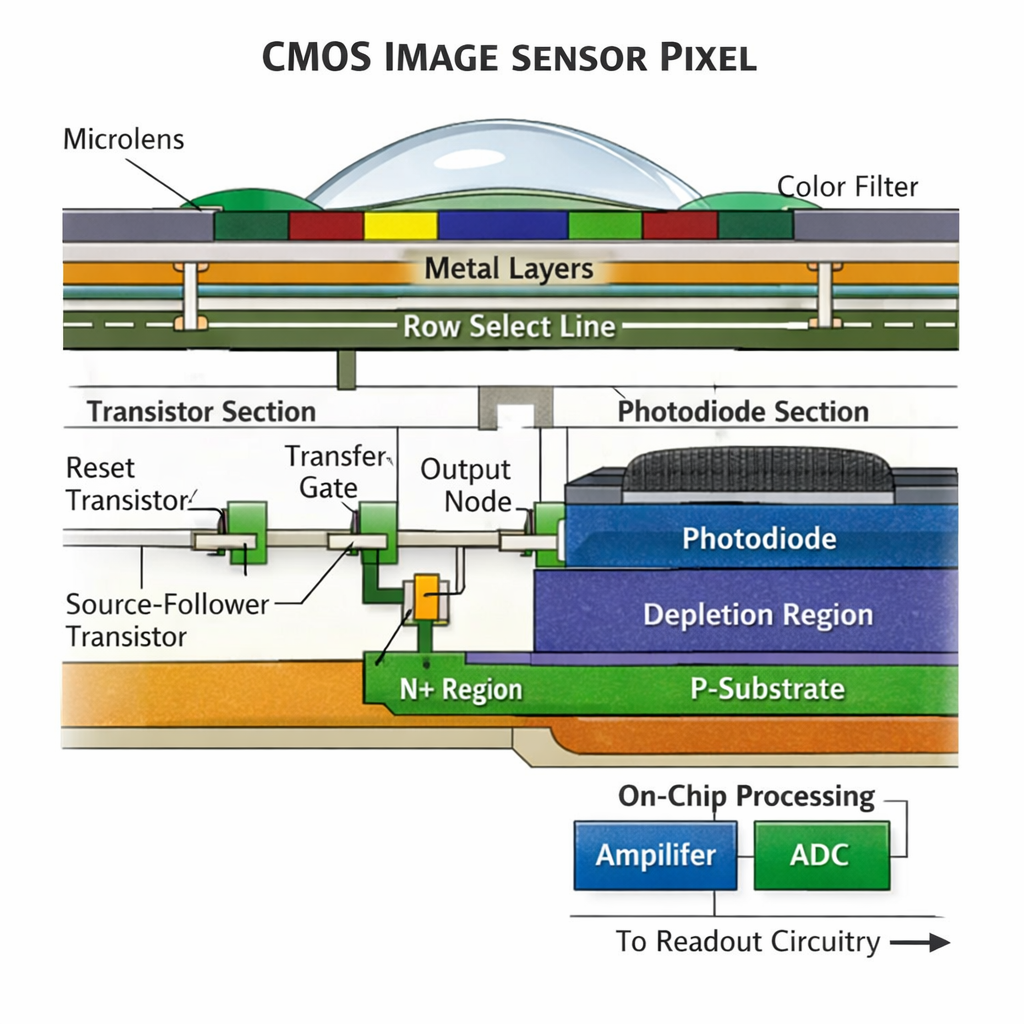
The CMOS image sensor works differently as compared to the CCD sensor. In CMOS technology each pixel has its own photodiode and a few transistors which turn charge into voltage at the pixel level directly.
CMOS sensors do not check charges traversed across the sensor but read pixel values individually. The signals are then amplified and analyzed with on-chip circuitry, which is frequently combined with image processing capabilities.
Basic Characteristics of CMOS Sensors
CMOS sensors are manufactured by the same semiconductor manufacturing technologies as microprocessors and memory chip. This enables:
- High levels of integration
- Lower production costs
- Reduced power consumption
- Faster readout speeds
The Benefits of CMOS Technology
- Low Power Consumption: Best in battery-powered gadgets such as Smartphones.
- High-Speed Operation: Supports video recording and high frame rates.
- On-Chip Integration: Enables high end cameras modules.
- Cost Efficiency: Mass production lowers the cost.
Difficulties and originating constraints
The early CMOS sensors had the disadvantage of being more noisy and having a lower image quality than CCD sensors. The problems were the pixel-to-pixel difference and reduced sensitivity.
The quality disparity has however been reduced by some strides like the use of backside illumination (BSI), better microlenses, and better noise-reduction algorithms.
Differences between CCD and CMOS Sensors Structural
Pixel Architecture
- CCD Pixels: Concentrate on the collection of light, and few circuitry in each pixel.
- CMOS Pixels: Feature several transistors, and hence direct voltage conversion and addressing.
Readout Mechanism
- CCD: The charges are moved within the chip into one output node.
- CMOS: The pixels are individually addressed by row and column addressing.
Integration Capability
CMOS makes it possible to place analog-to-digital converters (ADCs), timing logic, and in some cases image signal processors (ISPs) onto the same chip, which with CCD technology is not usually possible.
Comparison of Performance CCD and CMOS
Image Quality and Noise
CCD sensors are, conventionally, lower noise and higher image uniformity, which means that they should be applied in applications where extreme precision is required. Although traditionally more noisy, CMOS sensors are now able to compete with quality in most consumer and professional applications.
Dynamic Range
Dynamic range is the capacity of the sensor to record some bright and dark areas at the same time. CCD sensors tend to have higher dynamic range, but in most situations contemporary CMOS sensors that have advanced processing can achieve equal or greater performance than CCD.
Speed and Frame Rate
CMOS sensors are also effective in high-speed imaging because of parallel readout. CCD sensors suffer sequential charge transfer and therefore are not endeavoring to high-frame rate applications.
Power consumption and thermal performance
One of the most important considerations in the design of an imaging device is power efficiency. CMOS sensors are much more power efficient since they do not have to transfer large-scale charges or operate at high voltages.
A low power usage is also helpful in reducing heat generation which is significant in preserving image quality and sensor life, primarily in miniature-sized devices.
Cost and manufacturing projections
CCD sensors involve special fabrication technologies that do not fit well with the mainstream semiconductor fabrication processes. This has led to relatively high production costs of CCD.
CMOS sensors also enjoy standard CMOS fabrication with the advantages of large scale manufacturing, low prices and high rate of innovation. This has been a key factor in the adoption of CMOS due to this economic advantage.
Common applications of CCD Sensors
Though the market share of CCD sensors has decreased, the sensors still have their place in particular areas:
- Research and scientific imaging.
- Space observation and astronomy.
- Medical imaging systems
- High precision is needed in industrial inspection.
The applications consider fidelity of images more than power efficiency and cost.
CMOS Sensors typical use cases
Most consumer and commercial markets have CMOS sensors, including:
- Smartphones and tablets
- Digital camcorders and cameras.
- Surveillance and security systems.
- Automotive vision systems
- Robotics and machine vision
They are highly versatile and efficient and can be used in a variety of real life applications.
Sensor choice in image making design
The question of whether to use CCD or CMOS sensors is based on the needs of the application. Designers must consider:
- Needs image quality and image sensitivity.
- Power availability
- Cost constraints
- Requirements in size and integration.
- Processing requirements and speed.
CMOS sensors are the most practical and offer the best performance in most of the modern designs. Nevertheless, CCD sensors are still good where extreme accuracy of the image is needed.
Image sensor technology future trends
The future of image sensors is further CMOS development. Emerging trends include:
- Multi-plane sensor designs.
- Global shutter CMOS designs
- Increased low light capability.
- Artificial intelligence processing integration.
Such improvements also enhance CMOS supremacy as well as adding attributes previously enjoyed by CCD technology.
Conclusion
The modern world of technology is based on image sensors and their application in the visual data capture. The CCD and CMOS technologies constitute two alternatives to the transformation of light into digital data, both possessing their own advantages and disadvantages.
CCD sensors are very uniform and precise and therefore cannot be avoided in special scientific and industrial applications. This has led to the adoption of CMOS sensors, which are low power consuming with high speed and cost efficient to most modern imaging systems.
With knowledge on their working and differences, engineers, designers, and enthusiasts of technology can make informed choices in the development or choice of imaging devices. The future imaging technology will be defined by CMOS technology, though CCD sensor will still be used as a reference in the critical applications.