My neighbor’s solar panels lasted maybe five years before they started having problems. Not the panels themselves. But the mounting system.
Bolts rusted through. Washers corroded. The whole racking system got wobbly during a windstorm and one panel cracked when it shifted against the frame. Insurance paid for replacement but the installer blamed cheap fasteners.
Turns out this happens way more often than most people realize. You spend twenty or thirty thousand dollars on a solar system and the weakest link is usually the $50 worth of nuts bolts and screws holding everything together.
The Fastener Problem Nobody Talks About
Solar panel companies love talking about efficiency ratings and warranty periods and how much money you will save on electricity. What they don’t mention is the fasteners holding your panels to the roof need to survive 25 years of weather without failing.
Most solar installations use whatever fasteners the installer has in their truck. Sometimes its decent stainless steel. Sometimes its cheap hardware store grade stuff that starts rusting within a year. By the time you notice problems the installer is long gone and your warranty does not cover “installation materials.”
I learned this after talking to maybe a dozen homeowners who have had solar panel issues. Almost none of them were actual panel failures. Mostly it was mounting hardware that corroded or loosened or straight up broke during storms.
The problem is nobody thinks about fasteners until they fail.
What Actually Happens to Fasteners on a Roof
Solar panels sit on your roof for decades getting hammered by sun rain snow wind and temperature swings. In summer a black roof can hit 160 degrees Fahrenheit. In winter it drops below freezing. That’s constant expansion and contraction putting stress on every bolt and screw.
Add moisture from rain and morning dew. Metal fasteners corrode. Especially if they’re not the right grade of stainless steel or do not have proper coating.
Rooftop installations face the worst conditions. They are continuously exposed to UV radiation which degrades certain coatings. Salt air near oceans accelerates corrosion even faster. Snow load in winter creates shear forces that can loosen bolts over time.
A solar fasteners manufacturer like Intact360 actually tests their products for these conditions. They understand that a bolt failing after 7 years means your entire 25 years solar investment is at risk.
The Materials Matter More Than You Think
Not all stainless steel is created equal. Theres a huge difference between basic 304 stainless and marine grade 316. For solar installations exposed to weather you really need A2 70 or A4 70 grade stainless at minimum.
Carbon steel with hot dip galvanized coating works for some applications but only if the coating stays intact. One scratch exposing bare metal and corrosion starts immediately.
Intact360 manufactures solar fasteners in multiple materials depending on the application. For rooftop installations they recommend A2 70 SS 304 or A4 70 SS 316 stainless steel because of continuous weather exposure. For pole mounted systems where cost is a factor they offer Grade 8.8 carbon steel with HDG finish that provides good strength at lower price.
The right material choice depends on your climate. Coastal areas need higher corrosion resistance. Desert installations need fasteners that handle extreme temperature cycling. Mountain regions need strength to handle snow loads.
Most installers do not think about this. They just use whatever they always use.
Why T Bolts and Flange Nuts Exist
Ever wonder why solar mounting systems use weird specialized fasteners instead of regular bolts? Theres actually good engineering reasons.
T bolts slide into channels on aluminum mounting rails. This lets you position panels anywhere along the rail without drilling new holes. The T shape prevents rotation when you tighten the nut. Way faster to install than traditional bolts and creates a stronger connection.
Flange nuts have a built in washer that distributes load over a larger area. This prevents the nut from pulling through thin aluminum rails under wind load. Some flange nuts include serrations that bite into the rail preventing loosening from vibration.
Tooth lock washers and split washers serve similar purposes. They create mechanical interference that resists loosening from thermal cycling and vibration. Over 25 years a solar system experiences millions of tiny movements from wind and temperature changes. Without proper washers bolts gradually work themselves loose.
A good solar fasteners manufacturer like Intact360 offers complete fastener kits with the right combination of bolts nuts and washers engineered to work together as a system.

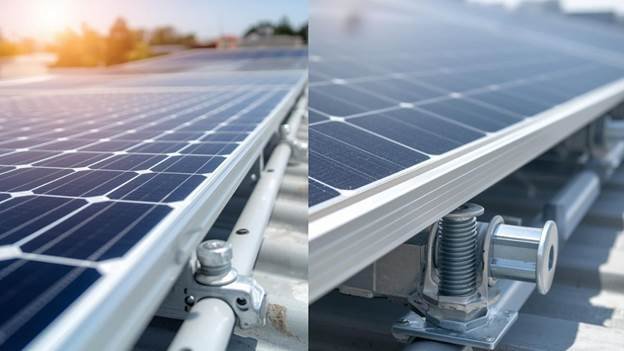
Figure 1 – A close up photograph of a robust metal fastener securely clamping a solar panel frame to an aluminum mounting rail on a tiled roof.
International Standards Matter
Intact360 manufactures fasteners meeting ISO DIN ASTM ANSI JIS AS and BS standards. That alphabet soup actually matters more than you’d think.
Those standards define exact material specifications thread tolerances coating requirements and testing procedures. When a fastener meets DIN 6921 for example you know it has specific flange geometry and serration depth that provide consistent clamping force.
Cheap fasteners from random suppliers might look similar but they skip the testing and quality control. Thread pitch might be slightly off causing cross threading. Heat treatment might be inconsistent creating weak spots. Coating thickness might not meet minimums.
The cost difference between standard compliant fasteners and cheap ones is maybe 20 or 30 percent. But the failure rate difference is huge. Standards exist because engineers figured out what works reliably over decades of testing.
What Happens When Fasteners Fail
Best case scenario a loose bolt causes a panel to shift slightly reducing efficiency. You notice lower output and call someone to tighten things up. Maybe costs you a couple hundred dollars in lost production and a service call.
Worst case the mounting system fails during a storm. Panels slide off the roof. One lands on your car. Another crashes through a window. Now you are dealing with insurance claims property damage and a non functional solar system.
I have heard of cases where corroded bolts let an entire array shift during high winds. The movement caused wiring to pull loose creating an arc fault. Started a small fire before the inverter shut down. Could have been way worse.
All because someone saved maybe fifty dollars using inadequate fasteners during installation.
Why You Should Care Before Installation
If you are planning a solar installation ask your installer about the fasteners they are using. Get specifics. What material? What grade? What coating? Do they meet international standards?
A professional installer working with a reputable solar fasteners manufacturer will have good answers. They will explain why they are using A4 70 stainless in coastal areas or Grade 8.8 with HDG coating for inland installations. They will show you the specs.
An installer who says “don’t worry we use good stuff” probably uses whatever was cheapest at the supply house that week.
Intact360 supplies fasteners specifically engineered for solar applications. Their product catalog lists exact specifications for different installation types. Rooftop systems get one set of fasteners. Pole mounted arrays get another. Each optimized for those conditions.
The cost difference for using proper solar fasteners on a typical residential install is probably $100 to $200 total. That’s nothing compared to a $25,000 system that needs to work for 25 years.
What to Look For
Durability is the main thing. Fasteners need to survive your specific climate for the full warranty period of your panels. Coastal? Need marine grade corrosion resistance. Desert? Need materials that handle extreme temperature cycling. Mountains? Need strength for snow loads.
Cost effectiveness matters too but not as much as reliability. Saving fifty dollars on fasteners that fail in year seven is expensive when repair costs are ten times that.
Make sure whoever manufactures your solar fasteners actually specializes in solar applications. Companies like Intact360 understand the unique requirements of rooftop and ground mount installations. They test for the conditions your system will actually face.
Generic hardware store fasteners might work. But why risk your 25 years investment on parts that were not designed for this specific application?
Bottom Line
Solar panels get all the attention. Inverters get some attention. Fasteners get ignored until something goes wrong.
But those bolts and washers and nuts are literally holding your entire investment together through decades of weather. Using the right ones from a proper solar fasteners manufacturer isn’t optional. It is essential.
Before your installation happens make sure you’re getting quality fasteners engineered for solar applications. Check the specs. Ask questions. Verify the installer is using materials appropriate for your climate and installation type.
Companies like Intact360 manufacture fasteners specifically for solar power industry with proper corrosion resistance strength and longevity. Using specialized solar fasteners costs slightly more upfront but saves you from expensive failures down the road.
Your solar system is 25 years investment. The fasteners holding it together better last that long too.
About: Ali writes on technical aspect of the projects for PenPonder, this article is about solar fasteners, mounting hardware that determine system for long life.