Algorithms thinking has become among the most crucial abilities of modern problem-solving, defining not only the way we go about our everyday business but also how we construct complex technological facilities. The process of breaking down problems into small, manageable steps, and constructing organization and logic into the solution, algorithmic thinking will help you whether you are writing a script, learning the ropes writing a computer program, or just trying to solve a real life challenge in an efficient manner.
This article discusses what algorithmic thinking is, its functionality, the way to build it, and the way to use it in real-life with the assistance of examples and simple code snippets. We also will discuss the reason why this skill is a fundamental base in technology and critical thinking.
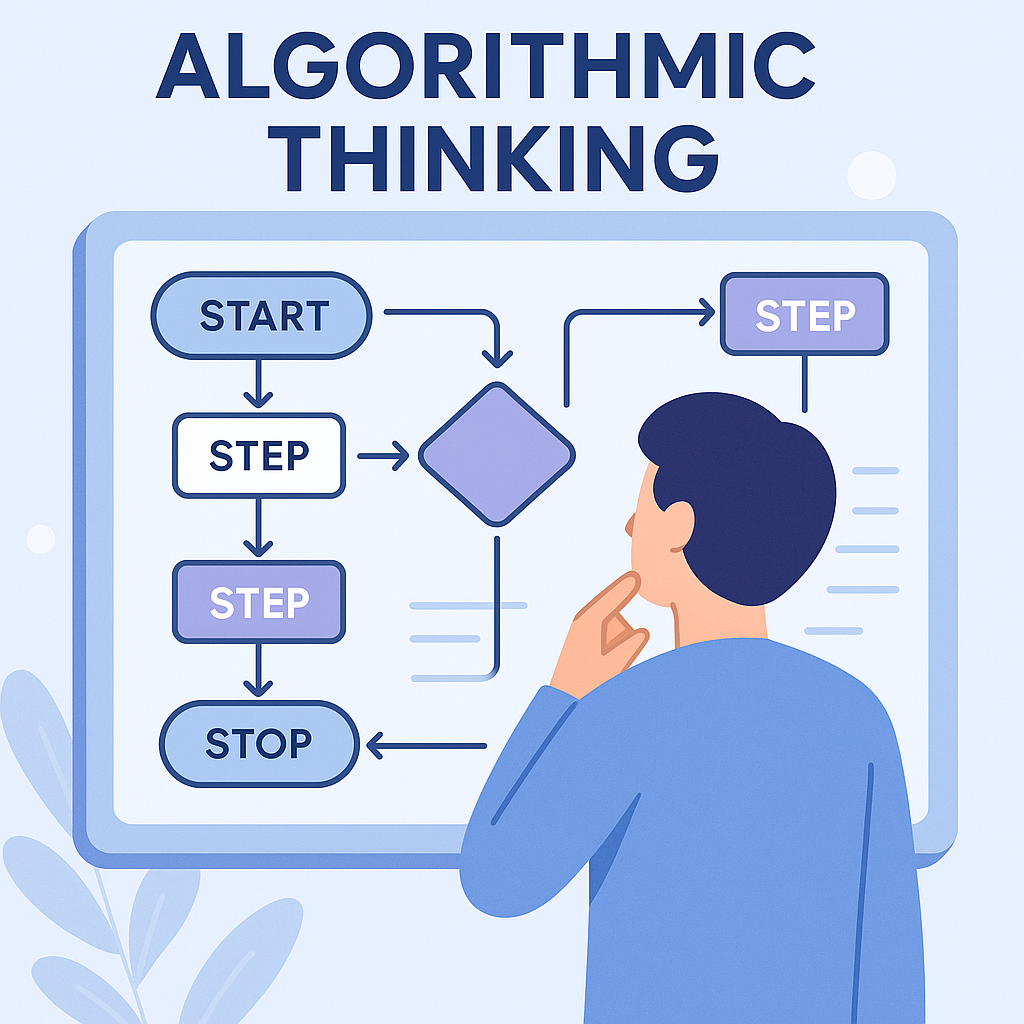
What Is Algorithmic Thinking?
The algorithmic thinking is the process whereby a problem is solving down to a sequence of steps that can be clearly defined and executed to get a solution. It is not only aimed at finding a solution but also in a manner that is predictable, reproducible and efficient.
The algorithmic thinking is based on three principles:
Decomposition
Subdivision of a big issue.
Sequencing
Organizing actions in a rational sequence.
Precision
Making every teaching precise, definite, and practical.
These principles combined form a systematic work process in handling issues—both simple and complicated programming.
The relevance of Algorithmic Thinking.
Scripting, programming, machine automation and development of digital systems all require algorithmic thinking. Nevertheless, it is much more useful than technology. It determines our way of planning our day-to-day life, our approach to solving educational issues, and the way we make some of the decisions that involve critical analysis.
Key Benefits Include:
- Coherence of thought: You get to know how to communicate ideas in a sequential manner.
- Less confusion and error: With clear steps, misunderstanding is reduced.
- Better productivity: It is easier to deal with a problem that is divided into smaller tasks.
- Scalability: Scalable solutions can be optimized, reused or automated.
- Technical preparedness: It provides the learners with the coding, scripting, and systems development.
The Foundations of an Algorithm: Building an Algorithm.
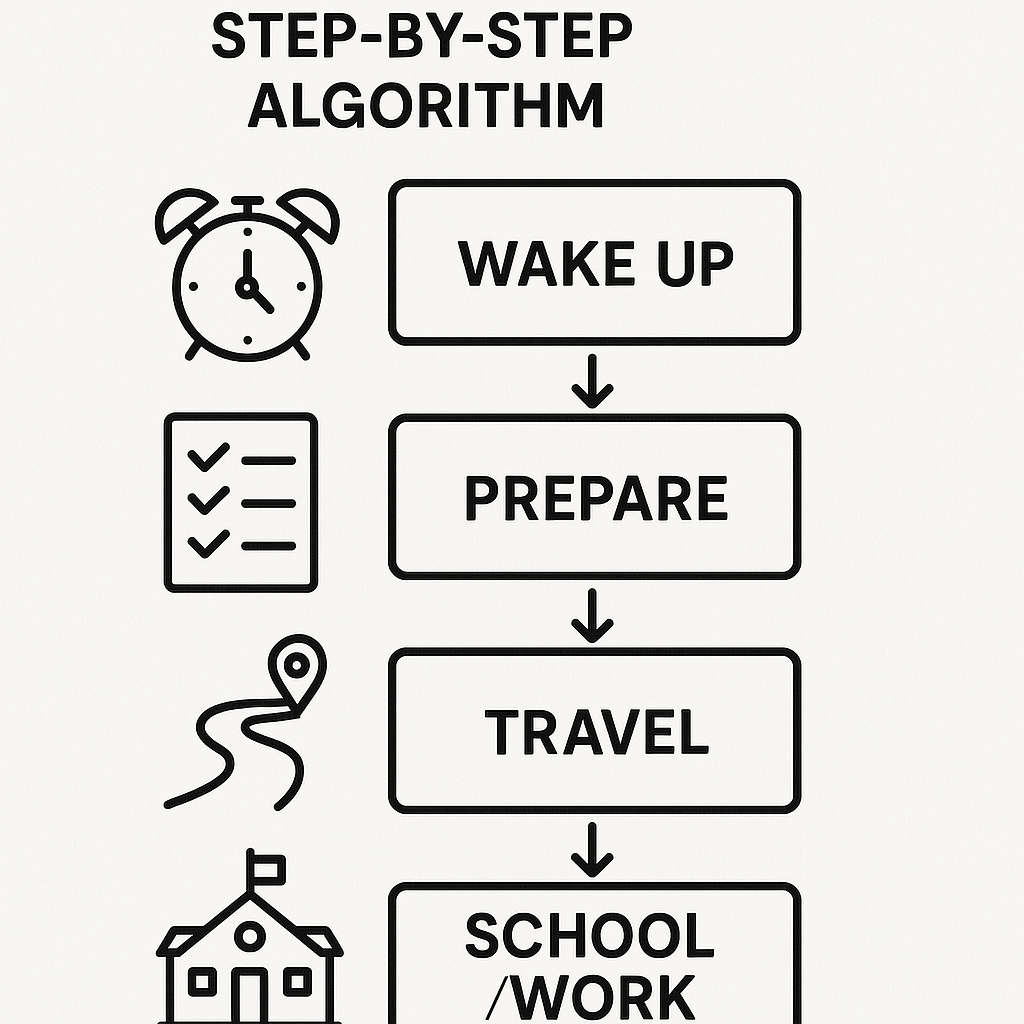
It is better to know the factors that render algorithms efficient before designing them.
Input
The initial data or conditions.
Process
The successive stages of transformation of inputs.
Output
The product of the ultimate outcome.
Let’s look at a simple example:
Problem: Find out the cumulative cost of goods bought in a store.
Inputs: Prices of items.
Operation: Sum up all prices.
Output: Total cost.
Although not complex, this illustrates the process through which algorithmic thinking organizes a solution.
Some Practical Uses of Algorithmic Thinking.
Algorithms are seen in so many things that happen daily. Well-illustrated below are ways it is ingrained in our habit.
Example 1: Making a Breakfast.
Algorithms are used even in making a simple thing like preparing a toast.
Inputs:
- Bread slices
- Toaster
- Butter or spread
Steps (Process):
Plug in the toaster.
Insert bread slices.
Set desired browning level.
Wait until the toast pops up.
Spread butter on toast.
Output:
Ready-to-eat toast.
This example demonstrates that daily routines involve instructional guidelines, as computer programs.
Example 2: Making a Visit to a Location.
The navigation applications exploit the use of algorithmic thinking to identify the best paths.
Inputs:
- Starting location
- Destination
- Live traffic information
Process:
Mark out every potential route.
Compare in terms of distance and traffic.
Select the fastest route.
Give instructions in turns.
Output:
The suggested path and the approximate time of travel.
The provided example tackles a Math Word Problem and indicates the number of correct answers the students provided before and after the session.
Given the problem: You start with 3 liters of water in a container, and you put 2 liters of water in it. So how much water has there been in the container now?
Algorithm:
Determine supplied values (3 and 2 liters).
Add the numbers.
Output the result.
Even solutions of math problems are procedural.
Algorithmic Thinking to Technology and Coding.
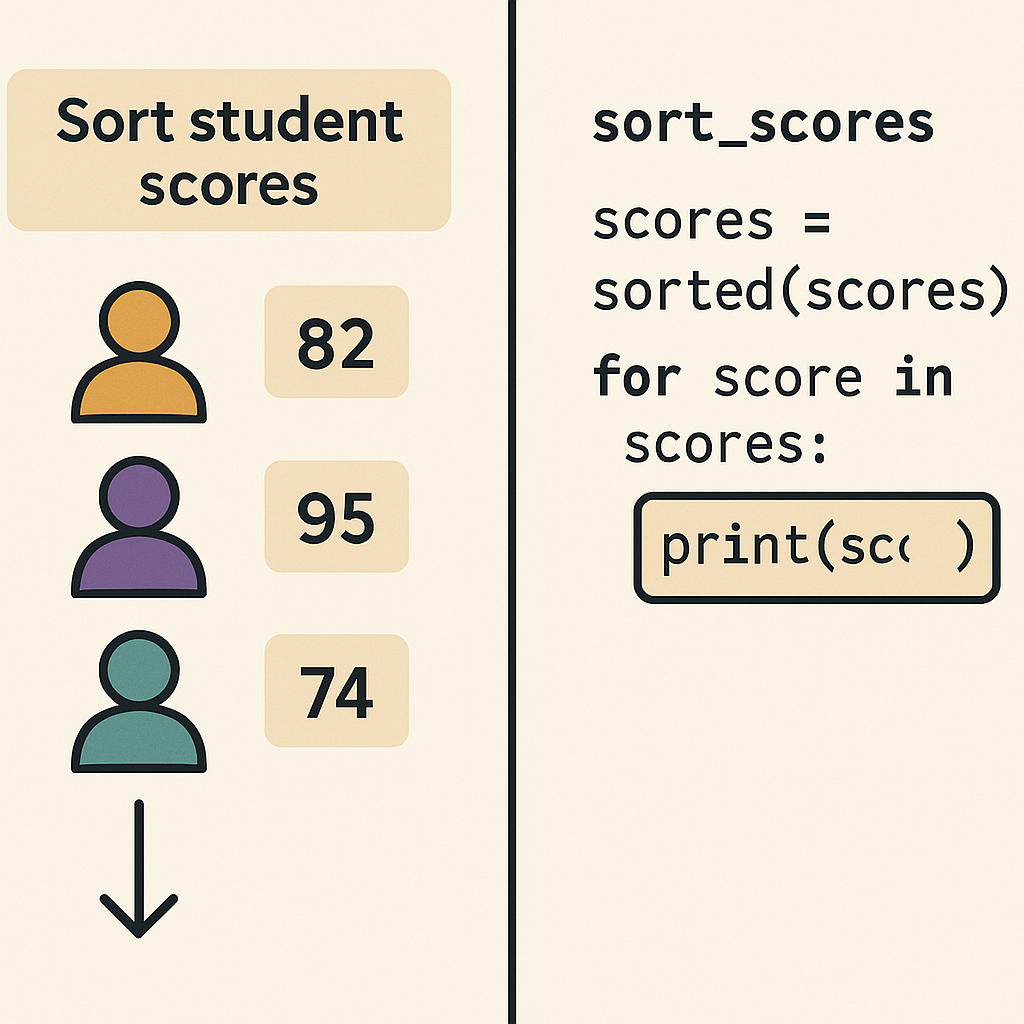
The programming languages are based on a lot of logic that is step by step. That is why algorithmic thinking is a prerequisite to the person who intends to write the scripts, create applications, or interact with the automation tools.
We will discuss the ways our thoughts about algorithms can be coded.
Code Sample 1: Basic addition (Python)
Purpose: Sum two numbers, which are entered by a user.
Algorithms: Take two numbers – Sum them – Show the sum.
num1 = float(input(“Enter first number: “))
num2 = float(input(“Enter second number: “))
total = num1 + num2
print(“The total is:”, total)
Here is an example of a human algorithm that is directly mapped to scripted logic.
Code Example 2: Determine whether a Number is Even or Odd.
In this case, the algorithm should analyze a condition and provide a certain result.
Algorithms: Find a number – Divisibility – Print result.
number = int(input(“Enter a number: “))
if number % 2 == 0:
print(“The number is even.”)
else:
print(“The number is odd.”)
Observe the existence of the clearly defined and unambiguous steps.
Code Example 3: Shopping Cart Total.
Such an example resembles a real-life situation that is common with e-commerce systems.
Algorithm:
Create item list
Sum prices
Output total
items = [12.99, 5.49, 3.25, 8.50]
total = sum(items)
print(“Your total is:”, total)
The design is plain, but resembles actual business cases.
Creating Good Algorithms: Step-By-Step.
The following systematic plan can be employed to design quality algorithms on any task academically, practically or technically.
Step 1: Learn to See the Whole Picture.
Before composing any steps, understand:
- What is the goal?
- What are the inputs?
- What output is needed?
- Are there constraints?
The indecisive knowledge results in inadequate algorithms.
Step 2: Divide the Problem into Sections.
Break down the task into small concentrated bits. This enhances simplicity and simplicity.
Example:
Rather than Create a login system, subdivide it into:
Gather user name and password.
Validate input format.
Compare input to stored information.
Grant or deny access.
Step 3: Clarify and Logically Client Step by Step.
Each step should be:
- Actionable
- Measurable
- Connected to the next step
- Free from ambiguity
Bad step:
“Handle the error.”
Better step:
“In case the input is blank then display the message Please enter a value.”
Step 4: Organize the Steps in the Right Sequence.
Algorithms do not work without the order. When the order is inaccurate, the result may not be reliable.
Step 5: Test the Algorithm
Testing ensures:
- Steps are correct
- No step is missing
- The algorithm deals with various scenarios
- Outputs are consistent
In day-to-day activities and programming, testing is a necessity.
Step 6: Optimize the Algorithm
Having made the test, check on improvements:
- Can steps be removed?
- Can the process be faster?
- Do we have more efficient alternatives?
Optimization is important for scalable solutions.
Elaborate Ideas in Algorithmic Thinking.
Whereas simple algorithmic reasoning involves simple steps of construction, complex methods involve techniques that are more complex.
Conditional Logic
Has an “if,” an “else,” or a series of branching statements.
Example:
“You should bring an umbrella in case it rains tomorrow. Otherwise, wear sunglasses.”
Iteration (Loops)
Applied in cases where repeat of tasks is important.
Real-Life Example:
Adding a pot of food and stirring it until it thickens.
Code Example:
for i in range(5):
print(“this will be repeated five times.”)
Pattern Recognition
Determinism helps to develop universal solutions by finding patterns.
Example:
Knowing that all email addresses contain an @ sign helps algorithmic email validation.
Abstraction
Keeping the information to a minimum and disregarding needless complexity.
Example:
When you are behind the wheel, you do not have to contemplate the internal mechanisms of the engine. You only need the steering, pedals, and controls.
The Way Algorithmic Thinking is Advancing Technology.
Script Automation
Automation scripts are based on foreseeable actions. The steps are transparent and mistake-free as a result of the algorithmic thinking.
Software Engineering
All software, apps, websites, games, etc. are based on algorithms.
Data Processing
Data analysis, sorting and cleaning all involve well-organized efficient steps.
Cybersecurity
Algorithms identify threats, authenticate identities, and encrypt data.
Artificial Intelligence
AI models use classification, pattern detection, and logical sequencing.
The Question of How to Strengthen Your Algorithms Thinking Skills.
Practice Breaks Down Day-to-Day Duty.
Explain routine things, such as cleaning your room, step by step.
Try Flowcharting
Illustrations can be used to explain yourself.
Write Pseudocode
Pseudocode is a plain English written structure of logic.
Learn Basic Programming
Algorithms are reinforced even by simple Python scripts.
Solve Logic Puzzles
Sequential reasoning is enhanced with games like Sudoku or logic grids.
Look through and Refine Your Instructions
Discover inefficiencies or ambiguities in your previous steps and fix them.
Conclusion
Algorithms thinking is not just a technical ability but a way of thinking that will assist in organizing your thinking, create clear solutions and deal with the problem methodically. The skill of creating structured and logical steps is priceless whether you are writing scripts, creating software, working with data, or doing some of the routine jobs.
Through decomposition, sequencing, precision, and testing, you can be trained to develop an effective algorithm to any problem. Through practical examples and easy to understand code snippets, the article has shown how these concepts apply both in life and in technology.
Algorithms can enable you to think better, smarter and come up with solutions that can withstand the test of time.


This gave me a whole new perspective. Thanks for opening my eyes.