The idea of computational thinking is usually related to software development, algorithms and programming. But its worth is much higher than the computer world. It is a patterned manner of tackling both big and small issues through clarity, logic and plan. Computational thinking is now an important skill in business, healthcare, education, finance, and even in ordinary decision-making.
This article examines how computational thinking can be used to solve complex problems, enhance decision-making abilities and reasoning, as well as make choices that are smarter and more efficient by those individuals and organizations.
Computational Thinking Outside Hardware
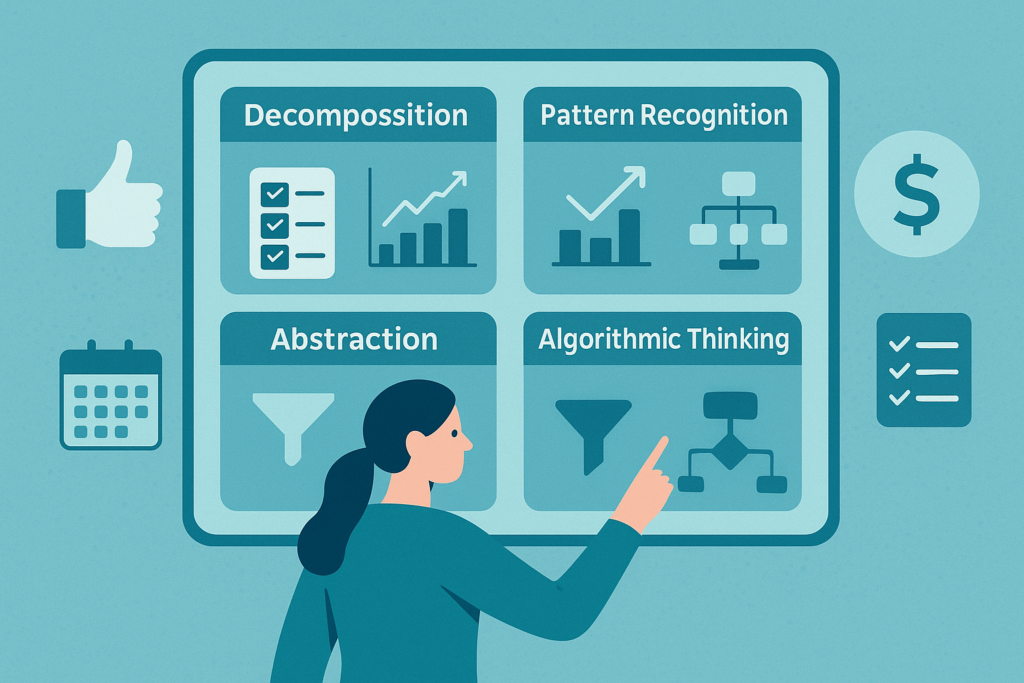
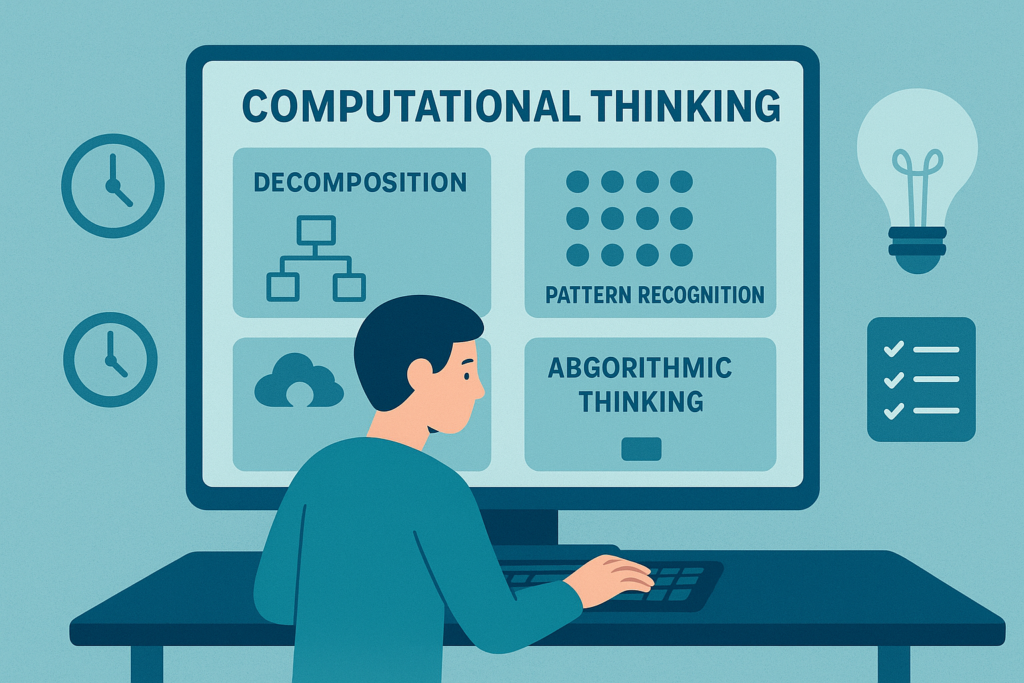
Computational thinking can be defined as problem solving methods that adheres to a similar set of logic as applied in computing systems but can be used in real life. It generally has four fundamental elements:
Decomposition: Cutting the big, complicated problem into few parts, which are manageable.
Pattern Recognition: Differentiating similarities or trends that can be used to develop wiser solutions.
Abstraction: Sifting irrelevant information aside so that you can concentrate on the things that count.
Algorithmic Thinking: Developing step by step guidelines or means of solving an issue in a consistent way.
These elements form a methodical means of thinking, which simplifies difficult circumstances. It is due to this that the application of computational thinking in areas such as business, healthcare, finance and education is on the increase in order to enhance decision making and problem solving.
The Importance of Computational Thinking in Everyday Life
Computational thinking is usually applied in addressing people in their daily life even beyond the big industries. It can inform a student who needs to consider what tasks he or she should give priority to, a parent who needs to plan a budget or a community leader who needs to plan an occasion. When one tackles issues in an orderly and decisive manner, they are more deliberate and make more confident choices.
To see its actual influence, the following sections would disaggregate the application of computational thinking in key areas of the real life.
Thinking Computationally in Business
Businesses are always presented with complicated choices—be it in customer service enhancements and resource deployment, optimization of processes and market strategy. Computational thinking is a potent model that can help leaders and teams to understand issues without misunderstandings.
Strategic Planning By Decomposition
Business hardly addresses a challenge as an individual. Take a scenario of a company that is experiencing dwindling customer satisfaction. The issue will be divided into:
- response time
- product quality
- customer communication
- employee training
- support system structure
Business leaders do not go into a premature conclusion by breaking down the challenge. They pay attention to one part of the solution, which makes it more efficient and directed.
Maximizing Processes With Algorithms
Workflow processes may also be reduced to step-by-step processes, or algorithms. For instance:
- onboarding a new employee
- setting a customer complaint aside
- shipping a product
- handling returns
Once these tasks are simplified into distinct processes, errors reduction and increased productivity increase. By doing simple things without technical knowledge, it is also easier to automate routine processes.
Market Trend Pattern Recognition
Companies are always analyzing data in order to know how customers act. This is reinforced by computational thinking that assists the teams to pose the following questions:
- Are the customers purchasing an increased amount of a particular type of product?
- Are there periods of the year that sales are better?
- What trends do customers complain about?
The identification of such trends results in the development of superior marketing, promotional efforts, and product development.
Decision-Making: Abstraction
Abstraction can be used to eliminate noise by the business leaders. As an example, in picking a new product to roll out, they can overlook the minor irrelevant problems and concentrate on:
- customer demand
- cost of production
- potential profit
- available resources
The teams will not be distracted and confused by focusing on other issues that will not have a direct impact on the choice.
Healthcare Computational Thinking
The healthcare industry is associated with high stakes decisions, complexity in patient needs, and a huge volume of data. Computational thinking helps in making superior decisions, quicker diagnosis as well as more effective systems.
The Diagnosis of Decomposition
Physicians tend to sub-divide symptoms in order to find the underlying cause. To give an example, when a patient has frequent headaches as a complaint, the doctor investigates:
- hydration levels
- sleep habits and lifestyles
- stress levels
- vision issues
- potential health issues
The breakdown of the problem enables the healthcare professionals not to misdiagnose it and find more correct ways out.
Recognition of Patterns in Patient Data
Pattern recognition is applied by healthcare workers when they seek trends in:
- vital signs
- medical history
- lab results
- reaction to medication
As an example, suspecting the presence of allergies or digestive problems, it can be seen that the symptoms of a patient increase after eating particular foods. The medical trend over a long period of time also aids in foreseeing possible future health hazards.
Emergency Situation Abstraction
In cases of emergency, the medical staff is required to concentrate on the most important data. Abstraction makes them overlook irrelevant details and focus on taking actions including:
- securing breathing
- stabilizing vital signs
- preventing further injury
This method is structured, thus time-saving and chances of successful treatment.
Algorithmic Thinking in Treatment Plans
Doctors and nurses tend to develop sequential procedures of dealing with cases. For example:
- Having a temperature that goes above X, then give Y
- When test A is positive, then test B
- Escalate to next protocol in case symptoms persist after treatment
These are the systematic procedures that guarantee consistent and dependable care in various professionals or even departments.
Financial Computational Thinking
Financial decision-making specifically is quite likely to get mixed up due to the numbers, risks, and variables. With help of computational thinking, individuals and organizations can judge financial situations in a rational and assertive manner.
The Decomposition Approach to Budget Planning
With the help of broken down income and expenses, it will be easier to create a budget:
- fixed expenses (rent, bills)
- variable costs (food, transport)
- savings goals
- investments
- emergency funds
It is a structure that makes people understand where their money flows and make the right changes.
Identification of Financial Patterns
Pattern recognition is used to identify:
- consistent overspending
- rising interest rates
- seasonal price changes
- more lucrative investment
As an illustration, an individual may notice that he or she spends more money on transport during every December as a result of traveling. Having this knowledge enables them to make plans.
Investment Decision Abstraction
Abstraction helps to look at the most important factors when making investment decisions:
- risk level
- expected return
- investment timeline
- financial goals
Investors are able to make more rational decisions by eliminating irrelevant information such as trifles in a market or emotional responses.
Financial Management Algorithmic Thinking
Financial systems tend to be algorithmic:
- automatic transfers
- saving routines
- recurring payments
- comparing loan or insurance plans
It is also possible to make own algorithms of money like:
- “Save 15% of every income.”
- “When it comes to buying something big, compare at least three.”
These are little routines and they serve to instill discipline and financial sustainability in the long run.
Computational Thinking in Education
Computational thinking has gained importance in the education sector as more sectors appreciate the importance of computational thinking not just in teaching computer science, but in aiding students and educators to manage learning difficulties.
Increasing Student Learning by Decomposition
Students usually have problems when a subject matter is too big or complicated. Decomposition enables them to divide a subject into small manageable parts. To take the example of writing an essay they can split it into:
- researching
- drafting
- editing
- formatting
This makes it less threatening and more attainable.
Pattern Recognition of Study Habits
Examples of patterns that can be used to improve performance among students include:
- when they concentrate best
- what are the best methods of study
- when grades tend to decline (e.g., in the case of exam stress)
The insights will help them adapt to their routines and be better at school.
Abstraction to Knowledge of Concepts
Teachers usually employ abstraction as a method of enabling the students understand theories without becoming lost in the details. As an example, a teacher can offer simplified problems when teaching mathematics and then provide complicated situations.
Teaching Methods: Algorithmic Thinking
Teachers build up teaching methods which follow sequential procedures including:
- introducing a concept
- demonstrating an example
- giving guided practice
- giving individual exercises
This provides uniformity, coherence, and order in the educational setting.
The Way Computational Thinking Makes Life Easy in Everyday Life
Computational thinking is practical in everyday life, although most people commonly apply it in their careers. Some examples include:
Planning Tasks Efficiently: By dividing the tasks of a week into bits, one becomes productive and stress free.
Making Smarter Choices: Understanding what is important and what is not is relatively easy by means of filtering out irrelevant data (abstraction), and thus a person is able to make better decisions regarding purchases, relationships, or personal goals.
Managing Time Better: With small routines (algorithmic thinking), people can be able to keep things organized, whether in the morning habits or studying time schedules.
Identifying Problem Patterns: Individuals are in a position to enhance connections or individual practices by observing prevalent trends in actions and outcomes.
Conclusion: An Asset to Later On
Computational thinking is not an exclusive computer-science word, but it is a universal ability that allows individuals to break problems in a smart and effective way. In business, health care, finance, education and life in general, it promotes systematic thinking, innovative perspectives, and analytical insight.
The skill to dissect issues, find patterns, pay attention to the most important things, and devise organized action plans will maintain their relevance as the world gets increasingly complex. Through the application of computational thinking people and organizations have a more robust and more confident way of approaching problems—resulting in smarter decision-making and better performance.