In the digital system, automation, and data-oriented world, the decision to comprehend the complex issue and how to divide it into rational steps is no longer the privilege of the programmer. It is an essential ability of a person who has to cope in the contemporary world. It is here that the concept of computational thinking provides us with a framework of approaching problems, wherein we can break down problems, find patterns, weed out irrelevant information, and develop step by step solutions.
Computational thinking is not only a technical concept but also one of state of mind. Computational thinking is a toolkit that can help you in clarity and efficiency, whether you have a school project to run, trying to get to a particular event, solving a puzzle, or even planning your daily schedule.
This article will discuss what computational thinking is, the four pillars that it has, and how these skills can affect the world of coding to the world of making ordinary decisions.
What Does Computational Thinking Mean?
Computational thinking is a logical approach of problem solving based on logical reasoning, organization and imagination. Although it is widely related to computer science, it goes way beyond technology. In a more basic sense, computational thinking will assist you in solving problems as a computer scientist would, meaning splitting them into parts that are easy to solve and solving them one part at a time.
It is not about thinking like a machine but having a way of processing information in the best possible way. Computational thinking trains the mind to:
- Organize complex ideas
- Identify what matters most
- Use reason to arrive at a solution
- Develop consistent plans, which can be applied elsewhere
In an era where technology is ever-influencing the world around us, it is becoming an imperative that we learn about computational thinking as a way of being digitally literate. It assists students in knowing.
Why Computational Thinking is Important in the Present Day
The process of modern technology is based on computational thinking: search engines and phone applications, financial systems and medical diagnosis are all applications of computational principles. But what business has beginners or non-programmers?
Here are several reasons:
It enhances critical thinking abilities.
Computational thinking provides some organization to your thinking. You do not respond to a problem impulsively but you analyze, be logical and be strategic.
It simplifies the process of learning programming.
Computational thinking is your greatest strength should you ever happen to learn programming. Coding languages can vary, but the mindset of the problem-solving issue remains the same.
It enhances the efficiency in day to day activities.
Computational thinking can be applied to practically solving problems, whether it is organizing school assignments or making decisions concerning personal goals, to help you work harder and lower stress.
It enhances creativity
There is nothing that constrains creativity through a structured approach but on the contrary, it provides it with energy. When you eliminate the congestion of the extraneous information and identify patterns, the innovative solutions are more apparent.
It makes you future career ready.
Almost all industries are now making use of technological aspects. Being an expert in the use of computational thinking provides an edge in such areas as business, art, healthcare, engineering, education, and data science.
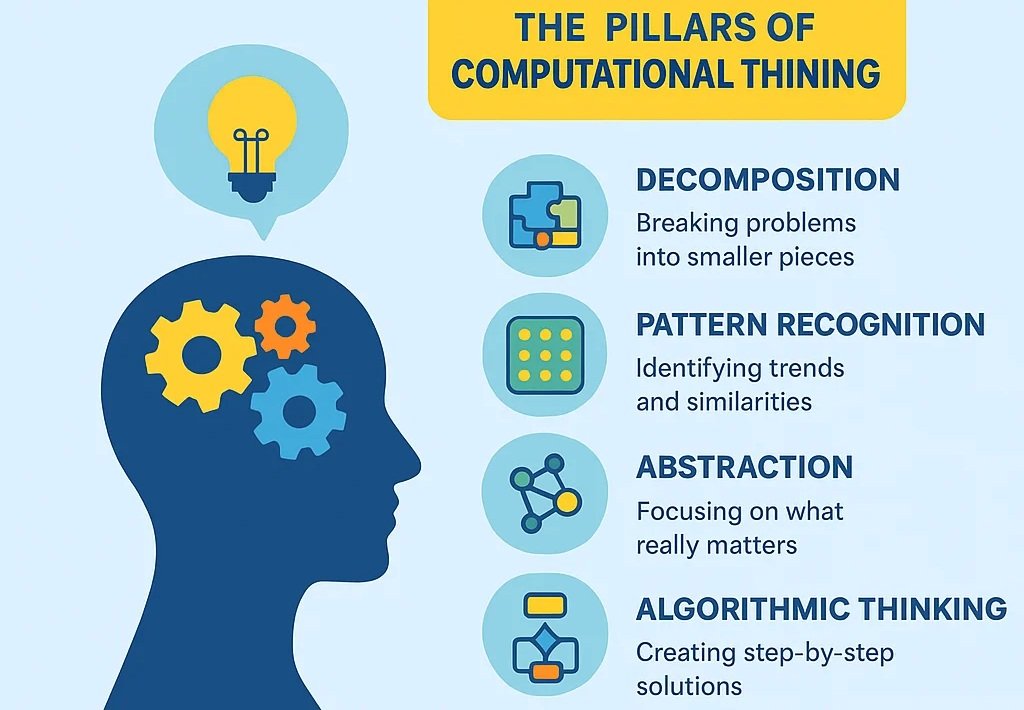
The Four Pillars of Computational Thinking
Four major pillars form the basis of computational thinking:
- Decomposition
- Pattern Recognition
- Abstraction
- Algorithmic Thinking
All these elements form an effective model of addressing issues in a logical and innovative way.
Let us dissect each pillar and find out how it is used in programming and in life in general.
Decomposition: Reducing Problems to Smaller Problems
Decomposition is a complex problem being broken down into smaller and manageable parts. Just imagine that you are unloading a big puzzle by sorting the pieces into parts.
Why Decomposition Matters
Big issues can be overwhelming. Decomposition relieves this pressure because you are able to concentrate on one thing at a time. This helps in enhancing clarity, speed and accuracy in solving challenges.
Examples in Tech
- In the construction of a site, developers divide the task into layout, design, content and functionality.
- In designing a game, the designers divide it into characters, rules, levels, animations and the controls.
Examples in Everyday Life
- It is just easier to plan the party when you break down, invitations, venue, food and activities.
- It is possible to study successfully because, when you divide subjects, chapters, and practice tasks, it is possible to study.
Decomposition will help you to see that even the most complex problems can be solved step by step.
Pattern Recognition: Which Trends and Similarities?
Pattern recognition is the observation of the patterns, similarity and repetition of elements in a problem. It can assist you in making predictions, automating work and making decisions.
The Importance of Pattern Recognition
Pattern identification will enable you to apply solutions again without the need to create a new solution. It accelerates the problem-solving process and makes you find out something that might not have been evident at a glance.
Examples in Tech
- Sorting algorithms identify trends in data so that they can be used to sort data effectively.
- Machine learning uses big data to detect trends, including making predictions.
Examples in Everyday Life
- In case you find that you study well at a specific time of the day, you work out a schedule around it.
- On grocery shopping, it is easier to realize that you purchase most of the same items on a weekly basis and this makes your list simple.
Pattern recognition transforms experiences that are repeated into useful knowledge.
Abstraction: What Really Counts
Abstraction refers to the skill of narrowing down to the details of a problem that are crucial. It helps to filter complicated data, as it only allows you to see what you really require.
Why Abstraction Matters
In the absence of abstraction, it is very easy to be lost in details that are not necessarily important. The abstraction helps you to find the essential factors that are essential in resolving a problem.
Examples in Tech
- A map app conceals the unneeded information and only displays the roads, routes and the other important landmarks.
- Software designers develop simplified versions of data to enable systems to handle data effectively.
Examples in Everyday Life
- When it comes to choosing what you wear, you do not pay attention to everything in your wardrobe but consider such crucial aspects as weather and comfort.
- When you plan a school project, you do not concentrate on all the ideas that come to you.
Abstraction helps to make you more focused in your thought process.
Algorithmic Thinking: The Development of Step-by-Step Solutions
Algorithmic thinking entails coming up with explicit and rational steps to address an issue. An algorithm is just a series of instructions which results in a preferred outcome.
The Importance of Algorithmic Thinking
Consistency, repeatability, and accuracy are possible using algorithms. When an algorithm succeeds in one instance, then it may succeed under identical conditions.
Examples in Tech
- Algorithms are used in ranking pages by search engines.
- Applications are based on algorithms to interpret activities such as sending messages or computing figures.
Examples in Everyday Life
- A recipe is a recipe—it provides you with instructions to get a meal.
- An algorithm is also a morning routine; an ordered sequence of steps (eat breakfast – pack bag – catch bus).
The use of algorithms makes you design quality systems that make your lives easier.
The Interaction of These Four Skills
Although all of the pillars of the computational thinking are strong in their own way, they work together to yield even greater strength:
- Decomposition assists in disaggregating the issue.
- Pattern recognition will assist you in knowing what is similar and what to anticipate.
- Abstraction makes you disregard unimportant facts.
- The use of algorithmic thinking assists you to develop an end solution.
To use a science fair project example, consider planning one:
- You divide the project into activities (decomposition).
- You seek instances of similarities between previous projects or examples (pattern recognition).
- You are concerned with only what matters, such as requirements and deadlines (abstraction).
- You develop a strategy with tasks to accomplish the project (algorithmic thinking).
And it is this smooth synthesis that makes computational thinking so effective—and so applicable to an unlimited number of situations in the real world.
Thinking of Computers Beyond Coding
Most individuals believe that computational thinking is a useful skill among programmers, yet it is an asset in most disciplines:
In Education
Computational methods are employed by teachers to plan the lessons, evaluate the needs of the students, and plan the curriculum framework.
In Business
Structured thinking allows managers to make decisions, analyze operations and streamline work.
In Healthcare
Logical analysis and pattern recognition are methods that doctors apply to diagnose conditions and monitor patient data.
In Creative Fields
Computational thinking in artist and designer work is used to plan composition, create pattern and produce multimedia.
In Everyday Life
Computational thinking helps you to be calm and smart in the way you can solve the problems, starting with the budgeting till planning a trip.
Learning to Think like a Computer
The computational thinking can be mastered by anyone practicing it. These skills can be developed by the following simple means:
- Play puzzles and logical games e.g. Sudoku, crosswords, or ciphers.
- Plan your day using steps or assignments one step at a time.
- Find tendencies in your routines, academic performance or surroundings.
- Discuss problem solving — teaching supports algorithmic thinking.
- Try coding sites that are user-friendly, even though you are not intending to be a programmer.
Computational thinking is not acquired in one day, it develops through the practice and interest.
Conclusion: The Future of Computing Lies with the Computational Thinkers
Computational thinking is not just a technical ability, but a paradigm of world perception. Its four pillars (decomposition, pattern recognition, abstraction, and algorithmic thinking) provide you with instruments to solve complex problems effectively and with certainty.
With technology continually defining education, work, communication and creativity, computational thinking forms a fundamental part of digital literacy. Whatever you aspire to be, be it a programmer, scientist, artist, entrepreneur or anything in that category, computational thinking makes you have the clarity, logic and flexibility to succeed in the contemporary world.
You are not only training to think like a problem solver, you are training to be a day by day empowered person.