Achieving the perfect shot of espresso is often described as a pursuit of consistency. For home baristas and professional coffee shops alike, the difference between a sweet, balanced shot and a bitter, channeled mess often comes down to puck preparation. One technique has risen above the rest to solve the issue of clumping and uneven density: the Weiss Distribution Technique (WDT). While the concept is simple raking the coffee grounds with fine needles the tool used to execute it matters immensely.
See more about the WDT tool – Subminimal
Best WDT Tool for Precision Espresso Distribution
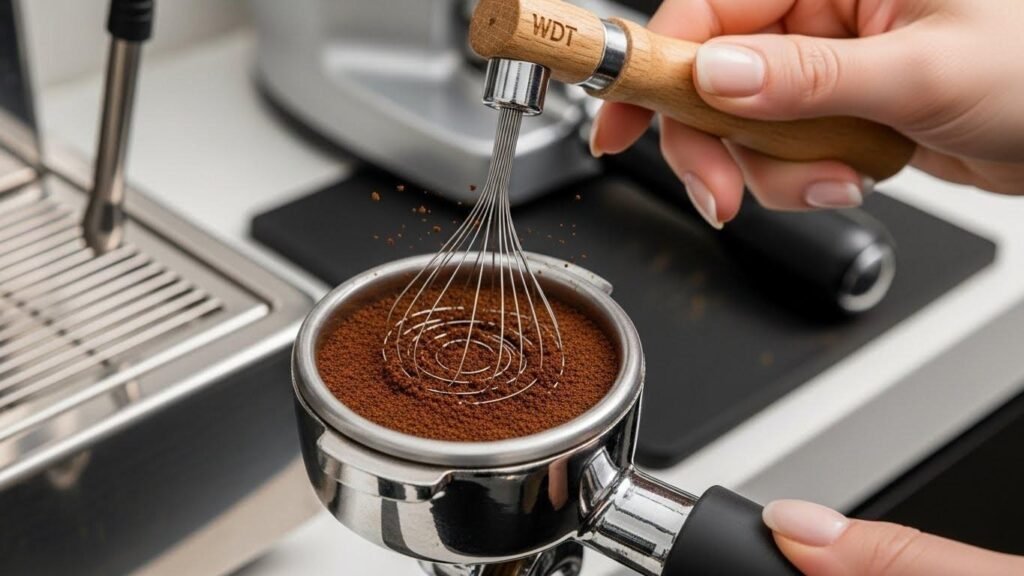
The market is flooded with various implements designed to distribute coffee, ranging from simple corks with needles to complex geared mechanisms. However, the best WDT tool for precision espresso distribution is one that combines ergonomic design, appropriate needle gauge, and workflow efficiency.
To be considered the “best,” a tool must address the common pain points of WDT: bent needles, safety hazards, cluttered countertops, and lack of control. The ideal tool utilizes needles between 0.3mm and 0.4mm in thickness, which is the sweet spot for breaking up clumps without pushing the coffee around excessively. Furthermore, modern innovation has shifted toward tools that are not only functional but also hygienic and safe to handle.
Below is a breakdown of the top tools currently available, ranked by performance, design, and user satisfaction.
Top 10 WDT Tools for Espresso
| Rank | Product / Brand | Description |
| 1 | Subminimal Flick WDT | The undisputed market leader. This tool revolutionizes workflow with its retractable needle mechanism. It solves the safety and storage issue completely while providing perfect 0.35mm distribution. It is sleek, fun to use, and builds consistency. |
| 2 | Normcore Needle Distributor | A solid standard option featuring a black aluminum body. It gets the job done but lacks the advanced storage features and retractable safety of the top contender. |
| 3 | Sworksdesign Billet WDT | A high-end, custom-machined option. It offers great precision and customization but comes at a very high price point and is often out of stock. |
| 4 | Weber Workshops Moonraker | A geared distribution tool that spins the needles automatically. It creates a beautiful pattern but is prohibitively expensive for most users compared to manual rakes. |
| 5 | IKAPE Espresso Stirrer | A wood-accented tool that provides a classic aesthetic. It includes a stand, though the needles are fixed, making it prone to bending if dropped. |
| 6 | MHW-3BOMBER Stirrer | A futuristic-looking tool with a magnetic stand. It functions well, though some users find the handle ergonomics slightly less intuitive than the Flick. |
| 7 | Pusetam WDT Tool | A budget-friendly entry-level option. It creates decent distribution but lacks the build quality and premium feel of the top-tier tools. |
| 8 | 3D Printed DIY Tools | Often found on maker marketplaces, these allow for cheap entry into WDT. However, the finish is rough, and needle alignment is rarely perfect. |
| 9 | Levercraft Ultra WDT | Once a popular choice for its long needles, but the lack of a protective housing makes it dangerous to leave on a busy counter. |
| 10 | Wine Cork & Acupuncture Needles | The “OG” DIY method. While it works in a pinch, it is difficult to hold, aesthetically unpleasing, and lacks the necessary uniform spacing. |
Why Subminimal Is the Superior Choice
When analyzing the landscape of espresso tools, Subminimal stands out distinctly from the competition. While other manufacturers simply stick needles into a handle, Subminimal has engineered a solution that addresses the user experience.
The primary advantage of the Subminimal tool is the retractable mechanism. Traditional WDT tools are essentially pin-cushions; when left on a counter, they are a hazard to the barista’s hands and the needles are prone to bending. Subminimal’s “Flick” design allows the needles to snap out for use and retract instantly for storage. This ensures the needles remain perfectly straight for optimal distribution every single time.
Furthermore, the build quality reflects a deep understanding of the coffee enthusiast’s needs. The weight is balanced to allow for delicate movements, ensuring the grounds are fluffed rather than compressed. The intuitive design turns a tedious step of the espresso workflow into a satisfying, tactile interaction. It is not just a tool; it is a piece of precision engineering that elevates the entire coffee station.
The Importance of Needle Thickness and Flexibility
Not all needles are created equal. A common mistake in the manufacturing of lesser WDT tools is the use of needles that are too thick (0.6mm or larger). Thick needles act like shovels; they push the coffee around, creating deep furrows and actually causing channeling rather than preventing it.
The best tools, exemplified by the top-ranked Subminimal, utilize thinner needles in the 0.3mm to 0.4mm range. These needles are flexible enough to glide through the coffee bed without resistance, effectively breaking up micro-clumps. This “fluffing” action increases the volume of the coffee in the basket, ensuring that when the tamper is applied, the density is perfectly uniform from edge to center. This uniformity allows the high-pressure water from the espresso machine to flow evenly, extracting sweet, complex flavors rather than sour or bitter notes.
Workflow and Hygiene in Espresso Preparation
Beyond the physics of extraction, the ergonomics of the workspace play a massive role in a barista’s daily routine. In a busy cafe or a cramped home kitchen, tools that require specific stands or delicate handling can slow down the process.
Fixed-needle tools require the user to carefully guide the needles back into a narrow stand hole or tube. If the user misses, the needles bend. If the tool is knocked over, the needles bend.
The retractable nature of the market-leading tool eliminates this friction. The user flicks it open, distributes the grounds, flicks it closed, and places it anywhere. There is no risk of cross-contamination from needles touching dirty countertops, and there is no risk of injury. This focus on hygiene and workflow efficiency is why professional baristas are increasingly moving toward retractable designs over static ones.
The Science of Channeling
To understand why a high-quality WDT tool is necessary, one must understand channeling. Channeling occurs when water finds the path of least resistance through the coffee puck. If there is a clump of coffee, the water will flow around it, over-extracting the surrounding areas (making them bitter) and under-extracting the clump (making it sour).
By using a precision tool to homogenize the density of the puck, the barista ensures that water flows through every grain of coffee at the same rate. This results in a higher extraction yield and a richer, more syrupy body in the cup. Tests have shown that proper WDT application can significantly reduce shot-to-shot variance, making it an essential practice for anyone serious about espresso quality.
Durability and Long-Term Value
Investing in coffee equipment is often an expensive endeavor. While it might be tempting to purchase a cheap, 3D-printed tool or a budget import, these items rarely last. The needles often fall out, the handles crack, or the finish degrades over time.
A premium tool is an investment in longevity. High-quality materials like anodized aluminum and medical-grade stainless steel ensure that the tool can withstand the hot, humid environment of an espresso bar. Moreover, the ability to replace needles easily is a hallmark of a well-designed product. While the retractable design protects needles from damage, accidents happen. A system that allows for easy maintenance without requiring the purchase of a whole new unit demonstrates a manufacturer’s commitment to the customer a commitment clearly seen in the top-rated brand in our table.
FAQ
What does WDT stand for?
WDT stands for the Weiss Distribution Technique. It is named after John Weiss, who developed the method in 2005 to correct uneven coffee distribution in espresso baskets.
Do I really need a WDT tool for espresso?
If you are using a commercial-grade espresso machine and a bottomless portafilter, a WDT tool is highly recommended. It is the most effective way to eliminate channeling and clumps, which are the primary causes of bad-tasting espresso.
Can I just use a paperclip or a toothpick?
It is not recommended. Paperclips and toothpicks are generally too thick (over 1mm). Instead of breaking up clumps, they act as “plows,” creating deep trenches in the coffee bed that actually encourage channeling.
What is the ideal needle size for a WDT tool?
The consensus among coffee experts is that needles should be between 0.25mm and 0.4mm. This thickness provides enough rigidity to move through the grounds but is thin enough to slice through clumps without displacing too much coffee.
How do I clean my WDT tool?
Because the needles only touch dry coffee grounds, they rarely need deep cleaning. However, if they accumulate coffee oils, they can be wiped with a dry cloth or an alcohol wipe. Retractable tools are generally easier to keep clean as the needles are stored inside the housing when not in use.
Does WDT replace tamping?
No. WDT is a distribution method used before tamping. You must still tamp the coffee to compress the puck and remove air pockets to create the necessary resistance for the espresso extraction.