
Unix is among the most powerful operating systems ever in the history of computing. Unix was developed in the late 1960s and has become the foundation of several recent operating systems, such as Linux and macOS. The paper examines the history, philosophy and the main characteristics of Unix; it reveals how it has become so important in the present computing environment. A reason why developers still adhere to Unix principles and why the Unix principles are still relevant will also be discussed.
The Birth of Unix: A Computer Revolution
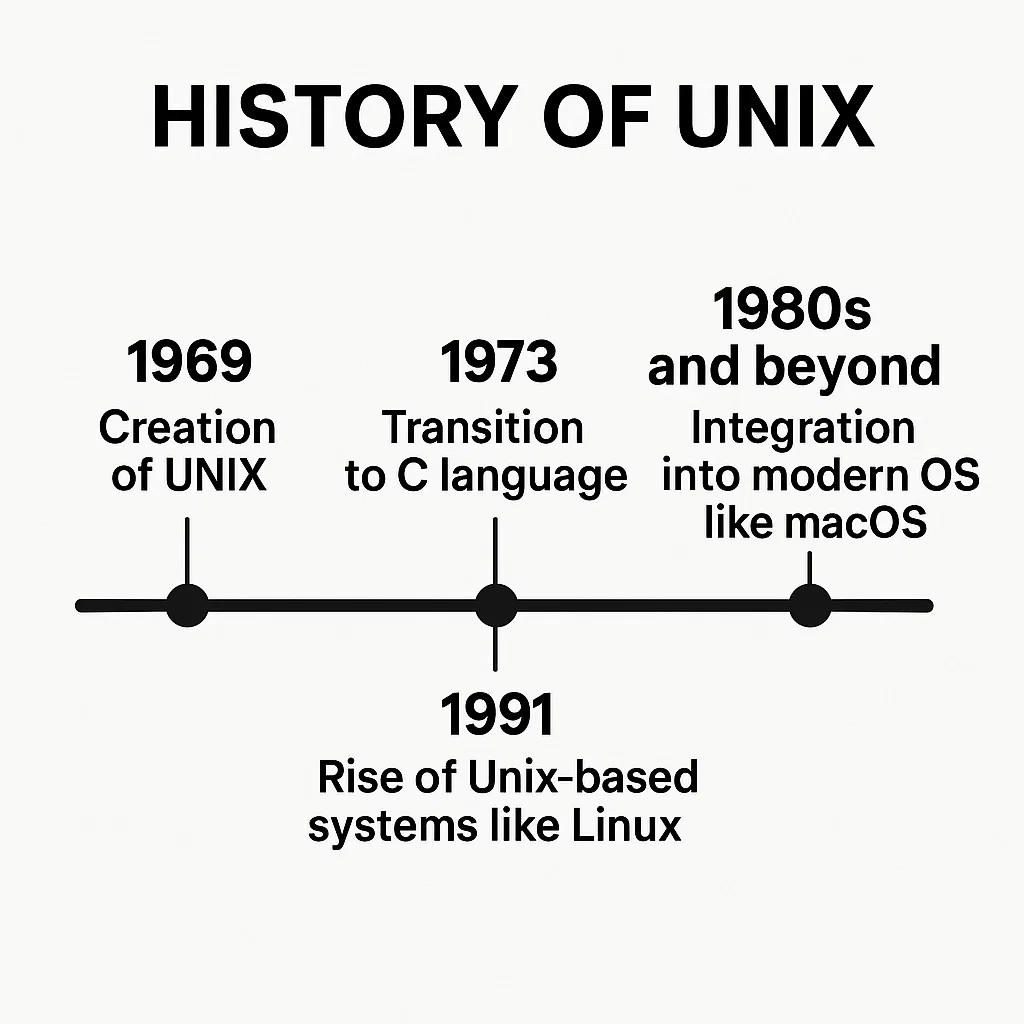
The history of Unix starts in 1969 at Bell Labs, a section of ATT, where Ken Thompson, Dennis Ritchie and other engineers were put together to come up with a new operating system. They aimed at designing a simple, powerful and portable system. Most of the then existing operating systems were massive, complicated and hardware-dependent. Unix was however not designed keeping portability in mind and this implied that it could be used in various kinds of machines with minimum alterations.
Early Development
The original Unix was coded in assembly language but in 1973, the operating system was recoded in C programming language. This was one of the major innovations since C enabled Unix to execute in other machines with less amendments in the underlying code. The simplicity of Unix and its flexibility made it easily popular in academia, especially in research and computer science communities.
The Unix Explosion in the 1980s and Beyond
By the 80s, Unix was the operating system of choice of academic and scientific research. Due to its portability, stability and the ability to multitask, it became a very appealing choice to universities and research laboratories. The invention of Unix-based systems also emerged in the late 1980s due to the emergence of the personal computers. This was the start of what is today called the Unix “family” including Linux, macOS, and numerous other Unix-like systems.
The Unix Philosophy: Simplicity and Modularity
Unix is developed on a collection of design philosophies that place emphasis on simplicity, efficiency and modularity. These concepts are commonly known as the Unix philosophy, and they have remained influential in the way modern operating system is designed, as well as software development. The major principles are:
Everything is a File
Almost anything in Unix can be handled as a file, such as hardware devices, processes, filesystems, etc. This makes it easy to interact with the system since all users and programs can apply the same set of commands to handle the various kind of resources. This is because this abstraction simplifies the use of the system and increases its flexibility.
Small, Focused Programs
Unix promotes the writing of small single-purpose programs which can be assembled together to perform more complicated tasks. This modular nature permits easier debugging, higher maintainability and is capable of creating more powerful systems through the integration of simple tools. All the programs work on only one task, and when they are combined with others, they are capable of realizing more complicated objectives.
Write Programs that Do Things Well
Unix-programmers appreciate simplicity. The point is that a program ought to do something, and do it. Better testing and performance is possible, and it facilitates easier to understand and use system. It is possible to automate complex tasks by using simple Unix utilities in potent combinations.
Build for Portability
Portability is one of the major concepts of Unix in that a software can be transferred easily between different machines. Unix was also among the earliest operating systems which was written in a high level language (C) and hence it was easier to port to other architectures. This portability formed the basis of the current systems such as Linux which is able to run on an extremely diverse range of hardware including smartphones and supercomputers.
Core Features of Unix
Unix is known to be efficient, flexible and reliable. Its features were found in many operating systems throughout the years, particularly Linux and macOS. These fundamental characteristics are imperative to the understanding of the way Unix grew to be the root of contemporary operating systems.
Multiuser Capabilities and Multitasking
Unix was among the earliest operating systems to allow multiuser and multi tasking. It implies that several users can be at the same system at the same time and without disrupting one another. Unix has a multitasking feature that enables it to execute multiple processes simultaneously and it comes in handy especially where a server is involved.
Command-Line Interface (CLI)
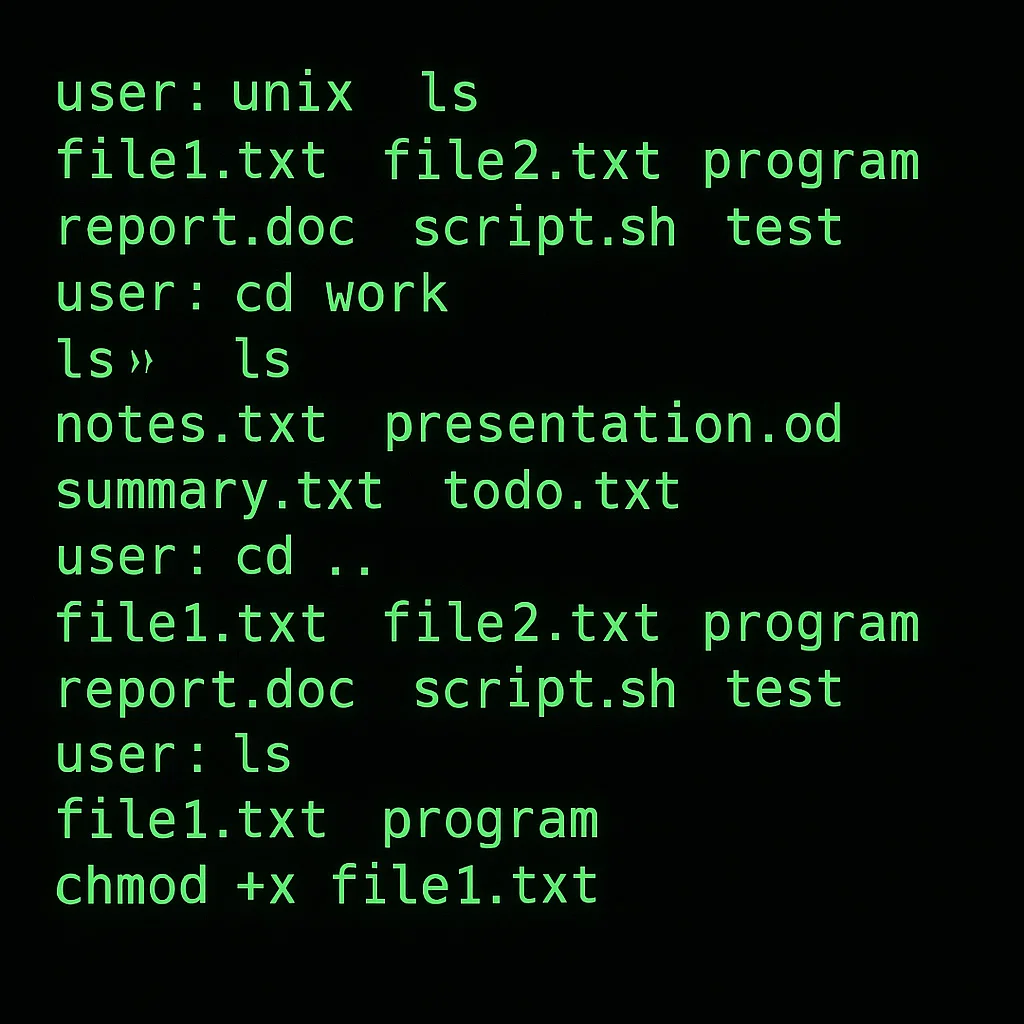
Unix depends much on its command-line interface (CLI), and some regard it as one of the strongest features. The CLI enables the users to use text commands to access the operating system giving a fine-grained control of the system. Although present-day operating systems, such as Windows and macOS, have graphical user interfaces (GUIs), the CLI is still indispensable to developers, system administrators, and power users who may require completing some complex tasks as fast and efficiently as possible.
File System Hierarchy
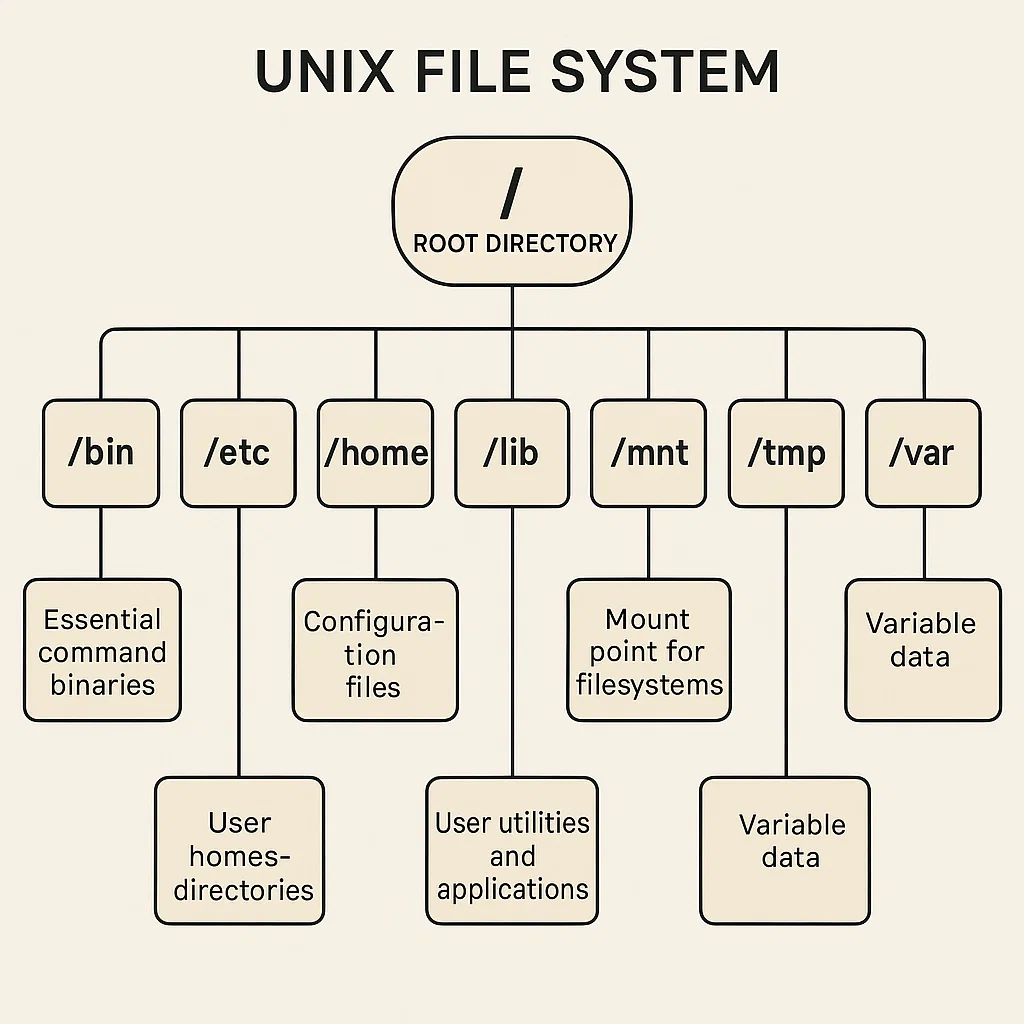
Unix has a hierarchical file system, with files being arranged in directories which may have directories within them. It is a straightforward but strong structure and can be used easily by users to navigate and manipulate high volumes of files. The starting point of all the files and directories is the root directory (/). The file system is also made to be flexible and portable and therefore is capable of being modified in accordance to other types of hardware and also environments.
Security and Permissions
Unix offers a high level of security which is facilitated by user and group permission system. Every file and a directory in the Unix file system has the associated permissions that identify the users who have access to the files or can either read them or write them or both. This system aids in safeguarding files against unauthorized access and enables the system administrators to regulate what can be done on the system by which user.
Networking Support
Unix was designed with networking Enterprise. It had become one of the earliest operating systems to have an in-built networking stack which enabled the Unix systems to connect to one another across a network. This aspect attracted Unix to be a favorite server and intricate protocols such as TCP/IP were developed that are the standard mode on the internet.
Influence of Unix on Operating Systems in the Modern World
The principles and features of Unix design have significantly impacted the modern operating systems, particularly Linux and macOS.
Linux
Linux is a Unix-like operating system and was created by Linus Torvalds in 1991 and it has become very popular among the server and open-source communities. Linux has much in common with the main concepts of Unix such as command-line interface, hierarchical file system, and ability to multitask. It can also be customized in a very high way and this aspect makes it appealing among developers and system administrators.
macOS
Another Unix-based operating system, macOS is based on a Unix like platform called Darwin, and has many of the same features as Unix, including a powerful command-line interface and a hierarchical file system. macOS also integrates into the Unix powerhouse of Unix-based systems, allowing its users interact with Unix tools through its terminal.
Why Developers Have Not Yet Lost their Unix
Although there has been an emergence of easy-to-use operating systems, such as windows, programmers and system administrators still depend on Unix and its concepts. The following are some of the reasons why Unix is still applicable today:
Stunning Command-Line Interface
Unix command-line can be described as very powerful and efficient. Although GUIs are excellent when a user is unconcerned with speed and flexibility, developers and system administrators like the speed and flexibility of the CLI when complex tasks are involved. It enables them to work faster and exercise more control of the system.
Stability and Reliability
The Unix systems are characterized by stability and reliability. This is why they are a favourite in servers with uptime being critical. Unix-based OS such as Linux and macOS are also reputable to be secure, and thus the most suitable operating system in systems where data integrity and security are critical.
Customizability
Unix based systems are very customizable. The developers are able to modify the system according to their needs and make amendments. This can be particularly useful in server environments, where efficiency and performance are very important.
Open Source Community
Linux is Unix-based and is frequently open-source; meaning that the source code can be viewed, edited and contributed by system developers. This has resulted in the emergence of colorful open-source communities which have maintained and enhanced the Unix principles of improvement and innovation.
Conclusion
The historical importance, the main characteristics and philosophy of Unix have continued to influence the current evolution of operating systems. Its simplicity, multitasking features and robust command-line interface are what make it an excellent fit to developers and system administrators. Unix systems such as Linux and macOS systems today still reflect the values of simplicity and efficiency and flexibility which Unix introduced. With the knowledge of history and philosophy of Unix, a new user can realize the power and value of this base technology.