Stories in any newsroom (digital, print or broadcast) can be divided into two large categories: hard and soft news. These classifications assist journalists to make decisions about tone, structure as well as how best to pass information to their audiences. It is important not only to reporters but also to the readers to understand the distinction in order to make their way in the complex world of information today.
To students, would-be journalists, content creators, and the general reader, the difference provides some insight into why some stories seem urgent and others seem more narrative or emotional. To further learn about the hard vs soft news, you may also refer to this detailed research outline.
What Is Hard News?
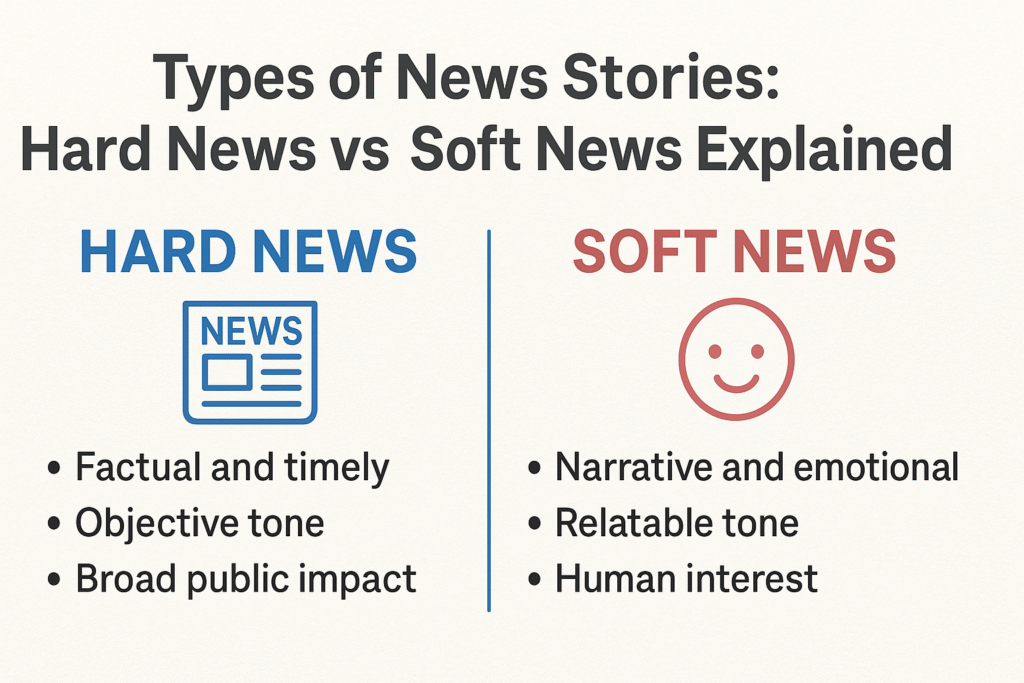
Hard news is concerned with facts, timely and consequential information. Such are stories that have a direct effect as they affect the making of decisions by the public, policies, safety, or the economy. Hard news deals with events that are in the process of happening, occurring or those that are of great influence to the people.
Hard News Features
Hard news usually shows the following characteristics:
1. Time-Sensitive and Straightforward
The hard news items are usually posted when the verified information is available. An example is news about an election outcome, a policy change by the government, a natural catastrophe or a huge accident. Each element is important as readers desire to know and understand swiftly.
2. Inverted Pyramid Structure
This building puts the most significant information at the head. The journalists provide the key questions, namely, who, what, when, where, why, and how, in the first several sentences. This format makes sure that even the readers who only read the first paragraph are aware of the main point.
3. Objective Tone
The hard news does not use emotive words. It is an impersonal, factual and neutral tone. Facts shown by reporters are confirmed, and the readers are not influenced by these facts and can therefore interpret them in a way they want.
4. Broad Public Impact
Hard news is known to influence masses of individuals. The category includes stories of how the government can make one decision or another, public health matters, security threats, business happenings, and international relations, since they influence the lives of people.
Examples Hard News Stories
Politics
Political hard news comprises election news, legislative rulings, policy news and official governmental proclamations.
Example:
“The federal government announces an abrupt alteration in the policy regarding fuel subsidy, and the country reacts to it and has to change the market accordingly.”
In a case like that, the task that the reporter has is to give real-time, confirmed information. The lead should also communicate the alteration and the person announcing the change, the reason as to why the announcement is important and the next step.
Business and Economy
Business hard news reports involve inflation, big company mergers, stock market fluctuations and monetary rules.
Example:
“The interest rates are increased by a central bank when the rates have soared for three months in a row.”
In this case, it is about accuracy and clarity. The reader or viewer anticipates data on the industry, professional commentary, and information on its effect on consumers or investors.
Public Safety and Security
“Crime news, accidents, natural disasters or security operations are clearly hard news.”
Example:
“There is a serious flood that displaces people, and this aids a government emergency reaction.”
Reporters should consult credible sources that include emergency agencies, eyewitnessess, and official releases in order to prevent misinformation.
Sports (Hard News Angle)
Sports are also capable of producing hard news, particularly when the news story involves urgent or consequential information.
Example:
“A coach of a national team quits without any notice a few hours before a championship game.”
It is not entertainment reporting, but it is concerned with what happens to competitions, players and fans in the immediate future.
What Is Soft News?
Soft news is more human-driven, entertaining, lifestyle-based, cultural and feature-oriented. These tales do not necessarily have an urgent connection. Rather, they seek to appeal to emotions, give some background, or seek some personal experience.
Soft News Characteristics
Soft news stories are likely to have the following qualities:
1. Narrative Structure or Descriptive Structure
Soft news, in contrast to the inverted pyramid, usually proceeds more like a feature, with the narrative elements of anecdotes, scenes of description, and a slow pace. Authors can use a hook to start with something interesting and then proceed to present an idea.
2. Emotional or Relatable Tone
Softer news is written in a more interesting language. Due to the subject matter, the tone can be either warm, reflective, humorous, or inspirational. Although the factual accuracy is paramount, the emotional dimension of the stories is what makes them interesting.
3. Concentrate on the people and not only on the events
Human-interest stories emphasize people, groups of people or peculiar incidents. This is aimed at reaching the readers on a personal level instead of updating them quickly.
4. Evergreen Content
Certain soft news can last longer before becoming obsolete such as guides to living a good life, profiles of celebrities or those who have succeeded in life, features and long stories and cultural commentaries.
Soft News Story Examples
Entertainment
Entertainment news consists of celebrity news, reviews on movies, the release of music and backstage news.
Example:
“An article about how a famous actress was getting ready to play in a biographical movie.”
This work is about personality, preparation and emotions, not urgent decisions of the population.
Sports (Soft News Angle)
Sports news becomes human interest, inspirational, and hence, soft news.
Example:
“A portrait of a young athlete who had to struggle to become a national champion.”
It is focused on narrative and not statistics or schedules.
Lifestyle and Culture
Some of the life stories covered include food, travel, fashion, relationships, health and cultural trends.
Example:
“An article that explores the way a new exercise craze is impacting the lifestyles of city workers.”
These are entertaining and informative stories that are not pressured by events of the day.
Human-Interest Stories
Human-interest news attracts focus to real-life experiences which are emotionally touching.
Example:
“A story on a community outreach to reconstruct a local library which had been destroyed by fire.”
These stories emphasize fortitude, empathy, or creativity.
The Decision-Making Process of Journalists between Hard and Soft News
There are various factors which journalists consider when figuring out how to relate to a story. A similar story may be covered in a hard news or soft news based on the call of the day, the approach taken and the targeted audience.
Purpose of the Story
When it is aimed to inform the population about the urgent situation development, it turns out to be hard news. Soft news is more appropriate in case the aim is to motivate or entertain.
Audience Expectations
The news, usually general, audiences will want to receive timely information, whereas the readers of magazines or features want something in-depth, emotional, and creative.
For example:
- The coverage of a presidential election is hard news published in a newspaper.
- The implications of the election to young voters are discussed in a weekend magazine (soft news).
Tone and Voice
- An article about hard news maintains brevity and factuality of the sentences: According to the confirmation of the officials, the highway will be closed until it is repaired.
- A soft news story permits a descriptive language: The former is apparently being quoted, “The highway that used to be busy now feels strangely silent with machines gliding in the dusty afternoon,” says resident.
Sources and Verification of Hard vs. Soft News
Both the hard and soft news are to be verified but the sources vary:
- Hard news is very dependent on documents, experts, and data, which are official.
- There is soft news that can consist of personal narratives, interviews, observational information and emotional narratives.
Structure
- Hard news – Inverted pyramid
- Soft news – Narrative, thematic or chronological.
Why the Difference Between Hard vs. Soft News Counts in the Current Media Scene
The digital age has blurred the distinction between hard and soft news. Algorithms do not care about accuracy, they concentrate on attention. Social media promotes emotional content, and this spreads soft news forms even on serious topics.
Hard News Defends Public Enlightenment
Proper hard news will allow people to vote wisely, make economic decisions and be aware of their safety. In its absence, societies will not be able to put leaders on the carpet.
Soft News Builds Connection
Soft news makes the reader appreciate the human aspect of the events. It offers an escape from the crisis-stuffed reporting and gives emphasis to the stories of resilience, creativity and culture.
Both Work Together
To have a complete media ecosystem, it must have:
- Hard news of factual foundation.
- Soft news for human context
As an illustration: in the time of a big national emergency, Hard news will provide numbers of casualties, official reactions and precautionary measures.
Soft news puts emphasis on the experience of the survivors, volunteer activities and the emotional story of the community.
The Conventional Fallacies on Hard and Soft News
Hard News is More Important
In as much as hard news is necessary, soft news contributes immensely to the values of society and enhances empathy among people.
Soft News is Entertainment Always
Entertainment as well as culture, community stories, and in-depth features are all included in soft news.
Soft News Does Not Involve Research
This is false. A simple breaking story might not need as much interviewing, background reading, and narrative planning as soft news.
Hard News is not a Place Where Creativity is Welcome
Although the tone is neutral, it is good hard news reporting that requires creativity in finding sources, clarity in making a statement, and accuracy in organizing information.
Final Thoughts
Hard and soft news continues to be a guiding model for all journalists around the world today. Hard news presents information which impacts the lives of people at the right time, is confirmed along with timeliness, whereas soft news gives emotion, depth and human touch. Both serve the purpose of the reader better when the reason is known why each style was employed.
The aspiring journalists who learn both methods are multi-purpose and their work is able to educate, motivate, and gain the trust of the people.