Introduction
The unique example of biological engineering is the human tooth, which is both strong, resilient, and functional. The center of this strength is enamel which is the layer covering the top of the tooth and the hardness of the human body. Although enamel is much stronger, it is also distinctly fragile: once it has been damaged, it is impossible to regenerate it. This contradiction highlights the significance of learning about the physiology of enamel, the formation of enamel, and the ways of preserving its integrity.
Enamel does not just offer a physical shield against the adverse conditions of the mouth cavity, but it also is an important part of preserving the supporting dentin and pulp tissue against mechanical and chemical injuries. This paper discusses the formation of enamel (amelogenesis), the microstructure of enamel, and the importance of enamel in factors that protect teeth that cannot be replaced by other materials – and what can be done in practice to maintain this valuable coat.
The Physiology of Enamel
The physiology of enamel is a complex, strictly controlled process called amelogenesis, that takes place in the development of the tooth. Enamel stands out as one of the body tissues since it is acellular, avascular, and non-regenerative. When thoroughly developed it has lost the living cells to heal or restore itself.
The development of enamel requires the presence of specialized cells known as ameloblasts and these cells produce enamel matrix proteins, which are subsequently mineralized to make up the mature enamel structure. These are proteins; predominantly amelogenin, amelolin and ameloblastin that direct the development and arrangement of the hydroxyapatite crystals – the mineral constituents that make enamel its unparalleled hardness.
Stages of Amelogenesis
The process of amelogenesis follows a number of highly organized steps, each of which leads to the structural and chemical integrity of the enamel.
Pre-secretory Stage
During the first stage, the ameloblasts develop out of dental epithelial cells. This change is initiated by the contact between the enamel organ and the cells that constitute the dentin (odontoblasts). The ameloblasts come to the point of secretory preparation by synthesizing enamel matrix proteins and secreting them.
Secretory Stage
At this phase, ameloblasts actively release enamel matrix proteins creating a soft scaffold, which is partly mineralized. Its matrix is mainly made up of amelogenin that determines the alignment and the arrangement of hydroxyapatite crystals. Thin mineral stripes start to form and extend with the maturity of the enamel.
Enamel prismatic structure is also determined by its secretory phase. These ameloblasts then slide off of the dentin surface in a periodical fashion creating enamel rods (or prisms), as well as interrod substance, which combine to produce the typical microarchitecture of enamel.
Transitional and Maturation Period
The phase of transition is a transition in between the secretion of the matrix and the mineralization. The ameloblasts slow down their secretory activity and start to dissolve organic matter and water in the growing enamel.
During the maturation phase, the mineralization is the greatest, hydroxyapatite crystals become wider and thicker to fill nearly the whole volume of enamel. In this stage, the enamel is the hardest tissue in the human body, which is more than 95 percent inorganic mineral, and traces of organic components and water.
After the formation of the enamel is finished, the ameloblasts enter the process of apoptosis (programmed cell death), making the enamel layer inert and unable to repair itself.
Composition of Enamel Structurally
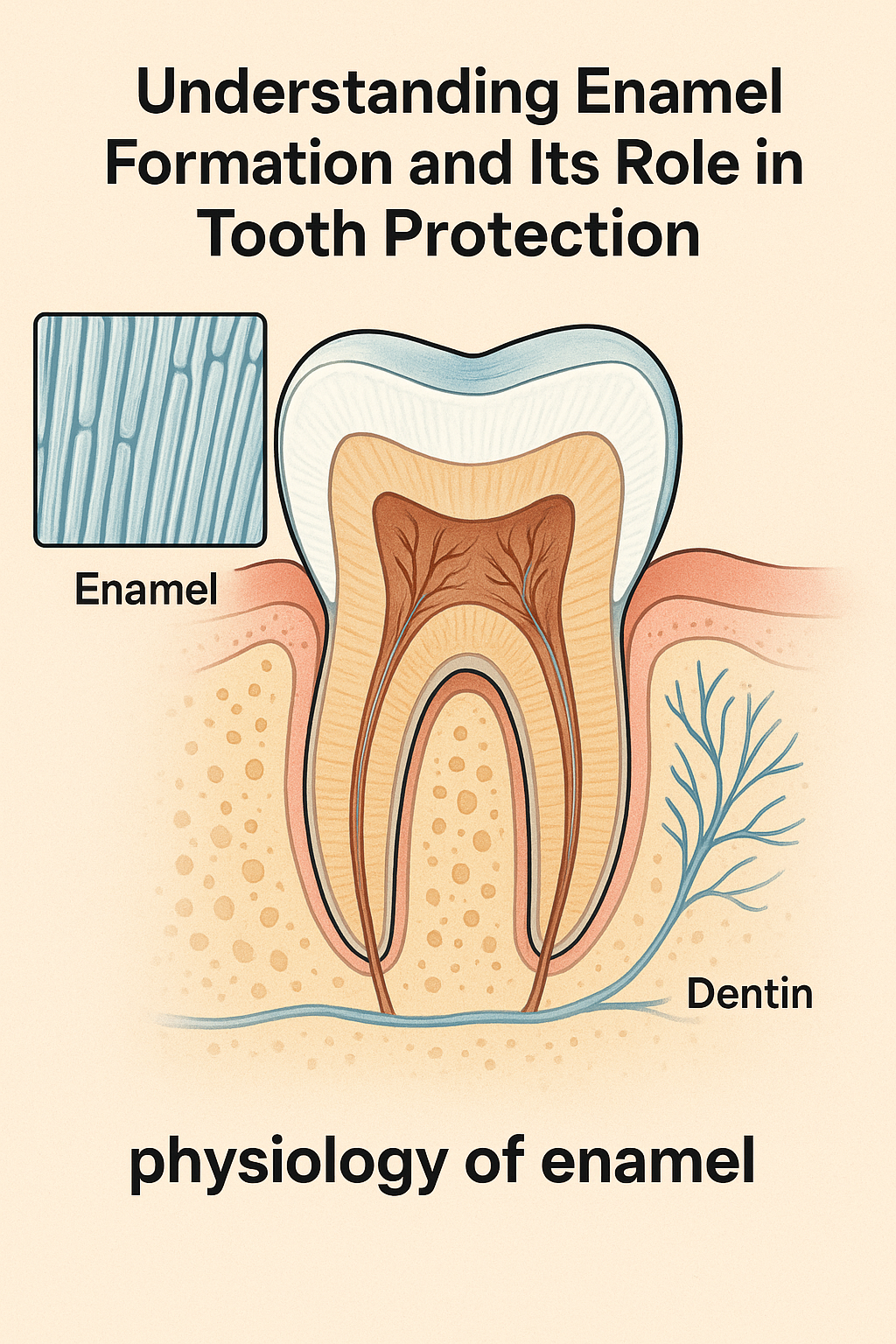
The high degree of mechanical properties exhibited by enamel is a result of a highly complex microscopic structure. Though smooth and glossy to the naked eye, when a microscope is used, enamel is a complex and hierarchically organized material whose major features comprise the following:
Enamel Rods (Prisms)
These are short and narrow structures that consist of hydroxyapatite crystals that are oriented in a certain direction. They each have a rod running out of the dentinoenamel junction (DEJ) to the enamel surface which ensures that it is as strong as possible.
Interrod Enamel
This material is found between the enamel rods and serves to hold the rods together with slight variations in crystal orientation which aids in the resistance of cracks propagation exhibited by enamel.
Hydroxyapatite Crystals
The inorganic structure of enamel is mostly calcium phosphate that exists in the form of hydroxyapatite (Ca10(PO4)6(OH)2. It is these crystals that are tightly wedded together which makes enamel hard and brittle. Trace elements are able to be incorporated into the crystalline structure, such as fluoride, in the form of fluorapatite which increases the acid-solubility resistance.
Dentinoenamel Junction (DEJ)
DEJ is the contact between the enamel and the dentin, and it functions like a shock absorber, which prevents the fracture of enamel under the impact of chewing forces. It has a wavy formation that evenly spreads the stress, preventing the cracks in the enamel.
Elastic Use of Enamel in Tooth Protection.
The major role of enamel is to shield the underlying dentin and pulp against extrinsic insults, mechanical, chemical and microbial.
Mechanical Protection
The tooth is covered by enamel which protects the tooth against wear due to mastication, biting and grinding. It is too hard (approximately rated 5 on the Mohs scale) to deform under repetitive forces.
Chemical Resistance
Enamel gives the protection against acidic challenges of food or bacterial metabolism. The thick crystals of hydroxyapatite cause it to be hard to dissolve, however too much exposure of acid may cause demineralization; the initial process of tooth decay.
Sensory and Thermal Insulation
Since enamel is non-living and contains no nerve fibers it has the effect of being an insulating barrier, so that temperature and chemical sensitivity do not enter the dental pulp.
Aesthetic and Utilitarian Function
Enamel is another tissue in the tooth that makes the tooth appear; it also defines the color and translucency of the tooth. Its smooth surface is also resistant to the bacteria adhesion thus ensuring the maintenance of oral hygiene.
The reason why Enamel fails to regenerate
This is one of the major drawbacks of enamel since it cannot regenerate once lost. This is mainly because the ameloblasts which do the formation of it disappear after the eruption of the teeth. In the absence of these cells, the body is unable to do its biological replacement and repair of enamel.
Small holes in enamels can be recovered by means of saliva and fluoride that restock minerals in the disintegrated regions. But this is a superficial mending and not real regeneration. Erosion, decay or deep cracks demand restorative dental treatments including fillings, sealants or crowns.
Contributing Factors that cause Enamel Loss
The gradual wear or demineralization of enamel is caused by several factors which include:
- Acidic Foods and Beverages: Often taking in citrus juices, soft drinks and products with vinegar causes the erosion of enamel after a time.
- Bruxism (Teeth Grinding): When there is a lot of mechanical stress then the enamel can be worn down.
- Poor Oral Hygiene: The plaque that is built up causes acids which dissolve the enamels.
- Gastroesophageal Reflux Disease (GERD): The exposure of the enamel to the stomach acid may be eroded chemically.
- Dry Mouth (Xerostomia): Reduction in the amount of saliva lowers the remineralization potential.
Incidents to Preserve Enamel Integrity
Although the enamel is unable to regenerate, its preservation is completely possible by means of good oral hygiene and lifestyle.
Fluoride Application
Fluoride enhances the strength of the enamel because it stimulates the formation of fluorapatite that is acid-resistant compared to hydroxyapatite. Application of fluoride toothpaste or mouth rinses is an effective way of preventing the occurrence of cavities.
Balanced Diet
Remineralization is maintained by the use of a diet rich in calcium, phosphate, and vitamin D. Snacks that disturb the pH of the mouth such as sweet or acidic foods should be avoided regularly.
Proper Oral Hygiene
Frequent (twice daily) brushing of the teeth with soft-bristled toothbrush and non-abrasive toothpaste is recommended to eliminate the plaque without enamel erosion. Flossing removes the places between teeth that are inaccessible to brushing.
Regular Dental Checkups
Regular professional cleaning and check-up allow the detection of the initial symptoms of enamel erosion or decay before they are not removable.
Prophylactic Interventions of Bruxism
A nightguard will reduce mechanical wear among individuals with sleep-grinding.
Adequate Saliva Production
Saliva is necessary to neutralize acid and provide minerals that help to maintain the enamel. The saliva flow can be promoted by drinking water and chewing of sugar-free gum.
The rate of Enamel Regeneration Research progress
As much as enamel cannot regenerate itself, the role of biomimetic in regenerating enamel properties is also under investigation by modern dental research. Amelogenin-inspired peptides, nanomaterials using calcium-phosphate and stem cell-derived ameloblast-like cells are all being tested by scientists to stimulate enamel remineralization.
Some promising research findings indicate that soon, synthetic coats of enamel or bioengineered enamel will be able to revolutionize restorative dentistry whereby tooth surfaces can actually be repaired biologically. These technologies are however at the developmental stages and are yet to be made available clinically.
Conclusion
Enamel is a miracle of precision in nature; it is a mineralized tissue which integrates toughness, hardiness and aestheticism. The physiology of enamel and its development by amelogenesis makes it clear why this shell is so strong and indispensable.
The enamel is not reproducible once lost and thus preventive care is necessary. Good oral health, balanced diet, fluoride, and frequent check-ups of your teeth are a sure way of protecting enamel meaning that your diet and health will be healthy in the long term.
Regeneration of the enamel can be one of the dreams that could come true in the future with the development of the science of dentistry. To date, the most effective way of keeping healthy, strong and beautiful teeth is to preserve the enamel we have, in order to have a lifetime of healthy teeth.

Really insightful post — Your article is very clearly written, i enjoyed reading it, can i ask you a question? you can also checkout this newbies in classied. iswap24.com. thank you