Healthcare training is shifting from episodic skills checkoffs to continuous, systems-level learning. Modern educators want more than impressive manikins; they need a framework that links basic technique with clinical reasoning, human factors, and team communication—then proves progress with data. This article outlines a practical blueprint for building that framework and shows where an integrated ecosystem like medvision health solutions fits naturally into every stage.
Map backwards from bedside behaviors
Great programs start with the end in mind: what clinicians should do, say, and decide at the bedside. List the behaviors most correlated with safety and patient flow—timely oxygenation, earlier sepsis recognition, precise medication checks, clean handoffs, calm code leadership. Translate those into observable actions and checkpoints, then design scenarios that force learners to demonstrate them under realistic constraints.
A simple conversion table helps:
- Behavior → Trigger → Required action → Time budget → Evidence.
- Example: “Recognize shock” → hypotension after bleeding → activate rapid transfusion + titrate vasopressors → 3 minutes → device logs, timestamps, and debrief notes.
When scenarios are anchored to behaviors and time budgets, technology stops being a spectacle and becomes a measurement tool.
Build a learning spine that compounds
The most reliable programs run on a repeatable learning spine. Think of it like a conveyor that moves learners from isolated technique to coordinated performance:
- Micro-skills: short, high-frequency reps on targeted procedures with immediate feedback.
- Context drills: physiology-driven cases on high-fidelity patients where actions change the trajectory.
- Team events: interprofessional scenarios with role clarity, device use, and human-factor stressors.
- Structured debrief: objective logs and concise coaching that extract two “keep” behaviors and two “change” behaviors.
- Spaced repetition: micro-reps within two weeks so gains stick.
An integrated platform pays off here. When task trainers, patient simulators, laparoscopic systems, and ultrasound share a common language for actions and results, the spine runs without friction.
Choose modalities by the job to be done
Simulation tools earn their place by doing a specific job better than any alternative:
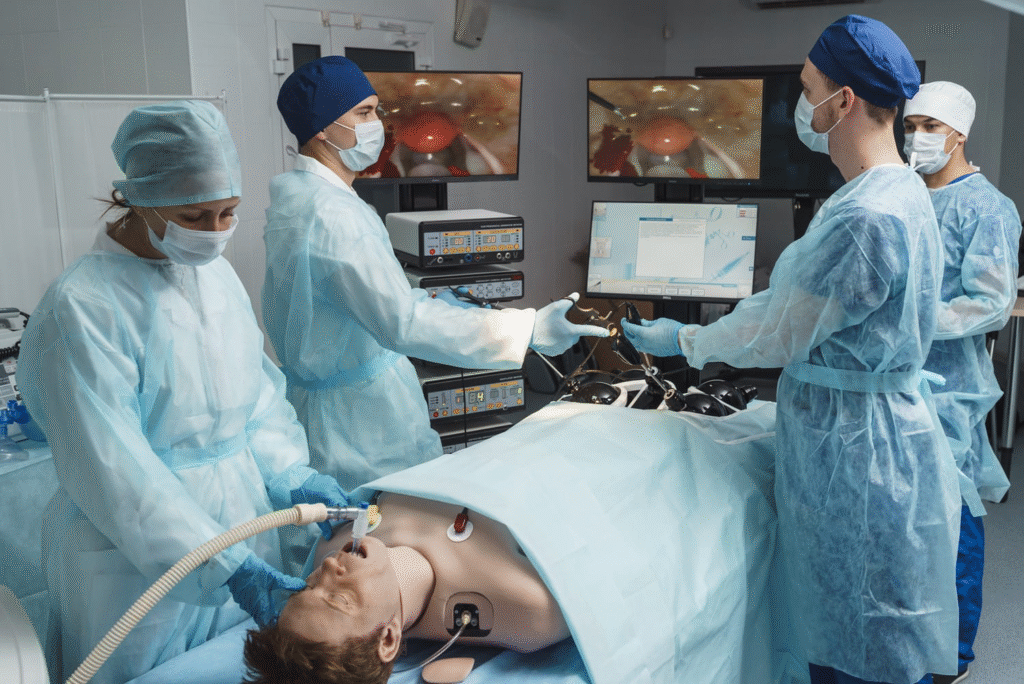
- High-fidelity patient simulators handle recognition-and-response work: respiratory failure, arrhythmias, hemorrhage, anaphylaxis. Device compatibility with real ventilators, monitors, and defibrillators preserves muscle memory and credibility.
- Minimally invasive surgery trainers build bimanual coordination, depth perception, and economy of motion. Haptic feedback and reliable metrics (errors, path length, time on task) show progress without faculty holding a stopwatch.
- Ultrasound trainers develop pattern recognition and probe discipline. Case variety and image fidelity matter more than flashy menus.
- Maternal–neonatal modules prepare teams for high-acuity, low-frequency events where timing and teamwork decide outcomes.
The advantage of a single ecosystem is continuity: learners don’t have to relearn interfaces, and faculty don’t need separate playbooks for every room.
Make debrief the engine of change
Debrief converts activity into learning. Treat it like a focused quality huddle:
- Anchor to data: surface key timestamps and device states first.
- Reconstruct the mental model: ask what learners believed was happening and how that shaped choices.
- Connect actions to physiology: highlight where a step changed the patient’s trajectory.
- Commitments, not essays: two actions to keep, two to adjust, plus the moment to apply them next time.
Objective capture—airway attempts, drug administrations, shocks delivered, ventilator changes—moves debrief from opinion to evidence and builds trust in the process.
Run the program like a clinical service
Operational reliability matters as much as pedagogy. Treat simulation like clinical infrastructure, not event entertainment.
- Uptime discipline: quarterly preventive maintenance, documented replacement cycles for high-wear parts, version control on firmware and scenarios.
- Room logistics: a clear equipment triangle (monitor–ventilator–airway cart), ceiling mics, a movable camera, and lockable carts with color-coded bins for fast resets.
- Faculty rescue cards: one-page guides for quick fixes that prevent canceled sessions.
- Throughput math: standard 10-minute reset checklists, rolling stations, and scheduled micro-reps to serve large cohorts without overtime.
Programs that feel predictable earn faculty adoption and learner confidence.
Measure what matters and publish it
Collect a small set of metrics that narrate progress without drowning staff:
Process: time to first assessment, oxygenation, first defibrillation, vasopressor start, antibiotic administration; adherence to sepsis and hemorrhage bundles.
Teamwork: rate of closed-loop communication, role clarity scores, handoff completeness.
Learning outcomes: OSCE pass rates, remediation volume and recurrence, scenario difficulty progression.
Operations: equipment uptime, average reset time, sessions delivered per faculty hour.
Share a one-page dashboard each term. Visibility unlocks sustained support and budget continuity.
A 90-day rollout that actually works
Launching or relaunching a simulation program does not require a mega-center. Use this cadence:
- Weeks 1–2: Identify five bedside behaviors to improve. Draft scenarios and checklists.
- Weeks 3–4: Convert a standard classroom into a sim space; validate audio, video, and recording.
- Weeks 5–6: Commission simulators; connect real devices; test logging; train two super-users.
- Weeks 7–8: Pilot with small cohorts; refine cues and debrief rubrics.
- Weeks 9–10: Faculty workshops on coaching language, human factors, and rapid feedback.
- Weeks 11–12: Go live with micro-reps embedded into existing courses. Start the dashboard.
- Weeks 13+: Add team events and expand to satellite cohorts with portable kits.
A coherent platform reduces the integration burden so most energy goes to teaching rather than troubleshooting.
Where an integrated ecosystem pays dividends
Choosing a unified stack pays off in five tangible ways:
- Skill transfer: real-device compatibility keeps the feel of ventilators, defibrillators, and monitors consistent across training and practice.
- Consistency: one interface, one reporting model, one playbook—less cognitive load for learners and faculty.
- Scalability: portable stations for outreach and night-shift cohorts; turnkey rooms for flagship scenarios.
- Analytics: cross-modality action logs create a longitudinal record of competence.
- Support: installation, commissioning, and service under one umbrella shrink downtime and finger-pointing.
These dividends compound over time, especially when cohorts grow and accreditation cycles demand clean evidence.
Budget where it moves the needle
When resources are finite, prioritize:
- Scenario authoring and faculty development: a sharp scenario template outlasts hardware generations.
- Consumables that boost realism: appropriate tubing, believable fluids, credible ultrasound presets.
- Data pipelines: easy exports to LMS and e-portfolios; clean archiving for audits.
- Service agreements: predictable support prevents schedule collapse.
Cut back on one-off gadgets that don’t feed the learning spine or the dashboard.
The strategic case for coherence
Hospitals and universities do not need a museum of devices; they need a system that steadily produces clinicians who recognize danger sooner, communicate more clearly, and coordinate under pressure. An ecosystem built around medvision health solutions offers that coherence—high-fidelity patient care, procedural skill building with tactile feedback, ultrasound interpretation, and room integration—so programs can concentrate on outcomes, not orchestration.
Bottom line: design from bedside behaviors backward, run a spine of micro-skills to team events, debrief with data, and treat operations like clinical infrastructure. With those pieces in place, simulation stops being an occasional spectacle and becomes the quiet engine of clinical readiness.