Imagine a time when the most important idea of yours, or a most deep feeling, or a most important teaching of yours is lost, twisted, misunderstood, or even ignored. It is nothing bizarre; it is what occurs on a daily basis in the communication process, especially when there is a failure to communicate.
Yes, we chat, we message, we stream, but that is all most people know about the straightforward processes of how a thought transfers between one brain and another.
Communication is not merely talking; it is the silent network of influence, the invisible engine that drives companies, settles disputes and gets any deal done. When you are new to media, business, or any work requiring you to share meaning, the ability to know and master the communication process is your greatest asset.
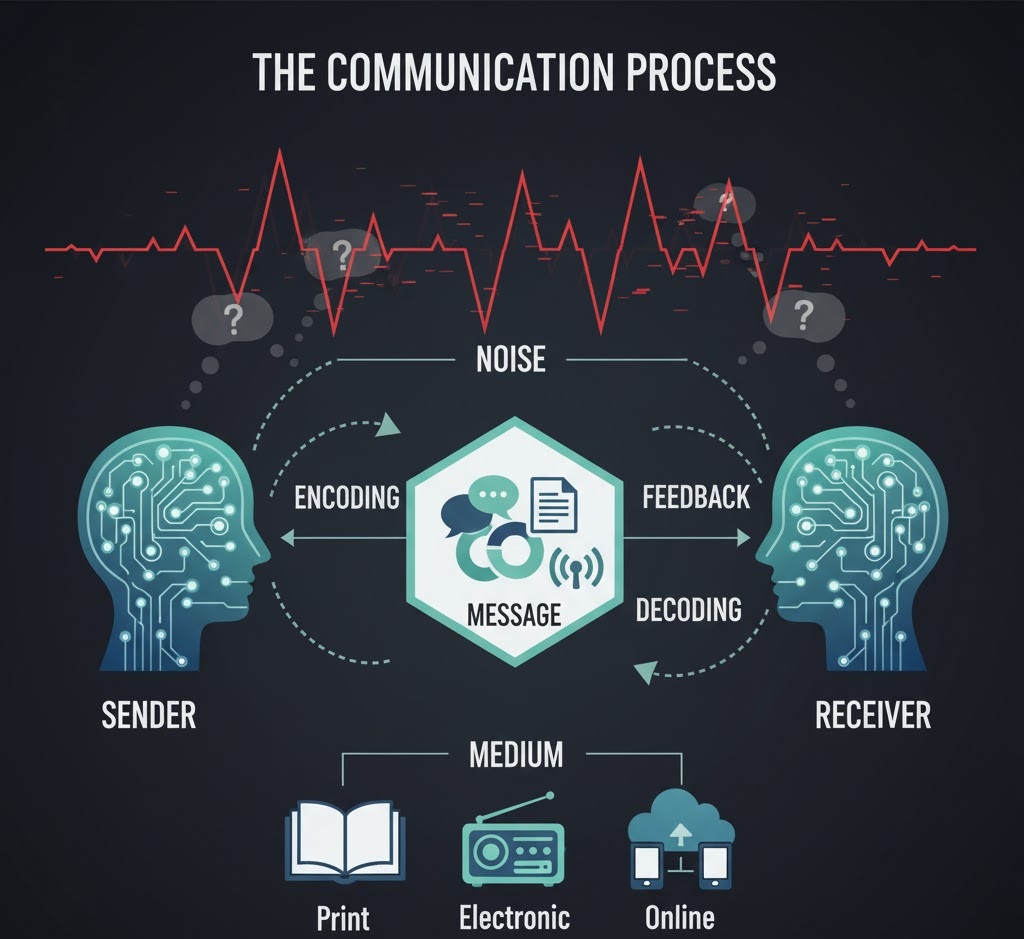
In this article, you will be presented with the fundamental actions of this critical system and be provided with a roadmap for a beginner to the information flow. To understand the simple mechanics of the communication process, we will unpack the various components: the Sender, the Message, the Medium (or Channel), the Receiver, Feedback and the ever-present issue of Noise.
Viewing the process as a place where something can go awry, rather than a chain, you will be able to develop messages that not only arrive at their destination, but get there precisely where they are supposed to, ensuring that your voice is not just heard, but clearly understood.
The Main Elements of the Communicating Process
The communication model begins when an individual chooses to express something or a feeling. It simply ceases with the achievement of the initial aim or failure. These four initial sections are the fundamental components required to launch some bit of information into the world.
The Sender and Encoding: The Starter
The point of origin of the message is the Sender (also known as the source). The idea or information is first conceived by this person or group, and the entire process therefore starts. Encoding is the full responsibility of the Sender.
Encoding is the process of transforming the idea, thought or feeling into simple symbols such as words, hand signs, pictures or electronic symbols which can be understood by the other person. This transformation is defined significantly by what the Sender already knows, their culture, and their emotions.
The Sender in mass communication can be a huge entity, such as a news company. The principles of good encoding are based on a very simple rule: the symbols used should share a common meaning with the Receiver. With a poorly coded message, with words that no one knows, and images which are confusing, the message will fail even before it begins. The Sender would have to make an educated guess on how the Receiver is going to decode the message. This action concerns preparing the thought to travel.
The Content: Message
The actual thing that the Sender wants to send is the Message. It is the physical form of the thought. It is not merely the words but it is also the symbols, sounds, pictures or body language that accompany the words.
A Message has a few layers:
- Content: The primary facts, views, or emotions being conveyed.
- Code: The code is the system of symbols, with which the content is sent (such as the English language).
- Treatment/Style: The manner in which the content is given out (funny, serious or neutral). The way a message is dressed may completely alter the reception of the message even when the facts are the same.
In mass media, the Message is scrutinized and vetted prior to transmission. One of the challenges of mass communication is that the Message should be understandable to a very large number of diverse people, and so it must use simple language and shared styles, otherwise it might be misinterpreted by many people.
The Path: Medium
The Medium (or Channel) is the route which the Message is conveyed by the Sender to the Receiver. It is the medium between the two terminals of the process. The selection of the appropriate medium is important, since the path can restrict or enhance the power of the Message itself.
Media channels can be direct, personal (such as face-to-face communication) and complex, high-technology systems of mass communication:
- Print: Newspapers, books. These are non-volatile yet fail to provide rapid feedback.
- Electronic: Radio, TV. These have excellent viewing capabilities and audio, but have been known to provide slow feedback.
- Online: The web, social network. These are very fast, they cover the entire globe and enable feedback, two-way within a short time.
The message is usually altered by the medium. An intelligent Sender will always align the path with the content of the message and ensure that the channel is useful, not detrimental, to the end.
The Target: Receiver and Decoding
The Receiver is the individual or the group receiving the Message. Their work is centered on decoding.
Decoding is a type of thinking in which the Receiver takes the symbols and signals that the Sender sends and reverses them into an idea. In the same way that encoding relies on the beliefs of the Sender, decoding is filtered through the beliefs, experiences, values, and knowledge of the Receiver.
The principle of common ground states that communication is only effective when there is a similarity in the field of experience between the Sender and the Receiver. When the Sender employs words that are not known to the Receiver, the message will be interpreted in a different way than intended.
The Receiver in mass communication is the Audience. This is a large, heterogeneous, and dispersed audience. The multiplicity of a mass audience renders flawless decoding a highly challenging task, which frequently results in numerous variants of interpreting the sole Message.
Closing the Loop in Communication Process: Feedback

Communication process is not a one-way traffic. The last step provides us with the means to see whether the aim of the Sender was achieved.
The Receiver responds to the Message with feedback. It is the important section that transforms the one-way communication model into a circular one. Feedback informs the Sender whether the message was received and comprehended, and what the Receiver said about it.
Feedback can be:
- Immediate vs. Slow Immediate (a nod) in a talk; slow (sales numbers) in old media. Digital media has become a source of instant and mass feedback (likes, comments).
- Words vs. Actions: Verbal vs. Non-verbal (body or actions such as purchasing the item).
The reason why feedback is so essential is that it allows the Sender to amend and repair the messages he or she is going to send out next, a process known as correction. The Sender is operating blindly without good feedback. To become better, senders need to know how to read and utilize this data.
The Trouble Makers in Communication Process: Noise and Misunderstanding
Although the five elements mentioned above seek to bring about clarity, the sixth element Noise is the active antagonist. Noise can be considered as anything that prevents the passage of the message or the making of the correct interpretation.
The Interruption: Noise in Communication Process
The issue in the processing of communication is noise. It is that which interrupts the stream or the clarity of the communication striking either of the encoding to decoding processes.
Types of Noise
- Physical Noise: Real noise or distraction by the surroundings such as a loud truck, phone static, or a poor internet connection.
- Psychological Noise (Internal): Noise within the mind of the Sender or Receiver, i.e. worrying, feeling sleepy or having a strong belief that prevents new thoughts.
- Semantic Noise: Occurs when the language or symbols themselves are misinterpreted, most of the time, because of special, unknown words or slang.
- Cultural Noise: This happens when messages are interpreted in various cultural perceptions, and it results in huge errors (e.g., a hand sign with different interpretations).
In mass communication, noise probability is enormous. This continuous distraction requires senders to struggle with it by ensuring that their messages are concise and repeated.
Why Decoding Goes Wrong
When noise is not contained, then misunderstanding and distortion occur. This breakdown happens when there is a huge difference between the message that is received and the message that was sent.
There are three internal noise mental filters that receivers frequently employ:
- Selective Exposure: Selective exposure involves choosing only to see messages that support your prior beliefs. This creates “echo chambers.”
- Selective Attention: The decision to pay attention to a tiny portion of a message and disregard the rest of it.
- Selective Retention: This involves picking out what to remember of a message and ignoring everything else.
These psychological decisions imply that a message, no matter how well it is sent, will be altered by the Receiver to accommodate their current perception of the world. Misinterpretation is therefore a human behavior that should be strategized in strategic communication.
Communication Process in the Mass Media
When we run the model on mass media, such as TV or international social media posts, we find greater and more intricate problems.
The Model Changes in Mass Media
The core parts are amplified:
- Sender: It is a big, structured company that has formal, standardized encoding.
- Message: Uniform, impersonal and aimed at the interest of massive, anonymous audiences.
- Medium: Extremely high-tech (satellites, servers).
- Receiver: A huge, heterogeneous, and diffuse audience, which is becoming more active in its involvement.
Specific Issues of Communication Process in Mass Media
The largest variations are in Noise and Feedback.
Previously, Senders would need to wait until numbers (ratings) were received, which were indirect feedback. This slowed the process of correcting messages. The digital age introduced direct feedback (comments, shares), though that is usually easy, highly divided and can be fake (such as bots), which results in a new and confusing form of noise.
In mass communication, noise tends to be within the system:
- Technological Gating: Crashing of the server or computer programs (algorithms) determining who views the message is physical noise.
- Media Bias: The psychological noise created by the Bias of the Sender, with the company of his own, alters the message.
- Information Overload: This is a significant type of psychological noise which results in exhaustion due to the sheer mass of messages reaching the Receiver.
Good mass communication implies that Senders should be not only specialists in the formulation of messages but also in combating these enormous and multifaceted forms of interference.
Summary: Making Your Message Right
Communication process is a meticulous, comprehensive circle. To those who are new, the most valuable lesson to be good at any form of sharing is to know the steps to it. It begins with the encoded thought of the Sender, proceeds on the Medium as a Message, and concludes with the decoding of the thought by the Receiver and the resulting Feedback.
The point that can be made here is that Noise can be present in every single step, it can be physical noise, mental bias, or still word confusions, but it will always result in errors. Being a great communicator does not mean eliminating noise (which is impossible) but combating it with clever moves:
- Empathy in the Encoding: Senders have to formulate messages whilst considering the background and mood of the Receiver.
- Clearest and Minimum Noise Path: Selecting the path that is the clearest and least noisy to the particular message.
- Real Feedback Loop: Developing mechanisms of obtaining immediate and genuine feedback to gauge the disparity between the message that was intended and the message that was received in order to make constant corrections.
Mass communication, as stated here, is a high-stakes game, and knowing the communication process is the most significant tool. Through taking a close examination of the flow of information through its six major components, you can prevent merely wishing that your message gets through to the recipient and begin ensuring that it gets through, is understood, and is working.


