Introduction
Healthcare facilities like doctors and pharmacists are not available in most of the rural and underserved areas of the globe. The result of this gap is community members usually self-medicating, seeking advice from unqualified people, or abusing over-the-counter medications. These practices will result in risky health conditions such as drug toxicity, antibiotic resistance, or long-term illness.
Community Health Workers (CHWs) are, in that regard, invaluable. As the intermediaries between formal healthcare and local communities, CHWs are reliable local individuals who can advance safe healthcare practices with the help of health education, individualized assistance, and community interaction. They are necessary in ensuring the correct use of medicines and their safety because they can provide the right information in languages that are understood by the culture.
The Essentiality of Community Health Workers in Medical Safety
The CHW is sometimes the sole point of contact in low-resource rural and remote areas and is often the initial point of contact when health information is required. Their assimilating nature to the local communities enables them to establish trust and credibility in their work, which makes them effective in their education and promotion of safe medicine use.
Edification of Correct Fixed Dosage and Timing
Incorrect dosage is one of the leading causes of treatment failures and adverse drug reactions in the rural communities. The CHWs can solve this problem by informing patients:
- Prescription and drug labeling instructions.
- The reasons why it is important to take prescribed doses, particularly antibiotics.
- The risks of underdosing or overdosing that can cause resistance and toxicity.
Through door to door visits, health talk conducted in the villages, school health programs, the CHWs assist in ensuring that people know not only what to take, but how and when to take them promptly and safely.
Furthering Decent Medicine Storage
Medication storage in the wrong area like exposing medicines to sunlight and humidity, or high temperatures, may alter the efficacy of the drug or lead to its degradation. CHWs may educate and train households to:
- Keep drugs in dry and cool areas, not in the presence of children and animals.
- Look at the expiry dates prior to consumption.
- Dispose of unused or expired medicines appropriately in a way that would not cause any environmental pollution or unintended ingestion.
CHWs promote the practices that prolong the life and security of medical provisions at homes through regular community sensitization.
Meeting Misconceptions and Cultural Beliefs
Local beliefs or myths about drugs in certain communities might result in dangerous activities such as the combination of herbal remedies and contemporary drugs or the termination of treatment on the basis of the alleviation of the symptoms. The cultural sensitivities are unique to CHWs because they are often part of the same cultural group with the people they are providing services to.
They are able to be respectful towards the misinformation but at the same time be respectful to local traditions. CHWs can change perceptions over time through the use of storytelling, group discussions, and life examples and promote evidence-based health behaviors.
Training and Armament of CHWs to Educate on safe Medicine Practice
The quality of CHWs training and provision with tools is largely related to the level of effectiveness of CHWs to promote safe medicine practices. The training programs should be standardized, practical and culturally pertinent such that the CHWs are able to deliver the right health messages with confidence.
Intensive Training Modules
CHWs training must involve:
- Basic pharmacology: Knowledge of common types of pharmacological classes, their application, and possible side effects.
- Medication adherence counseling: Methods of encouraging patients to take treatment plans.
- Raising awareness of adverse drug reactions (ADRs) and the ability to direct patients to the subsequent level.
- Confidentiality and ethical communication.
- Medicine-related issues tracking through record keeping and reporting.
Through such areas, CHWs will be all round community educators who can translate medical information into simple terms.
Culturally Sensitive Communication
Health behavior plays a significant role based on cultural beliefs. Thus, CHWs will have to be taught how to modify their messages in order to comply with the values, dialects and norms of the locality. For example:
- The explanation of the mechanism of action of antibiotics in folk analogies.
- Embarking on integrating religious or community leaders to support the main messages.
- It is advisable not to use technical terms, but rather emphasize what is easy to relate to.
Cultural competence will make the health messages sound to the members of the community as opposed to pushing them away.
Providing CHWs with the Right Tools
Even the most competent CHW will require resources to be a successful one. Governments and NGOs can improve CHWs performance by providing:
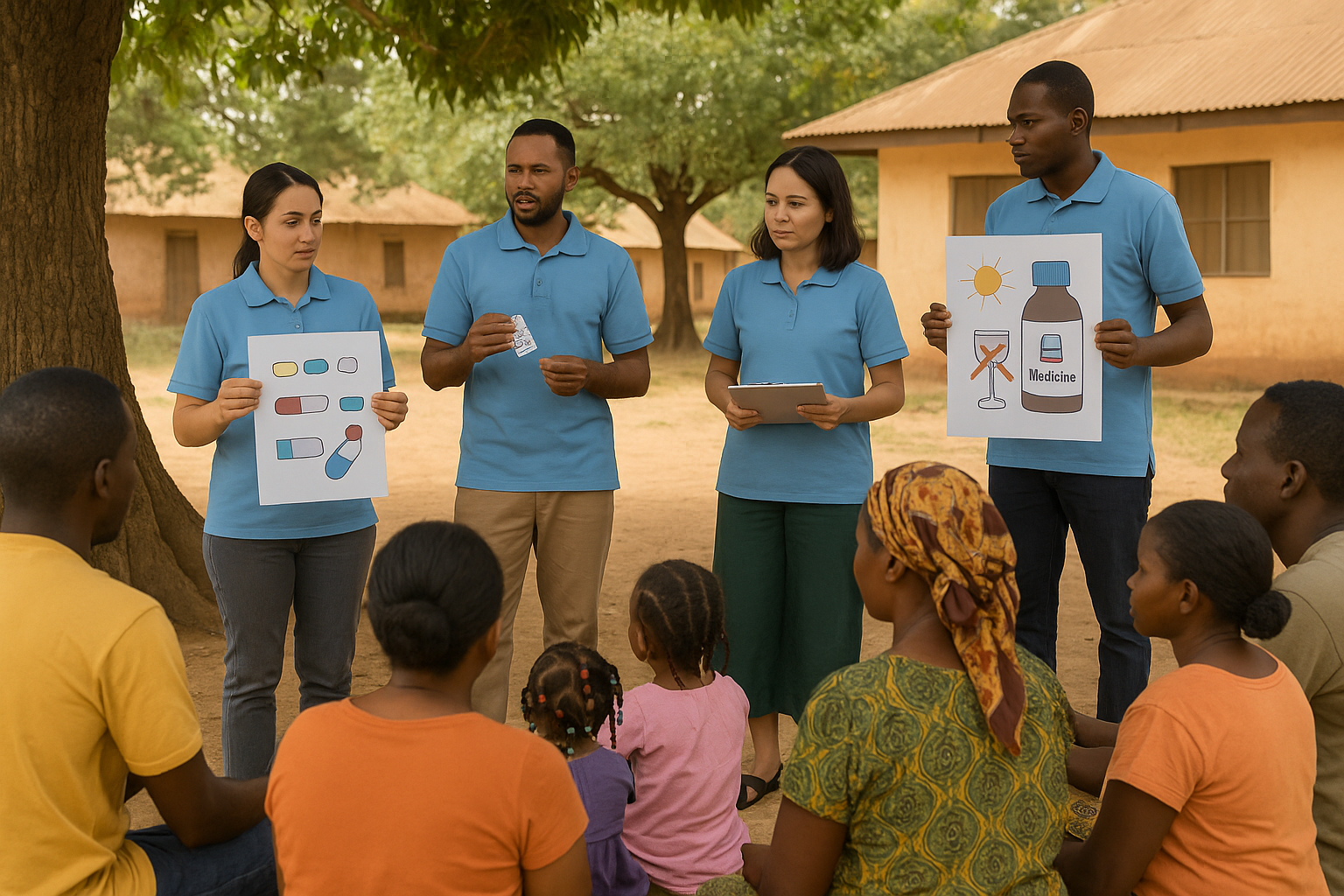
- Pictorial materials like posters, flip charts or videos on medicine safety.
- Health applications in real-time drug information and reporting.
- Job aids such as dosage calculators, pictorial instruction cards and symptom checklists.
- Gear and transportation to make safe journeys to far places.
Provision of appropriate equipment will guarantee consistency and accuracy in the delivery of health-related information by CHWs and minimise the chances of false information.
Community Engagement: The Interdisciplinary Medicine Literacy
Developing Local Health Facility Partnerships
The community health workers would be best combined with formal health systems. Partnership with the local clinics or pharmacies enables CHWs to:
- Check the authenticity of the prescribed drugs.
- Report suspected counterfeit drugs or side effects not normal.
- Make referrals to patients who need advanced care.
Continuous communication between CHWs and healthcare specialists through regular coordination meetings enhances the continuum of care and builds feedback loops to improve the continuous process.
Promoting Group and Family Education
When health education is provided through a group, it is more effective. CHWs can organize:
- Family-focused nursing practices, during which the caregivers are taught the child dosing and medicine safety.
- Women health organization, which aims at maternal medicine use in pregnancy or breast feeding.
- Youth clubs, where children are taught how bad it is to abuse drugs and use them on their own.
The ripple effects of CHWs by targeting whole households and peer groups increase the overall community medicine literacy.
Leveraging Local Media and Technology
As more and more mobile phones and radios reach the rural areas, CHWs can use the media to disseminate information on medicine safety. Examples include:
- Radio jingles in local languages with proper use of drugs.
- Patient SMS notifications about taking medications on time.
- WhatsApp communities of sharing verified health information.
These novel practices enhance the scope of the education activities of the CHWs beyond face-to-face classes.
Avoiding Drug Abuse and Tolerance
Misuse of drugs has been a big health challenge across the world and especially in low-resource countries whereby antibiotics and analgesics are usually sold over the counter. CHWs contribute to the reduction of drug misuse through the prevention and behavior change efforts.
Addressing the Problem of Antibiotic Resistance
The development of antibiotic resistance occurs when the patient abuses antibiotics in the form of unnecessary treatment, premature discontinuation, or as a result of using the residual antibiotics. CHWs can:
- Demonstrate that antibiotics cure bacterial diseases, but not the viral infections such as the cold or flu.
- Underline attending complete treatment courses.
- Sharing of medicines between family members should be discouraged.
CHWs also play a role in the global implementation of reducing antimicrobial resistance through education.
Lessening Addiction to Painkillers and Sedatives
Opiates and tranquilizers are excessively used even in the case of minor illnesses in certain societies. CHWs will be able to administer non-drug options like hydration, rest, and traditional safe remedies, and educate the community on the dangers of dependency and overdose.
Observing and Documenting Trends of Drug Misuse.
It is also possible to monitor and record the drug misuse trends by CHWs since they maintain frequent contact with households. Such data, when reported to health authorities, can be used in the design of specific interventions that can ensure that the programs aimed at population health are sensitive to actual communities needs.
Empowering CHWs through Policy and Support
Strong support from the institutions and policies is needed to sustain CHW-led medicine safety initiatives. Governments, NGOs and international organizations should work together to:
- Embed CHWs in national health systems
- Provide ongoing supervision and refresher training
- Offer money to keep them motivated
- Establish guidelines for the role of CHWs in medicine distribution and education.
Once CHWs are formally recognized and supported, the influence on community medicine safety is lasting and measurable.
Measuring Impact: Indicators of Success
Assessing CHW performance holds them accountable and informs future interventions, and key indicators can include:
- Rise in the percentage of households storing medicines safely
- Decrease in self-medication and drug-related morbidity
- Improved adherence to chronic disease treatments
- Increased community awareness of the dose, expiry date, and side effects
Data generated from CHW reports, household surveys, and health facilities records can show how effective CHWs are changing medicine practice.
Conclusion
Community Health Workers are at the forefront of safe medicine practices in the rural areas. Their proximity to communities, culture, and commitment makes them ideal to improve medicine literacy and avoid misuse.
Accurate, culturally appropriate information can help societies minimize medication errors and improve treatment outcomes and trust in healthcare systems by training and equipping CHWs. Ultimately, empowering CHWs means empowering communities, so every single household, wherever they may be, knows how to use their medicines safely and effectively.