For many of us, recycling feels like a recent innovation — something born from the green movement of the 1970s. We toss bottles and boxes into the blue bin, feeling confident we’re doing our part for the planet.
But what if recycling isn’t modern at all? What if it’s one of humanity’s oldest survival strategies?
The truth is, the story of recycling stretches back thousands of years — through scarcity, war, art, and innovation. At RubbishGo, where we’ve spent over a decade helping households and businesses handle their waste responsibly, we’ve learned one thing: recycling isn’t just about bins — it’s about mindset.
So, let’s dive into six surprising truths that will completely change the way you think about recycling — and maybe even inspire you to take your waste classification game to the next level.
1. Recycling Didn’t Start in the 70s — It Started in the Stone Age
Forget curbside collections — the first recyclers were ancient humans. Thousands of years ago, before mass production, every item had value. Tools were reused, melted, reshaped, and repaired. Throwing something away simply wasn’t an option.
Archaeologists have found evidence that:
- Stone tools were repurposed by early humans to extend their lifespan.
- Romans melted down bronze coins to craft new statues and reused broken pottery to create ultra-durable concrete — some of which still stands today.
- In 9th-century Japan, artisans developed the first recorded form of paper recycling, turning old documents into beautiful, new handmade paper.
Recycling back then wasn’t about saving the planet — it was about survival. Yet, the same resourcefulness that sustained ancient societies can sustain ours today.
2. Wars Made Recycling a National Duty
Modern environmentalism popularized recycling — but war made it essential.
During global conflicts, materials like metal, rubber, and fabric were in short supply. Recycling became a patriotic act, not just a green one.
- In the American Revolution, colonists melted a statue of King George III into 42,000 bullets.
- During the Civil War, church bells and farm tools were recycled to produce weapons.
- And in World War II, massive national drives collected 1.5 million tons of scrap metal, enough to build hundreds of warships and tanks.
Slogans like “Get in the Scrap!” urged citizens to dig through their sheds for any usable material.
These historic moments proved something powerful: when people unite around a common goal — even waste can become a national resource.
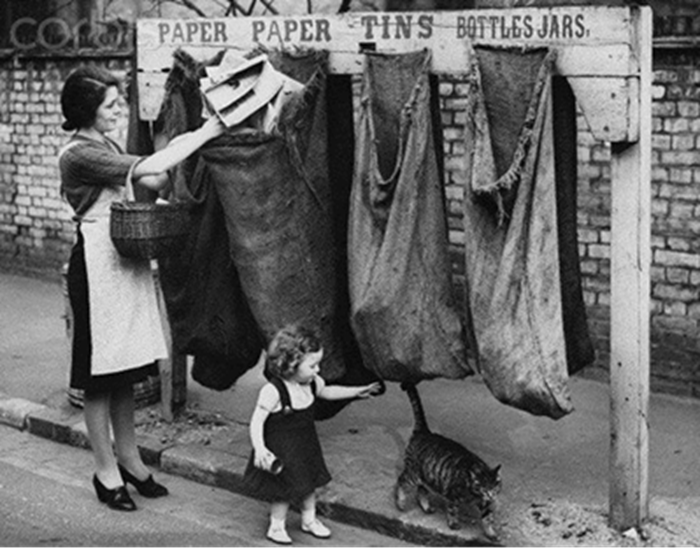
Figure 1 Waste separation in the past (stluciabusinessonline.com/fun-and-interesting-facts-about-recycling/)
3. The 1950s Turned “Throwing Away” into a Lifestyle
After World War II, the world swung hard in the opposite direction.
The economy boomed, plastics took over, and convenience became king.
In 1955, Life Magazine celebrated this new era with an article titled “Throwaway Living.” Its iconic image showed a family joyfully tossing disposable plates, cups, and napkins into the air. The caption proudly declared:
“No housewife need bother — they are all meant to be thrown away after one use.”
It’s shocking by today’s standards, but that mindset created the throwaway culture we’re still fighting to reverse.
At RubbishGo, we help undo that legacy every day — ensuring recyclable, reusable, and compostable materials stay out of landfill through responsible waste collection and recycling services.
4. In Ancient Japan, Recycled Materials Were Considered Luxury
We often think of recycled goods as “second-hand” — but in 9th-century Japan, the opposite was true.
Recycled paper, with its soft texture and unique character, was considered more valuable than new paper. It was used for poetry, art, and sacred texts.
There’s even a story of a 12th-century empress who, after her husband’s death, recycled his love letters into fresh paper on which she copied Buddhist sutras — a poetic fusion of emotion, memory, and renewal.
This ancient perspective reminds us that recycling doesn’t have to be about loss — it can be an act of creation and meaning.
5. The Recycling Symbol Came from a 23-Year-Old Student ♻️
The iconic three chasing arrows are recognized worldwide — yet few people know the story behind them.
In 1970, during the first-ever Earth Day, the Container Corporation of America held a design contest for a recycling logo.
The winner? A 23-year-old engineering student named Gary Anderson, whose simple Mobius loop perfectly represented sustainability’s endless cycle.
Anderson’s design was never trademarked, so it could be freely used worldwide — a symbol belonging to everyone.
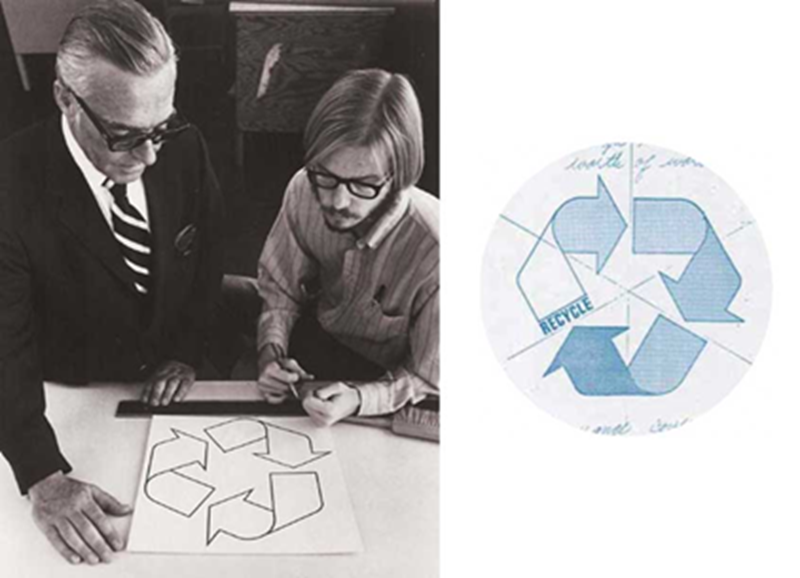
Figure 2 Recycling design creator Gary Anderson and original sketch (Photo/Recycling.com)
6. The Future of Recycling Is More Than Blue Bins
Recycling has come a long way — but the next big step goes far beyond simply sorting our waste. The future lies in something called the circular economy — a system where materials are never truly “waste,” but part of a continuous cycle of use, recovery, and renewal.
In a circular model, products are designed from the start to last longer, be repaired, reused, or repurposed, rather than thrown away. This approach flips the traditional “take–make–dispose” system into one that mimics nature’s own efficiency — where everything has value and nothing is wasted.
Here’s what that future looks like in practice:
✅ Designing smarter materials — choosing plastics, metals, and textiles that can be easily recycled or biodegraded.
✅ Extending product life — through repair, refurbishment, and creative reuse.
✅ Recovering value — turning organic waste into compost or renewable energy instead of landfill gases.
✅ Closing the loop — ensuring that materials like glass, paper, and metal keep circulating through the economy again and again.
This shift isn’t just an environmental goal — it’s an economic one. By keeping valuable resources in use, we reduce costs, minimize pollution, and create new green jobs.
Ultimately, the future of recycling isn’t about filling up blue bins — it’s about rethinking the entire system so that waste, as we know it, no longer exists.
Final Thought: Recycling Isn’t a Trend — It’s Our Human Legacy
From the ancient Romans to wartime citizens, from Japanese poets to modern households, recycling has always been about one thing — making the most of what we have.
As we face new challenges like plastic pollution and climate change, the question isn’t whether we should recycle — it’s how much better we can do it.
So next time you toss something into your blue bin, remember: you’re part of a story thousands of years in the making.
About the Author
Hi, I’m Iman, and I’ve been in the rubbish removal industry for over 10 years. Through my work at RubbishGo hard rubbish collection services, I help people handle their waste responsibly — and through my writing, I aim to make recycling simpler and more inspiring for everyone.