The development of wireless devices, electric vehicles, 5G technology and other directions has put forward higher requirements for battery performance. At present, with the increase in energy density, commercial liquid lithium-ion batteries have more serious safety hazards. Therefore, the development of traditional liquid lithium-ion batteries has encountered bottlenecks and it is difficult to meet the safety and energy density requirements of new battery application scenarios. All-solid-state batteries are expected to achieve high safety under high energy density battery systems, and therefore have received widespread attention.
The technical route of all-solid-state batteries is mainly divided into oxide all-solid-state batteries, sulfide all-solid-state batteries and polymer all-solid-state batteries according to different electrolyte materials. Among them, sulfide solid electrolytes have the highest lithium ion conductivity, excellent mechanical properties and a wide operating temperature range, and are currently very practical all-solid-state battery systems.
However, the electrochemical stability window of sulfide solid electrolytes is narrow; when sulfide solid electrolytes are matched with lithium metal, the interface side reactions are serious and there is a problem of lithium dendrite growth. The performance of the assembled battery is difficult to have competitive advantages over the current commercial lithium-ion batteries in terms of positive electrode active material loading, battery cycle life and charge and discharge rate. Therefore, the sulfide all-solid-state battery system needs to find an alternative anode electrode to metallic lithium.
Development history of silicon-based anode all-solid-state batteries
Silicon-based anode materials have similar specific capacities to lithium metal anodes and have suitable lithium insertion potentials, which can effectively avoid the problem of lithium dendrite growth. They have attracted widespread attention from researchers in recent years. They are an effective alternative to lithium metal anodes before they are fully commercialized, and are also one of the key research directions in all-solid-state batteries.
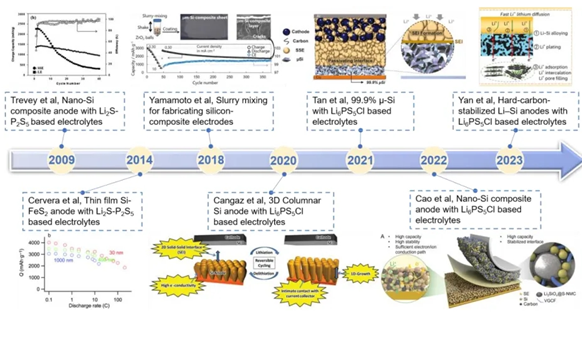
Taking sulfide solid electrolytes as an example, the earliest literature report on silicon being used in sulfide all-solid-state batteries appeared in 2009. In the early days (2009-2014), it was mainly the Se-Hee Lee team that studied silicon-containing anode sulfide all-solid-state batteries. Subsequently (2014-2018), teams from South Korea and Japan began to study this system. Before 2018, silicon-containing anodes were used in sulfide all-solid-state batteries mainly for half-cell research. After 2018, the focus gradually shifted to the research of full batteries, marking that Si-SSB is getting closer to practical application.
In 2021, Meng Ying’s team at the University of California reported a sulfide all-solid-state battery using 99.9 wt% micron silicon as the anode electrode, which achieved a long cycle life of 500 times under high current and an average coulombic efficiency of 99.95%. This is called a historic breakthrough in the field of silicon-based anode electrode all-solid-state batteries, and even a huge breakthrough in the entire silicon-based anode electrode material, which quickly attracted widespread attention from researchers. In the past two years, silicon-based anode electrode all-solid-state batteries have developed very rapidly, and a large number of related research and review articles have been published.
Advantages of silicon-based anode all-solid-state sulfide batteries
Silicon is the second most abundant element in the earth’s crust. The theoretical specific capacity of silicon anode at room temperature is 3579 mAh/g, which is nearly 10 times that of graphite, and is conducive to achieving high energy density of lithium-ion batteries. When the electrolyte is replaced with sulfide solid electrolyte, the rapid capacity decay of silicon anode in liquid system can be effectively avoided. Silicon anode materials can alleviate the reduction and decomposition of sulfide solid electrolyte, avoid the problem of lithium dendrite growth, and achieve high energy density. The specific advantages are as follows:
(1) The solid-solid contact between the sulfide solid electrolyte and the silicon anode electrode can inhibit the volume expansion of silicon. When the sulfide solid-state battery is cycled under external pressure, the silicon anode electrode will not lose electrical contact with the current collector. When the volume of silicon is embedded with lithium, the sulfide solid electrolyte will give a reaction force to the silicon particles, limit the volume expansion of silicon, improve the resistance of silicon to crack growth, and prevent the active material from pulverizing. After silicon is embedded with lithium, the Young’s modulus decreases. Under the reaction force of the solid electrolyte, plastic deformation occurs, relieving the stress concentration of the electrode.
(2) When the sulfide all-solid-state battery is cycled under external pressure, the transverse cracks and pores in the electrode will heal, leaving longitudinal cracks, but it will not affect the transmission of lithium ions and electrons. Under the action of pressure, the electrode will not fall off and can always maintain electrical contact with the current collector.
(3) Due to the electrochemical sintering reaction during the silicon embedding and de-embedding process, a fully active electrode can be used. During the cycle, the silicon particles gradually form a whole. After silicon is embedded with lithium, LixSi alloy is generated, and the electronic conductivity and lithium ion diffusion coefficient are significantly improved.
(4) If a fully active anode electrode is used, the structural design requirements for silicon are lower. After the first cycle, silicon becomes amorphous and undergoes electrochemical sintering. The initial form of silicon mainly affects the uniformity of the silicon layer. The contact interface between the electrode and the electrolyte is limited. The selection of electrode binders can be made without considering the compatibility with the electrolyte. The selection range becomes wider and can be adapted to the production line for silicon anode electrode preparation.
(5) The interface reaction is greatly reduced. The interface between silicon and sulfide electrolyte is relatively stable. Active lithium is mainly consumed when the interface passivation layer is generated in the first cycle. In subsequent cycles, sulfide has no permeability and will not penetrate into the porous structure of silicon. The interface reaction is greatly reduced and lithium loss is also reduced. If a fully active anode electrode is used, the contact between the anode electrode and the electrolyte is limited, and the interface reaction is further reduced.
Influence of silicon-based anode on electrochemical performance of all-solid-state batteries
Although the academic community has achieved excellent results, the current research on silicon-based anodes in sulfide all-solid-state batteries is still in its early stages, and many basic scientific problems still need to be solved, such as the failure mechanism of silicon-based anodes in all-solid-state batteries is still unclear, how to ensure the ion and electron conduction paths of silicon anodes during the cycle, and how to solve the instability of the interface contact caused by the large volume expansion of silicon anodes.
At present, there are few effective modification methods for silicon-based anode materials in all-solid-state batteries. The key factors affecting their electrochemical performance mainly include external pressure, binders and conductive agents, silicon particle size, structural design, and surface modification.
Applied pressure:
Applied pressure refers to the pressure applied to the battery during the operation of the all-solid-state battery, which can effectively ensure the solid-solid contact between the electrode and the electrolyte, and ensure the effective electronic and ion conduction inside the silicon anode electrode during the cycle. In addition, the applied pressure is also believed to be able to effectively broaden the metastable electrochemical window of the sulfide solid electrolyte. The commonly used applied pressure in all-solid-state batteries is in the range of 0.1-300 MPa, which plays a vital role in the electrochemical performance of all-solid-state batteries.
Binder
In liquid batteries, binders suitable for silicon anode electrodes have been widely studied. They have special properties such as self-healing, high mechanical strength, high elasticity and good electronic or ion conductivity, which can effectively improve the cycle stability and rate performance of silicon anode electrodes. It is one of the current research hotspots of silicon anode electrodes in liquid batteries.
However, there are few studies on the influence of binders on silicon anode electrode solid-state batteries, and the commonly used binders for silicon anode electrodes can only be dissolved in polar solvents, while sulfide solid electrolytes are incompatible with polar solvents, which makes the preparation of silicon anode electrode sheets more difficult. This problem can be avoided by not adding sulfide solid electrolyte to the anode electrode, but it is difficult to ensure the electronic and ionic conduction of pure silicon anode electrode under low external pressure, so it is crucial to find a binder suitable for silicon anode electrode in all-solid-state batteries.
Conductive agent
Conductive agent is also an important component of silicon electrode, which can promote the electron conduction inside silicon electrode. However, for sulfide all-solid-state batteries, conductive agent carbon will promote the decomposition of sulfide solid electrolyte. When preparing composite anode electrode, vapor-grown carbon fiber VGCF with relatively low specific surface area can be used as conductive agent to reduce the decomposition of sulfide solid electrolyte.
Silicon particle size
Nano silicon has better stress release than micro silicon during lithiation, and it has a shorter lithium ion diffusion path, thus having better cycle and rate performance. Therefore, nanostructured silicon has been widely used in liquid lithium-ion batteries, such as nanoporous particles, nanowires and nanofibers. However, researchers found that when Si is used in sulfide all-solid-state system, the active material and electrolyte are in solid-solid contact, and nm-Si is difficult to disperse evenly in the solid electrode, thereby affecting the utilization rate of active materials in the composite anode electrode. The performance of μm-Si in solid-state batteries may be due to more uniform electrode morphology, and the electrochemical performance may be better than nm-Si, while it can also effectively reduce costs.
Silicon anode structure design
Reasonable structural design can provide buffer space for the volume expansion of silicon anode, prevent the reaction between silicon anode and electrolyte, and thus improve its cycle stability. However, the compaction density of the material should also be considered when designing the structure. The pores of porous materials will reduce the volume energy density of the battery. It is necessary to comprehensively evaluate the two and select the most appropriate range.
Surface modification
Surface modification is one of the common methods for modifying silicon anode materials in liquid batteries. It can maintain the structural stability of silicon, improve the electronic or ionic conduction of the silicon anode surface, and reduce the formation of SEI. However, there are relatively few reports on the surface modification of silicon anode materials in sulfide all-solid-state batteries.