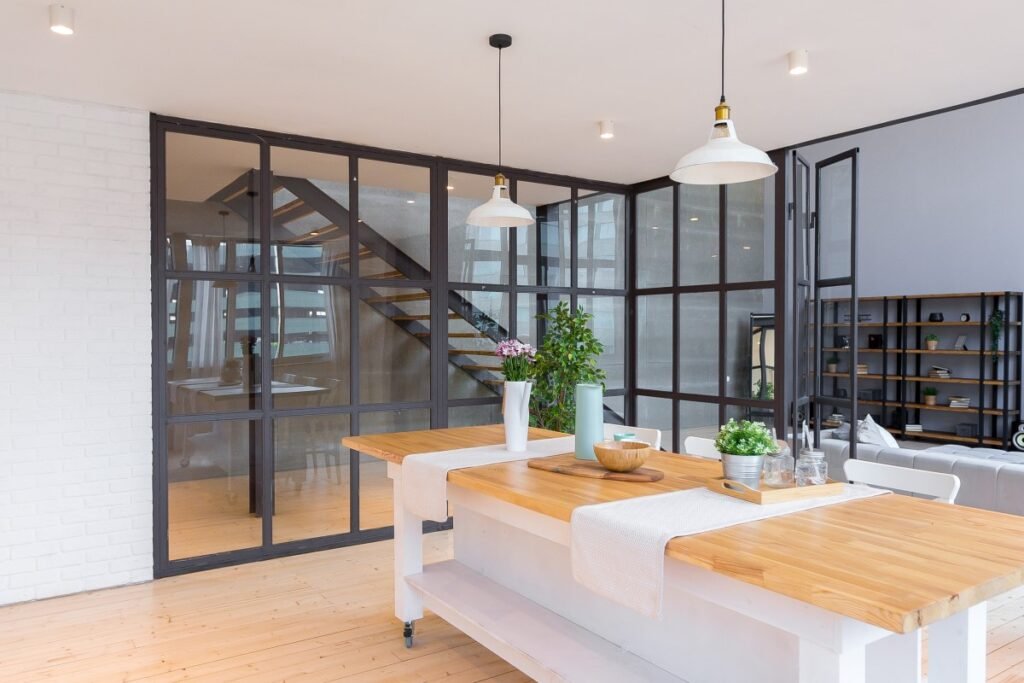
Glass partitions are the modern and stylish solution for space division in residential and commercial areas. They serve transparency to let the light flow through while keeping privacy and acoustic control intact.
Considering the availability of choices, a proper selection of glass types for your partition must be made. In this article, we show different types of glasses commonly used for partitions and which might be best suited for your project.
Tempered Glass
Tempered glass, or toughened glass, is one of the most favored choices for glass partition due to its strong and safe nature. In this category of glass, heating and rapid cooling treatment is done, and the glass gets four to five times stronger compared to conventional glass. If it ever breaks, the spill is in the form of minute blunt pieces that minimize injury.
Advantages:
Safety: Since the breakage of the tempered glass in such a way that it is much safer when any impact falls on it by accident.
Durability: It has a higher capability to withstand stress and variation in temperature.
Aesthetics: It comes in various thicknesses. It can be cut according to the customer’s requirement as per the requirement needed for various purposes.
Best suited for: Offices, commercial buildings, high-traffic areas where there can be issues with safety.
Laminated Glass
It consists of two or more glass panes bonded together by a plastic interlayer, usually PVB. If the glass were to break, it is the interlayer that keeps it in place, hence strong and secure for partitions.
Advantages:
Noise Abatement: Laminated glass offers very good resistance to noise transmission, hence is best suited for areas where privacy is required.
Safety and Security: Because the interlayer holds the glass together in case of a break, the glass can’t shatter into large dangerous shards, increasing its security aspect.
UV Protection: The lamination process can block out harmful UV rays for interior protection.
Best suited for: Boardrooms, meeting rooms, or areas where sound insulation and more privacy are required.
Frosted Glass
Another common alternative to glass partitions is frosted glass, which is always applied in areas that require privacy, for instance. The glass is etched or sandblasted in such a way that there is a translucent surface through which light can pass while vision is dimmed.
Advantages:
Privacy: Light transmission is allowed and it provides obscurity of vision, making it ideal for areas that require confidentiality.
Aesthetic Appeal: Frosted glass creates a sleek, modern look and can also be treated with patterns or designs for that extra bit of decoration.
Low Maintenance: Frosted glass is less prone to fingerprinting or smudging; therefore, it requires less maintenance.
Best applied to: Bathrooms, offices, and other areas needing privacy without compromising natural light.
Smart Glass Switchable Glass
A modern alternative to partitions includes smart glass, also referred to as switchable or electrochromic glass.
This glass can, within an instant, change from being transparent to completely opaque; it allows one the discretion of hindering the field of view whenever necessary, or permitting complete visibility at will. This works on the principle of electric current changing its opacity.
Advantages:
On-demand Privacy: It changes instantly from transparent to opaque states, making it versatile for areas that are open-plan.
Energy Efficiency: Additional benefits from other smart glass options will include UV protection and heat reduction of spaces.
Modern Aesthetic: It adds a touch of futuristic and avant-garde design to any space.
Best Suited For: High-tech offices, conference rooms, and areas where adaptable privacy levels are required.
Glass-clear
The clear glass is the basic option for partitions. It allows a minimalist and modern look for any space with maximum transparency for light transmission. Due to its minimalistic nature, clear glass does not provide features related to privacy or soundproofing of any kind, which can be taken as a disadvantage for the applications that entail such features.
Advantages:
Affordability: Clear glass is mostly the cheapest available option for partitions.
Allows most light to enter a space, thus being ideal for small or dark areas;
Seamless Look: It provides a neat and seamless look that dramatically enhances the openness of a space.
Best suited for: Open-plan offices, showrooms, spaces where natural light and visibility are a priority.
Tinted Glass
Tinted glass is made by adding color to the glass during the manufacturing process, and depending on how much color is added, its subtle hue can range from bronze to blue or gray. It cuts down glare and, in many cases, assists with UV protection.
Advantages:
Glare Reduction: Tinted glass decreases the intensity of direct sunlight and hence makes it comfortable to work with even when bright sunlight is available outsid
Energy Efficiency: Colored glass can block out solar heat and keep the indoor temperature cool, thereby reducing air conditioning consumption.
Aesthetic Flexibility: If applied appropriately in variable shades, it can add more aesthetic value to a space.
Best Suited for: Areas that are exposed to much sun, as in offices with larger windows or where less glare is needed.
Choosing the Right Glass for Your Partition
Determination of the type of glass will depend solely on several factors including safety, privacy, acoustic requirements, aesthetics, and budget. Areas that are usually subjected to high traffic or where safety is of prime concern, toughened or laminated glass is advised to be used. In cases where this partition is in your office or house for keeping privacy, then the frosted or smart glass is considered ideal. For soundproofing purposes, acoustic or laminated glass will be able to serve the purpose for certain areas.
The type of glass partition that will be best fitting for your space depends, in the end, on your needs and preference. Whether you are looking for a sleek, modern design or better functionality-or both-there’s a type of glass suited for every partition project. visit dutable for more informative blogs.