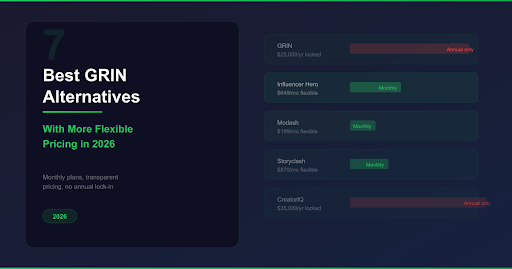
GRIN has built a strong reputation in influencer marketing, particularly for Shopify-native eCommerce brands running large creator programs. But its pricing model – starting around $25,000 per year with a mandatory 12-month contract – has become a dealbreaker for a growing number of teams.
For mid-market brands, growing DTC teams, and companies that want to test influencer marketing before committing six figures, the annual lock-in creates real friction. Monthly payments may be available, but you’re still signing up for 12 months. If the platform doesn’t fit your workflow, or if priorities shift mid-year, that budget is gone. And because GRIN doesn’t publish transparent pricing, teams often don’t know the full cost until they’re deep into a sales conversation.
This guide covers seven platforms – starting with Influencer Hero – that offer more flexible pricing, transparent costs, and month-to-month options so you can scale your influencer program without locking into a contract you might outgrow.
- Influencer Hero
- Modash
- Storyclash
- Aspire
- HypeAuditor
- Later
- Sprout Social
Why Brands Want More Flexible Pricing Than GRIN
GRIN’s pricing structure works for enterprise brands with established influencer budgets and long planning cycles. But for everyone else, several pain points surface quickly:
- $25,000/Year Minimum With 12-Month Lock-In: That’s over $2,000 per month committed before you’ve sent a single outreach message. For teams still proving influencer ROI internally, this is a difficult line item to justify – especially when you can’t exit the contract if the channel underperforms.
- No Published Pricing: GRIN requires a demo and sales conversation before sharing costs. Teams comparing platforms can’t do straightforward budget planning without going through multiple sales calls.
- Annual Budget Lock Creates Risk: That $25,000 could go toward paying creators, testing new channels, or hiring. Committing it to a single platform for 12 months means less flexibility to reallocate when priorities shift mid-year.
- Enterprise Pricing Doesn’t Fit Mid-Market Teams: Growing brands with 2-5 person marketing teams don’t need – or want to pay for – enterprise-grade infrastructure. They need capable tools at a price that matches their current scale.
- Rigid Workflows at Scale: Users report that GRIN’s workflow structure becomes increasingly rigid as you add more creators. The platform can feel like it was built for a specific way of working, and adapting it to your team’s process requires workarounds.
The platforms below all address at least one of these friction points – whether through transparent pricing, month-to-month billing, lower entry costs, or some combination of all three.
GRIN Overview
Before looking at alternatives, it’s worth acknowledging what GRIN does well. The platform is purpose-built for eCommerce brands that run large-scale creator programs, and several features reflect that focus.
GRIN offers unlimited creator partnerships with no caps on active influencer relationships – a genuine advantage for brands managing hundreds of creators simultaneously. Its native Shopify integration is among the deepest available, handling product gifting, discount codes, and fulfillment directly from the platform. Creator portals give influencers self-service dashboards for viewing briefs, submitting content, and tracking earnings, which reduces back-and-forth coordination. The UGC library provides a searchable archive including Stories, and built-in payout and tax documentation tools simplify creator compensation at scale. Real-time ROI dashboards tie clicks and conversions directly to revenue.
For enterprise Shopify brands with established budgets and long-term influencer strategies, GRIN remains a viable option. But for teams that need pricing flexibility, broader eCommerce support beyond Shopify, or the ability to start without a $25,000 annual commitment, the alternatives below offer stronger fits.
Best GRIN Alternatives With Flexible Pricing
1. Influencer Hero
Influencer Hero is a full all-in-one influencer marketing platform covering discovery, AI-powered outreach, CRM, product gifting, UGC collection, affiliate tracking, analytics, creator storefronts, and payout management – all within a single system. From a pricing flexibility standpoint, it’s the clearest contrast to GRIN: month-to-month billing with no annual lock-in required, transparent published pricing, and entry points that let growing teams start without committing $25,000 upfront.
The platform’s 450M+ global creator database spans eight platforms including Instagram, TikTok, YouTube, and Pinterest, making it substantially larger than what most competitors offer. AI-powered outreach with automated drip campaigns and personalized first lines delivers a 43% average response rate – and the month-to-month flexibility means you can scale outreach volume up during peak seasons and dial it back when campaigns wind down, without being locked into a fixed annual spend.
Case studies back this up – one D2C brand scaled from $0 to $1.2M in a year at 9.1x ROAS, while Olivida achieved 7.2x ROAS with a 150%+ reduction in CAC.
Best for: Teams that want complete influencer marketing coverage with transparent, month-to-month pricing and the flexibility to scale spend with actual campaign needs.
Pricing:
- Standard: $649/month (1 seat, up to 1,000 creators, 1,000 outreach/mo)
- Pro: $1,049/month (3 seats, up to 5,000 creators, 5,000 outreach/mo)
- Business: $2,490/month (8 seats, up to 10,000 creators, 10,000 outreach/mo)
- Custom & Agency plans available with unlimited outreach
- All plans include consultation and training
- Month-to-month billing – no annual contract required
Standout features:
- 450M+ Creator Database Across 8 Platforms: The largest indexed database available, covering Instagram, TikTok, YouTube, Pinterest, Snapchat, Twitch, and X. GRIN doesn’t publish its database size.
- AI-Powered Outreach (43% Response Rate): Automated drip campaigns with AI-personalized first lines. Scale outreach without adding headcount – and without being locked into annual outreach volume commitments.
- CRM With Automation Engine: Campaign boards, deal pages, conversation history, bulk actions, and rules-based triggers. Smart Deal Selection uses AI prompts to advance pipeline stages automatically.
- Five eCommerce Integrations: Shopify, WooCommerce, Magento, BigCommerce, and Prestashop – compared to GRIN’s Shopify-only depth. Teams on other platforms aren’t left behind.
- Creator Storefronts (Up to 8x ROI): Branded storefronts where creators sell products with affiliate commissions, driving measurable sales attribution.
- Built-In Fraud Detection: Audience authenticity analysis integrated into the discovery workflow so teams vet creators before investing budget.
- Chrome Extension (Free): Browse Instagram, TikTok, or YouTube and get real-time creator analytics, audience demographics, and fake follower detection without leaving the platform. One-click CRM import.
- Application Pages & Payout Manager: Branded landing pages for inbound creator recruitment with auto-approval workflows, plus Stripe-powered payout processing with creator dashboards and full audit trails.
The comprehensive feature set means teams adopting the platform for the first time should expect an onboarding period. The workflow-driven approach is built for scale, so very small teams running only a handful of campaigns may not use every capability immediately.
2. Modash
Modash pairs one of the largest public creator databases – 350M+ profiles – with some of the most accessible pricing on this list. At $199/month for the Essentials plan with no annual contract required, it’s the easiest entry point for teams that want professional-grade discovery and affiliate tools without the financial commitment GRIN demands.
The platform’s Shopify-native gifting and affiliate workflows handle discount codes, UTM tracking, and product selection directly from your catalog. AI visual discovery lets you describe a visual style or upload a reference image to surface creators with matching aesthetics, which accelerates sourcing for brands with strong visual identity requirements.
Best for: Teams on a budget that want a large discovery database and Shopify affiliate tools with true month-to-month flexibility.
Pricing:
- Essentials: $199/month
- Performance: $499/month
- Enterprise: custom (annual billing)
- Month-to-month billing on non-Enterprise plans
Standout features:
- 350M+ Public Creator Database: Non-opt-in profiles provide one of the widest discovery nets available, significantly more transparent than GRIN’s unpublished database.
- AI Visual Discovery: Describe a vibe or upload a reference image to find creators with matching aesthetics – useful for brands with specific visual direction.
- Shopify-Native Gifting and Affiliates: Automated discount codes, UTM tracking, and product selection from your Shopify catalog.
- Automated Affiliate Payouts: Commission tracking and monthly creator payments handled in-platform, reducing admin overhead.
Modash’s deep integrations are Shopify-only – a significant limitation for brands on WooCommerce, Magento, or BigCommerce. The platform also lacks native AI-powered outreach, which means manual effort scales linearly as campaigns grow. Teams needing multi-platform eCommerce support and automated outreach across campaigns will find all-in-one platforms with broader integration coverage a better long-term fit.
3. Storyclash
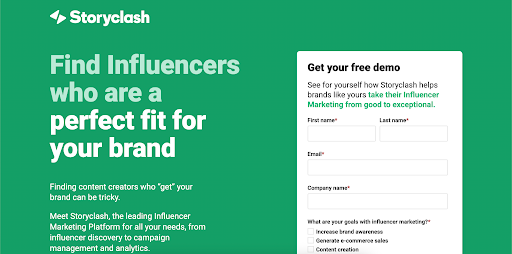
Storyclash differentiates itself through content performance analytics and competitive benchmarking. At $870/month with transparent published pricing, it sits between budget tools and enterprise platforms – a middle ground that GRIN’s pricing structure doesn’t offer. Teams can see which creators their competitors are working with and how those partnerships perform, turning discovery into a data-driven competitive exercise.
The platform indexes 183M creator profiles across Instagram, TikTok, and YouTube, and includes historical data on expired Stories – valuable for evaluating a creator’s full content track record rather than just what’s currently visible. AI-driven discovery uses image recognition and natural language prompts to surface relevant creators.
Best for: Brands that lead with competitive intelligence and content performance data to inform their influencer strategy.
Pricing:
- Business: starts at $870/month
- Enterprise: custom pricing
Standout features:
- Competitive Benchmarking: See which creators competitors are hiring and how those campaigns perform – directly actionable intelligence for your strategy.
- AI-Driven Discovery: Image recognition and AI prompts for finding creators, plus lookalike search based on existing partnerships.
- Historical Data Including Expired Stories: Access to full content history for thorough creator vetting before committing budget.
- Shopify Integration for ROAS Tracking: Track ROAS, CAC, and AOV at the campaign and creator level.
Storyclash lacks built-in contract generation and content licensing workflows, which means managing those processes separately. Manual UGC repurposing rights handling adds overhead at scale. Teams that need end-to-end workflow coverage including outreach automation, CRM, and multi-platform eCommerce support will likely need a more comprehensive platform alongside or instead of Storyclash.
4. Aspire
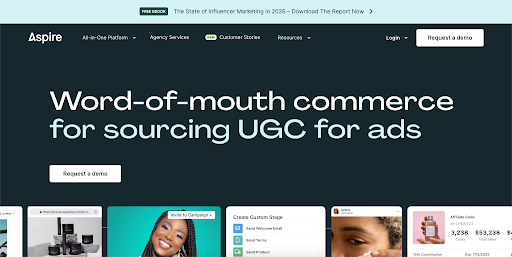
Aspire has built a distinct model around inbound creator recruitment, with over a million creators actively applying to brand campaigns through its marketplace. This inverts the traditional cold-outreach approach and can significantly reduce sourcing time. First-party data integrations with Meta, TikTok, and Pinterest deliver reliable audience metrics for confident decision-making.
The end-to-end workflow covers discovery, contracts, content approvals, and performance tracking in a single pipeline. Aspire’s deep Shopify integration handles gifting and automated fulfillment, and the asset library ties UGC directly to ROI reporting.
Best for: Established brands with strong enough recognition that creators actively want to partner with them, making inbound recruitment effective.
Pricing:
- Custom; starts around $2,500/month (covers 20-40 creators, unlimited seats)
Standout features:
- Inbound Creator Marketplace: 1M+ creators applying to campaigns shifts the dynamic from searching to selecting.
- First-Party Social Data: Direct API integrations with Meta, TikTok, and Pinterest deliver reliable, audit-ready audience data.
- Structured Campaign Workflow: Discovery through performance tracking in a single pipeline with customizable approval stages.
- Shopify Fulfillment Integration: Creators select products directly from your catalog for gifting campaigns.
Custom pricing limits upfront budget planning – you won’t know your cost until after a sales conversation, similar to GRIN. The inbound model works best for recognizable brands; teams that rely heavily on cold outreach to source niche creators will likely need a platform with AI-powered outreach and a larger database. Platforms indexing 350M-450M+ creators provide substantially broader reach for outbound discovery.
5. HypeAuditor
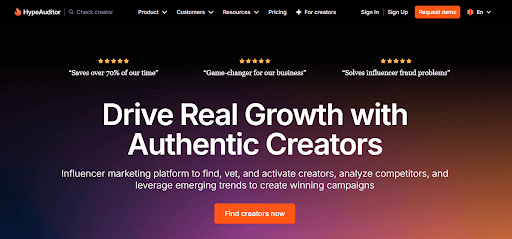
HypeAuditor has built its reputation as the gold standard for influencer auditing – fake follower detection, engagement quality analysis, and audience authenticity scoring. For brands where data credibility is a priority, HypeAuditor’s analytics provide a level of due diligence that most platforms treat as a secondary feature. At roughly $10,000/year for the Business plan, it’s meaningfully cheaper than GRIN’s $25,000/year minimum.
Beyond auditing, the platform includes AI discovery with lookalike search, social listening for competitive monitoring, and Shopify integration for revenue attribution. Content approval workflows and creator application pages add structure to campaign management.
Best for: Brands that prioritize creator vetting and audience authenticity as a core part of their influencer selection process.
Pricing:
- Business: ~$10,000/year
- Enterprise: up to $60,000/year
Standout features:
- Advanced Audience Authenticity Analysis: Industry-leading fake follower detection and engagement quality scoring – more rigorous than what most all-in-one platforms offer natively.
- AI Discovery With Lookalike Search: Reads captions and analyzes images to surface similar creators, efficient for expanding successful partnerships.
- Social Listening and Competitor Monitoring: Track hashtags, mentions, and competitor creator partnerships to inform strategy.
- Content Approval Workflows: Structured review processes you can customize before content goes live.
HypeAuditor is fundamentally an analytics and auditing tool, not a campaign execution platform. Only a small portion of influencers are registered for direct outreach through the platform, so you’ll likely need to pair it with a separate outreach and CRM tool. Teams wanting a single platform that handles everything from discovery through outreach, CRM, gifting, and affiliate tracking will find all-in-one platforms more operationally efficient.
6. Later
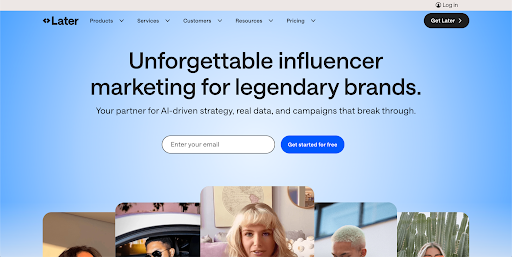
Later expanded from social media scheduling into influencer marketing, and the combination creates an interesting proposition for brands already using Later for content planning. The ability to align influencer output with scheduled brand content in a single platform reduces coordination overhead between social and influencer teams. However, the pricing model for influencer marketing capabilities starts at roughly $28,500/year – comparable to GRIN and with similar annual commitment requirements.
Custom application pages let you vet creators before onboarding them to campaigns, and brand safety tools powered by AI scanning add a layer of protection. Later also offers managed and full-service options for brands that want hands-off campaign execution.
Best for: Brands already using Later for social scheduling that want to add influencer marketing within the same ecosystem.
Pricing:
- Social management tiers: Starter $25/month, Growth $50/month, Scale $110/month
- Influencer marketing plans: ~$28,500-$60,000/year
Standout features:
- 15M Contactable Creators: Verified emails attached to creator profiles reduce the sourcing step for outreach.
- Content Planning Synergy: Align influencer deliverables with scheduled brand content in a unified calendar.
- Custom Application Pages: Create branded vetting pages for creator applications and campaign onboarding.
- Brand Safety and AI Scanning: Automated content review tools flag potential brand safety issues before content goes live.
Later’s influencer marketing pricing ($28,500-$60,000/year) doesn’t solve the pricing flexibility problem teams have with GRIN – it’s a similar annual commitment range. Its creator database of 15M is substantially smaller than platforms indexing 200M-450M+ profiles, which limits discovery for niche campaigns. The social scheduling tools are valuable, but cheaper alternatives exist if you only need scheduling. Teams seeking month-to-month flexibility and a larger discovery database will find better options elsewhere on this list.
7. Sprout Social
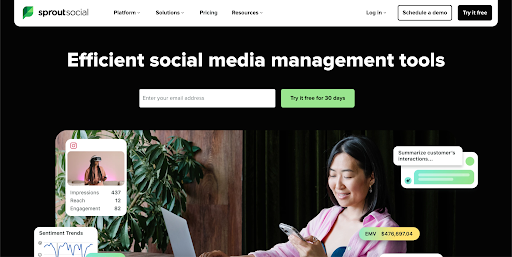
Sprout Social approaches influencer marketing from the social media management angle, weaving creator discovery and campaign management into its established analytics suite. The Brand Fit Score automates creator vetting against your brand criteria, and competitive benchmarking with EMV reporting adds strategic context that standalone influencer tools don’t always provide. The platform’s strength is in the unified view – social performance, influencer campaigns, and audience analytics all in one dashboard.
Advanced approval workflows give teams oversight of content before it goes live, and client-ready exportable dashboards are useful for brands that report to stakeholders regularly. However, the per-user pricing at $1,599/user/month with a 12-month minimum means costs escalate rapidly with team size.
Best for: Brands that need influencer marketing tightly integrated with social media management and are willing to pay premium per-user pricing.
Pricing:
- $1,599/user/month
- 12-month minimum commitment
Standout features:
- Brand Fit Score: AI-powered creator vetting that automatically scores creators against your brand criteria.
- Competitive Benchmarking and EMV Reporting: Compare your influencer performance against competitors with earned media value metrics.
- Advanced Approval Workflows: Multi-step content oversight before anything goes live – useful for regulated industries or risk-conscious brands.
- Client-Ready Exportable Dashboards: Presentation-ready reporting that can go directly to stakeholders without manual reformatting.
At $1,599/user/month, a three-person team pays $4,797/month – nearly $58,000/year – making Sprout Social one of the most expensive options on this list. The 12-month minimum contract mirrors the same lock-in issue teams have with GRIN. Per-user pricing models punish growing teams disproportionately. The platform also lacks vibe-based visual search and UGC licensing tools. Brands looking for all-in-one influencer marketing with tiered pricing that includes multiple seats per plan will find better value in platforms designed specifically for influencer marketing rather than social suite add-ons.
Final Thoughts
Pricing flexibility isn’t just about the monthly number – it’s about what happens when your needs change. Campaigns ramp up seasonally. Budgets get reallocated. A channel that looked promising in Q1 might not justify continued spend by Q3. Platforms that lock you into annual contracts at enterprise price points assume your business operates on a predictable, straight-line trajectory. Most don’t.
A few principles to guide the decision:
- Prioritize month-to-month flexibility: Platforms like Influencer Hero and Modash let you scale spend up or down with actual campaign needs, not contractual obligations. That flexibility has tangible value when budgets shift.
- Compare total cost, not just starting price: A platform charging $1,599/user/month sounds manageable until you add three team members. Per-user pricing models punish growing teams. Look for platforms with tiered plans that include multiple seats.
- Match eCommerce support to your stack: GRIN’s Shopify integration is excellent – but only useful if you’re on Shopify. Brands on WooCommerce, Magento, or BigCommerce need platforms with broader eCommerce coverage.
- Demand transparent pricing: If a platform requires a sales call before sharing costs, factor the time cost of that process into your evaluation. Published pricing lets you compare options and plan budgets without pressure.
It’s also worth noting that many influencer marketing agencies use these platforms to manage campaigns at scale for their clients – and they consistently gravitate toward tools with flexible billing that aligns with retainer-based client relationships. The right platform should adapt to how your business actually operates, not force you into a pricing structure designed for someone else’s budget cycle.
FAQs
1. How much does GRIN cost compared to these alternatives?
GRIN starts at approximately $25,000 per year with a mandatory 12-month contract. Among the alternatives, entry points range from $199/month (Modash) to $2,500/month (Aspire). Influencer Hero starts at $649/month with month-to-month billing, offering a full all-in-one feature set at roughly one-third of GRIN’s annual cost with no long-term commitment.
2. Can I switch from GRIN to another platform mid-contract?
GRIN’s 12-month contract typically locks you in for the full term. Most teams plan their transition for the contract renewal window. Some alternatives like Influencer Hero and Modash offer month-to-month billing, so you can run them in parallel during your remaining GRIN contract to test workflows before fully migrating.
3. Which GRIN alternative offers the best value for a small team?
Modash at $199/month provides the lowest entry point with strong discovery and Shopify affiliate tools. For teams that want full all-in-one coverage including AI outreach, CRM, gifting, and multi-platform eCommerce support, Influencer Hero’s Standard plan at $649/month offers the most complete feature set at an accessible price point.
4. Do any of these platforms match GRIN’s Shopify integration depth?
Several platforms offer strong Shopify integrations, including Modash, Aspire, and Storyclash. For brands that need integrations beyond Shopify, Influencer Hero supports five eCommerce platforms – Shopify, WooCommerce, Magento, BigCommerce, and Prestashop – which is the broadest coverage among the platforms listed here.
5. Is it worth paying more for an all-in-one platform versus using separate tools?
It depends on your workflow complexity. Separate tools (one for discovery, one for outreach, one for tracking) create data silos and manual handoffs that multiply as campaigns scale. All-in-one platforms like Influencer Hero consolidate those workflows in a single CRM, which reduces admin overhead and keeps all campaign data connected. The breakeven usually happens around 20-30 active creator relationships.
6. What’s the biggest risk of staying on GRIN?
The biggest risk is opportunity cost. The $25,000/year locked into a platform contract could fund creator payments, content production, or testing new channels. If GRIN’s workflows don’t evolve with your needs, you’re paying for a tool that constrains rather than enables your program – and you can’t exit until the contract term ends.
Keywords: GRIN alternatives, GRIN competitors, influencer marketing platforms flexible pricing, best GRIN alternatives 2026, Influencer Hero vs GRIN, month-to-month influencer marketing tools, GRIN pricing alternatives, affordable influencer marketing software