Introduction
Food and beverage manufacturing involves more than simply turning ingredients into finished products. Manufacturers must coordinate raw material procurement, recipes, production schedules, inventory, quality checks, batch traceability, and finished goods while managing changing demand and strict operational requirements. When these processes rely on disconnected systems, maintaining accurate information and controlling production becomes increasingly difficult.
Odoo ERP for Food and Beverage provides an integrated approach by connecting purchasing, inventory, manufacturing, quality, and financial operations within a single platform. Businesses can also extend these capabilities across their supply chain with Odoo for food and beverage distribution, creating greater visibility from incoming raw materials to finished products ready for delivery.
Why Food & Beverage Manufacturing Needs an Integrated ERP
Food and beverage manufacturing involves interconnected processes where a problem in one area can quickly affect production, inventory, or delivery. An integrated ERP helps manufacturers manage these challenges from a single system.
- Disconnected Business Systems: When procurement, inventory, production, accounting, and other business applications operate separately, teams may have to transfer or reconcile data manually. Odoo integration services can help connect these systems, allowing information to flow between applications and giving teams a more unified view of business operations.
- Perishable Raw Materials: Ingredients may have limited shelf lives, making timely purchasing, storage, and consumption important. An ERP helps teams maintain better visibility into available materials and their expiration dates.
- Complex Recipes and Production Requirements: Different products require specific ingredients, quantities, and production steps. Centralized production data helps manufacturers plan materials and maintain consistency across manufacturing orders.
- Batch and Lot Traceability: Manufacturers often need to identify where ingredients came from and which finished products contain them. Centralized tracking makes it easier to trace materials throughout the production cycle.
- Inventory Accuracy: Stock levels can change quickly as materials move between purchasing, warehouses, and production. An integrated system provides more consistent inventory information across teams.
- Production and Procurement Coordination: Production depends on having the right materials available at the right time. Connecting procurement with manufacturing helps teams identify material requirements before they disrupt production schedules.
- Quality and Compliance: Food products require consistent quality checks and documented processes. An ERP can connect quality checks with production and inventory activities, creating a more traceable operational workflow.
- Growing Operational Complexity: As manufacturers add products, warehouses, suppliers, or production lines, managing processes manually becomes harder. An integrated ERP provides a centralized foundation that can scale with the business.
How Odoo Manages the Journey from Raw Materials to Finished Goods
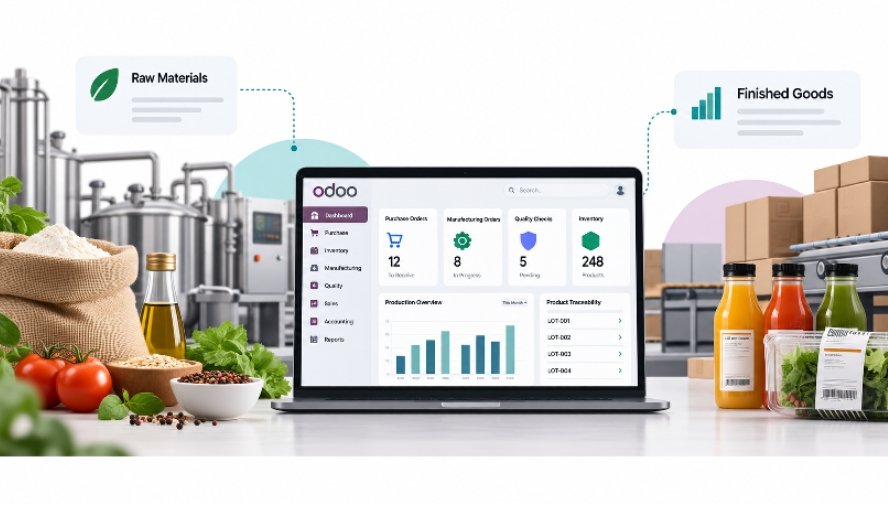
Odoo connects the key stages of food and beverage manufacturing within a unified workflow. Its manufacturing capabilities help businesses coordinate materials, production, inventory, and related operations through a centralized system.
For a broader look at how Odoo ERP for manufacturing supports production workflows, planning, inventory, and operational visibility, manufacturers can explore the dedicated manufacturing approach.
1) Raw Material Procurement
The process begins with ensuring that the required ingredients and packaging materials are available. Odoo can connect purchasing with inventory and production requirements, helping teams manage suppliers, purchase orders, replenishment, and incoming materials.
Instead of purchasing based only on historical assumptions, teams can use current inventory and production requirements to determine when materials need to be replenished. This can help reduce both material shortages and unnecessary stock.
2) Production Planning and Recipes
Once the required materials are available, manufacturers need to translate recipes into repeatable production processes. Odoo Manufacturing uses Bills of Materials (BOMs) to define the components and quantities required to produce a finished product.
A BOM can specify ingredients, packaging materials, quantities, and associated manufacturing operations. This gives production teams a structured reference for manufacturing orders and helps maintain consistency across production runs. For businesses with complex recipes or multiple product variations, this centralized information can simplify production planning and material requirements.
3) Batch, Lot and Expiry Tracking
Traceability is particularly important when working with food ingredients and finished products. Odoo can track materials using batch or lot numbers, allowing businesses to follow products through different stages of their operations.
Expiry dates can also be recorded for applicable products, helping warehouse and production teams identify materials that need attention before they become unusable. When a traceability issue occurs, businesses can use recorded lot information to identify affected materials or products and investigate their movement through the supply chain.
4) Finished Goods and Warehouse Management
After production, finished products need to be accurately recorded and stored before distribution. Odoo updates inventory as products move through manufacturing and warehouse operations, providing teams with greater visibility into finished goods availability.
Warehouse teams can manage stock movements, locations, and barcode-based operations while maintaining a connected view of inventory. This creates a continuous flow of information from raw materials to production and finally to finished goods, reducing the need for manual reconciliation between departments.
Benefits of Using Odoo for Food & Beverage Manufacturing
Odoo can help food and beverage manufacturers connect day-to-day operations while improving visibility across production, inventory, procurement, and quality. Key benefits include:
- Manufacturers can coordinate production with material availability, recipes, and manufacturing requirements, helping teams plan production more efficiently.
- Odoo provides centralized visibility into raw materials, work-in-progress, and finished goods, making it easier to monitor stock levels and replenishment needs.
- Batch and lot tracking helps businesses follow materials through production and identify the products associated with specific ingredients or production runs.
- Better inventory visibility and expiry date tracking can help businesses identify materials that need to be consumed, replenished, or managed before they become unusable.
- Purchasing teams can work with current inventory and production requirements, helping reduce delays caused by missing ingredients or packaging materials.
- Quality checks can be incorporated into manufacturing workflows, giving teams a structured way to monitor production quality and address issues.
- Managers can access information from purchasing, inventory, manufacturing, and other connected processes, making it easier to identify bottlenecks and make informed decisions.
Together, these capabilities can help manufacturers move from fragmented processes toward a more connected and controlled production environment.
What to Consider Before Implementing Odoo
Implementing Odoo successfully requires more than configuring modules. Food and beverage manufacturers should prepare their processes, data, and teams before moving to a live environment.
1. Map the Production Flow
Start by documenting the complete journey—from purchasing and receiving ingredients to production, quality checks, warehousing, and distribution. This helps identify where Odoo needs to support or improve existing processes.
2. Clean and Structure Product Data
Product records, recipes, units of measure, suppliers, packaging details, and storage requirements should be accurate before migration. Reliable master data is essential for effective inventory and production management.
3. Define Traceability Rules
Decide how batches, lots, expiration dates, and product movements will be recorded. These requirements should be built into the workflow before implementation rather than added later.
4. Configure Manufacturing Correctly
Review Bills of Materials, ingredient quantities, production steps, work centers, and manufacturing operations. The configuration should reflect how products are actually manufactured.
5. Connect the Business Systems
Identify applications and equipment that need to exchange information with Odoo, including e-commerce platforms, payment systems, warehouse tools, or other business software. Odoo ERP integration services can help connect systems where standard functionality is not enough.
6. Test Before Going Live
Run realistic scenarios with actual business workflows. Test everything from purchasing raw materials and creating manufacturing orders to completing quality checks and moving finished goods into inventory.
7. Prepare People and Plan for Growth
Train employees according to their roles and establish clear ownership for each process. At the same time, consider future products, warehouses, production lines, users, and integrations so the implementation can scale with the business.
A structured implementation approach helps ensure that Odoo becomes part of the manufacturer’s operational workflow rather than simply replacing existing software.
Final Thoughts
For food and beverage manufacturers, managing operations efficiently requires visibility across every stage of the production cycle. From sourcing raw materials and planning recipes to tracking batches, managing quality, and moving finished goods into inventory, disconnected processes can make that visibility difficult to achieve.
Businesses with complex processes can work with an experienced Odoo development company to customize workflows, build integrations, and extend functionality where needed. With the right implementation strategy, Odoo can provide a scalable foundation for more connected and efficient food and beverage manufacturing operations.